Nvidia’s new Alpamayo AI aims to make self-driving cars think more like humans
Nvidia Alpamayo brings humanlike reasoning to tackle rare, risky self-driving scenarios
Dubai: Nvidia is rolling out a new AI toolkit called Alpamayo designed to help future self-driving cars handle rare, complex situations on the road, rather than simply reacting to patterns they have seen before. The goal is to make autonomous vehicles better at handling the unpredictable “long tail” of real-world driving, from sudden roaworks to unusual driver behaviour, in a way that is safer and easier to explain to regulators and riders.
What Alpamayo is trying to solve
Most self-driving systems today split the problem into separate parts, such as “see the world,” “plan a path” and “control the car,” which can make it harder to adapt when something strange happens that falls outside normal training data. Alpamayo takes a different approach built around “vision language action” models that combine what the car sees with language-like reasoning and a chosen action, so the AI can effectively talk itself through a tricky situation step by step before deciding what to do.
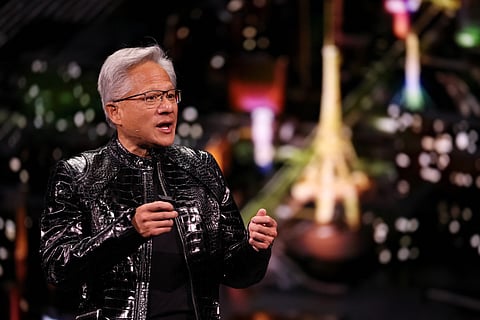
Nvidia describes Alpamayo as bringing chain-of-thought reasoning to autonomous vehicles, with models that can lay out the logic behind their driving decisions. Jensen Huang, founder and CEO of Nvidia, said: “The ChatGPT moment for physical AI is here, when machines begin to understand, reason and act in the real world. Robotaxis are among the first to benefit. Alpamayo brings reasoning to autonomous vehicles, allowing them to think through rare scenarios, drive safely in complex environments and explain their driving decisions, it’s the foundation for safe, scalable autonomy.”
The Alpamayo 1 model in simple terms
At the heart of the new family is Alpamayo 1, a 10‑billion‑parameter model that takes video as input and outputs both a proposed path for the vehicle and a text-like “reasoning trace” that explains each move. In practice, that means the model does not just say “turn left” but also sets out why that is the safe option based on what it sees, such as a blocked lane or a pedestrian stepping out. Developers can then shrink this large “teacher” model into smaller versions that can run inside a car or use it as a powerful testing and labelling tool during development.
Because the model weights and inference code are being released openly, research labs and carmakers can fine-tune Alpamayo 1 on their own data, build evaluation tools that score how well other systems reason, or create auto-labelling pipelines that speed up training. Future Alpamayo models are planned with more parameters, richer reasoning and broader input and output options, including commercial licensing paths for companies that want to productise the technology.
Simulation and real-world data to train “street smarts”
Alongside the model, Nvidia is releasing AlpaSim, an open-source simulation framework that lets developers generate realistic driving scenarios, complete with configurable traffic, sensor models and closed‑loop testing environments. This allows self-driving stacks to be stressed against rare edge cases in a virtual world before they ever reach public roads, such as sudden cut-ins, confusing junctions or bad weather interactions.
Nvidia is also making its Physical AI Open Datasets available, a large-scale collection with more than 1,700 hours of driving data captured across many geographies and conditions. These datasets are built to include the kind of rare, complex events that are essential for training reasoning-heavy AV models, giving developers and researchers a richer set of examples than standard urban or highway clips alone. Together, Alpamayo 1, AlpaSim and the Physical AI datasets create a loop in which models can be trained, tested in simulation, exposed to diverse real footage and then refined again.
Why big car brands and platforms care
Several mobility and research players are already positioning Alpamayo as a useful building block for their own level 4 autonomy plans, where vehicles can drive themselves without human input in set conditions. Lucid, JLR, Uber and Berkeley DeepDrive are among those highlighting Alpamayo’s value in bringing more transparent, reasoning-based AI into their stacks.
“The shift toward physical AI highlights the growing need for AI systems that can reason about real-world behavior, not just process data,” said Kai Stepper, vice president of ADAS and autonomous driving at Lucid Motors. “Advanced simulation environments, rich datasets and reasoning models are important elements of the evolution.” Thomas Müller, executive director of product engineering at JLR, added: “Open, transparent AI development is essential to advancing autonomous mobility responsibly. By open-sourcing models like Alpamayo, Nvidia is helping to accelerate innovation across the autonomous driving ecosystem, giving developers and researchers new tools to tackle complex real-world scenarios safely.”
What this could mean for future robotaxis and drivers
For ride-hailing and delivery players like Uber, the draw is the potential to better handle the “long tail” of odd or risky scenarios that can make or break trust in autonomy. “Handling long-tail and unpredictable driving scenarios is one of the defining challenges of autonomy,” said Sarfraz Maredia, global head of autonomous mobility and delivery at Uber. “Alpamayo creates exciting new opportunities for the industry to accelerate physical AI, improve transparency and increase safe level 4 deployments.”
Industry analysts and researchers see similar benefits. “Alpamayo 1 enables vehicles to interpret complex environments, anticipate novel situations and make safe decisions, even in scenarios not previously encountered,” said Owen Chen, senior principal analyst of S&P Global. “The model’s open-source nature accelerates industry-wide innovation, allowing partners to adapt and refine the technology for their unique needs.” Wei Zhan, codirector of Berkeley DeepDrive, called the launch “a major leap forward for the research community,” saying that open access will let labs train at unprecedented scale and push autonomous driving closer to the mainstream.
How developers can plug Alpamayo into broader AI stacks
Developers can combine Alpamayo with other Nvidia offerings such as the Cosmos and Omniverse platforms, then fine-tune the reasoning models on proprietary fleet data to capture local driving styles and regulations. These refined models can be integrated into Nvidia DRIVE Hyperion architectures powered by DRIVE AGX Thor compute hardware, and then validated in simulation before any commercial roll-out.
The impact for everyday users will come later, in the form of robotaxis and advanced driver-assistance systems that are better at explaining their behaviour, coping with surprises and improving over time. The real test will be whether reasoning-based AI like Alpamayo can translate into fewer edge-case failures on real streets and more confidence among regulators and passengers that self-driving technology is ready for wider use.