Design Mocks for the iPhone Fold
Apple’s foldable iPhone may hit $2,000: Leaks and specs so far
Apple’s ultra-thin, crease-free foldable may cost over $2,000 and ditch Face ID
Last updated:
7 MIN READ
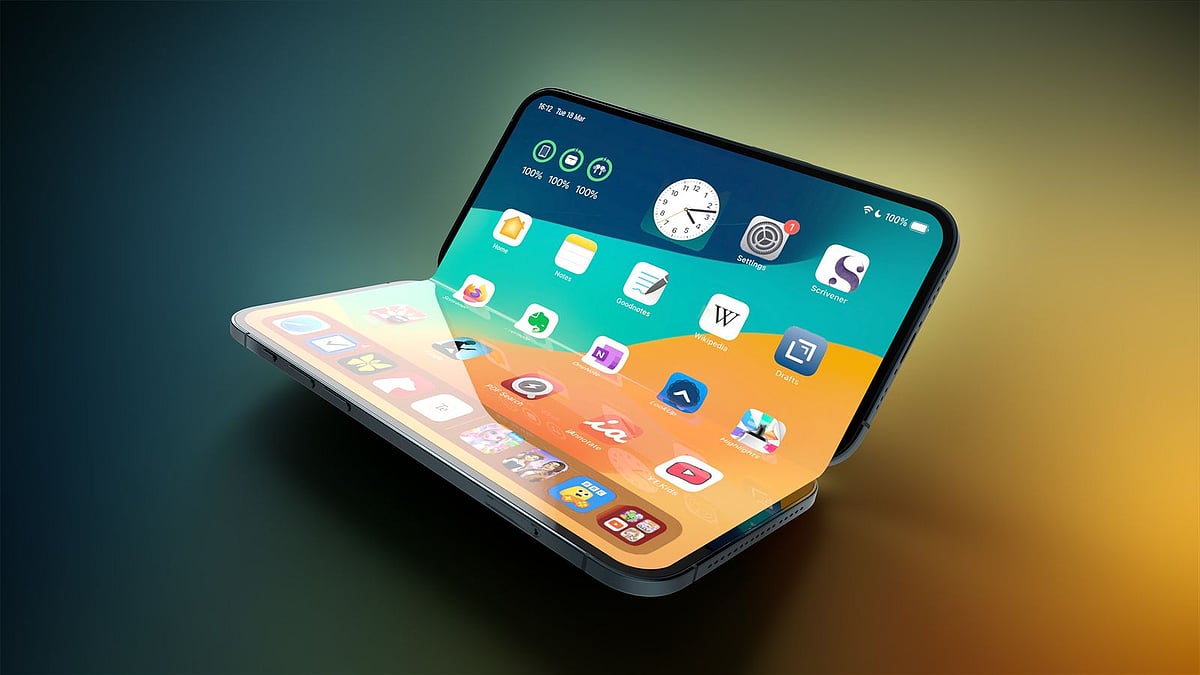
Ming-Chi Kuo believes Apple's foldable iPhone will be priced somewhere between $2,000 and $2,500.
MacRumors
Dubai: Apple is officially entering the foldable phone market, and they appear to be taking it seriously. After years of observing Samsung and other competitors navigate challenges like crease-prone displays and unreliable hinges, Apple seems confident it has solved these issues—and is going all in.
The foldable iPhone, expected to launch in late 2026 according to Apple analyst Ming-Chi Kuo, isn't just another iPhone with a bendy screen. According to MacRumors, this thing is shaping up to be one of the most ambitious pieces of tech Apple has ever attempted.
Impossibly thin and impossibly expensive
Let's start with the specs shared by MacRumors. When unfolded, this device could be just 4.5mm thick. To put that in perspective, that would make it Apple's thinnest device by far, beating even the 12.9-inch iPad Pro, which currently holds the title at 5.1mm thick. When folded, it will measure between 9mm and 9.5mm.
Think about that for a second. A phone that folds in half and is still thinner when open than an iPad Pro.
But all this cutting-edge tech comes at a price. Ming-Chi Kuo believes Apple's foldable iPhone will be priced somewhere between $2,000 and $2,500. Bloomberg's Mark Gurman has suggested a similar price range. That's nearly twice as much as an iPhone 17 Pro Max, which already costs a small fortune.
UBS Analysts reckon Apple will price it between $1,800 and $2,000, whilst Fubon Research says it will cost $2,400. Whatever the final number, you're looking at something that costs about as much as a decent used car.
Has the crease problem, finally been solved?
Here's where Apple might have had a breakthrough. Every foldable phone on the market today has that crease down the middle where the screen folds. It has just been an accepted compromise of the technology.
Not for Apple, apparently. The 2026 foldable iPhone reportedly has no visible crease. Apple is said to have pursued eliminating the crease 'regardless of cost,' and the company has developed a new material property that makes the crease disappear. The crease has been described as nearly invisible when the iPhone is unfolded.
This is supposedly one of the main reasons Apple waited so long to release a foldable iPhone. They struggled to make a device that didn't have a visible crease, but it may be a problem that has now been largely solved given the uptick in rumours.
Their secret weapon is liquid metal for the hinge, which will improve durability. Liquid metal, or amorphous metal, has a structure that is more resistant to bending, deformation, and denting than traditional metal. Its structure makes it tougher than titanium alloy, and it has a stainless steel look.
Apple might also use a combination of titanium and stainless steel for the hinge. Whatever they're doing, it sounds like they're throwing the kitchen sink at making this thing bulletproof.
Display tech that's actually interesting
The screen specs are pretty wild. According to MacRumors leaks, the inner unfolded display will measure in at 7.76 inches with a 2,713 x 1,920 resolution, whilst the outer display (when folded) will measure in at 5.49 inches with a 2,088 x 1,422 resolution and a 4:3 aspect ratio. Another leak suggests it will have a 7.6-inch display size when unfolded.
One analyst, Jeff Pu, believes Apple could be working on not one, but two foldable iPhones in different 7.9-inch and 8.3-inch sizes, though no other rumours have backed up this claim.
According to one leaker, the inner unfolded display will measure in at 7.76 inches with a 2,713 x 1,920 resolution, whilst the outer display (when folded) will measure in at 5.49 inches with a 2,088 x 1,422 resolution and a 4:3 aspect ratio.
The foldable iPhone will use a new type of display panel created by Samsung, using a custom display process that Apple has the trademark for. The process includes integrating touch sensors directly into the display panel, reducing overall thickness by approximately 19 per cent.
Apple is planning to use ultra-thin glass for the foldable iPhone, with Chinese manufacturer Lens Technology as Apple's primary glass supplier. Corning is likely to provide the raw materials to Lens Technology, with Apple choosing the supplier because of its expertise in glass strengthening and minimising side cracks after cutting.
Face ID gets the boot
In a genuinely surprising move, Apple is ditching Face ID for this device. Instead, the foldable iPhone will use Touch ID for authentication, with the Touch ID sensor built into a side button on the device.
It is simple if you think about it. There isn't enough space in the foldable iPhone for the Face ID components. Apple is prioritising the thinness of the iPhone Fold, and several design decisions have been made to reduce the overall thickness of the chassis.
Since the iPhone Fold is going to be around the same size as the iPad mini when it's unfolded, it makes some sense for it to have an iPad mini-like Touch ID button. And, this could be an exciting addition for users. The ID is instructive, but creates complications if you're wearing a mask or lying down.
Four cameras and an industry first
The camera setup is intriguing. The foldable iPhone could have an under-display camera for the interior of the device, with a single hole punch camera for the exterior when it's folded up. The under-display camera is not expected to feature Face ID, with Apple instead adopting Touch ID.
Here's the kicker, the camera could have a 24-megapixel resolution, which would be an industry first. Some Android devices use under-display cameras, but not at that high resolution.
For the rear cameras, the foldable iPhone rear camera setup will have a Main lens and an Ultra Wide lens with no Telephoto lens. Rumours suggest that both lenses will be 48 megapixels. All in all, the foldable iPhone is expected to include four total cameras.
The outer display of the foldable iPhone, which you see when it is folded, could have a hole-punch camera, whilst the inner display will feature an under-display camera.
Strong power under the hood
The foldable iPhone will use Apple's A20 chip, built on TSMC's 2nm process. The transition to 2nm will allow for more transistors in each chip, which will boost performance. The A20 chips could be up to 15 per cent faster and 30 per cent more efficient than A19 chips.
Apple is also expected to use TSMC's Wafer-Level Multi-Chip Module (WMCM) chip packaging technology. WMCM will see RAM directly integrated on the chip's wafer with the CPU, GPU, and Neural Engine. Incorporating RAM this way could bring faster performance for overall tasks and Apple Intelligence, better thermal management, and improved Apple Intelligence.
On connectivity, the foldable iPhone is expected to include Apple's second-generation C2 modem, a successor to the C1 modem. The C2 will be on par with Qualcomm's modems, and it will support mmWave 5G, unlike the C1.
According to The Wall Street Journal, Apple is aiming to introduce a foldable iPhone in 2026 or 2027.
Battery life that lasts
Foldable phones have historically had lower battery life, and it is notably difficult to cram cells into a folding chassis. However, Apple seems to have figured out this solution.
The foldable iPhone could have a battery in the 5,400 to 5,800 mAh range, which would make it the largest battery capacity that Apple has used in an iPhone. The iPhone 17 Pro Max has the current largest battery at 5,088 mAh.
Apple worked to increase the power efficiency of its first foldable display in an effort to maximise battery life, and rumours suggest that the foldable iPhone will have decent battery life despite a thin size. Apple reduced the display driver integrated circuit (IC) from 28nm to 16nm, which is a notable improvement.
When can you actually buy one?
According to The Wall Street Journal, Apple is aiming to introduce a foldable iPhone in 2026 or 2027. The iPhone could be Apple's first foldable, with a MacBook/iPad with a 19-inch display slated for launch later.
Ming-Chi Kuo believes Apple's first foldable iPhone will come in late 2026, alongside iPhone 18 Pro, iPhone 18 Pro Max, and iPhone 18 Air devices. Analyst Jeff Pu believes that a foldable iPhone could come out as soon as late 2026, whilst TrendForce believes it will come in 2027. The Information, a tech portal, says that Apple could release a foldable iPhone as soon as 2026.
So probably late 2026, but possibly 2027 if Apple hits any snags.
Colour leaks for the iPhone 18 line
The bottom line
Apple's foldable iPhone is already generating excitement. A nearly invisible crease, impossibly thin design, under-display cameras at unprecedented resolution, and battery life that doesn't make you want to throw the thing out a window.
But let's be real: at $2,000-plus, this is a device for early adopters with deep pockets. Apple is planning to use high-density battery cells for the foldable iPhone, Apple's foldable iPhone won't have a SIM slot and will instead use eSIM, and Apple is only testing variations of black and white for the foldable iPhone, though Apple could opt to include other colours prior to when the device enters mass production.
Areeba Hashmi is a trainee at Gulf News.
Network Links
GN StoreAbout Gulf NewsTerms & ConditionsReach by GNSitemapContact usPrivacy PolicyGN FocusHave your sayWork with usAdvertise with usGulf News epaperPrinting Services
Download our app
© Al Nisr Publishing LLC 2026. All rights reserved.