China's Solar Installations Rise on Month | Newly installed solar capacity still down from year earlier
5 ways China is leading the world: Here's the data
From robotics and renewables to AI and EVs, China's tech revolution is a game-changer
Last updated:
4 MIN READ
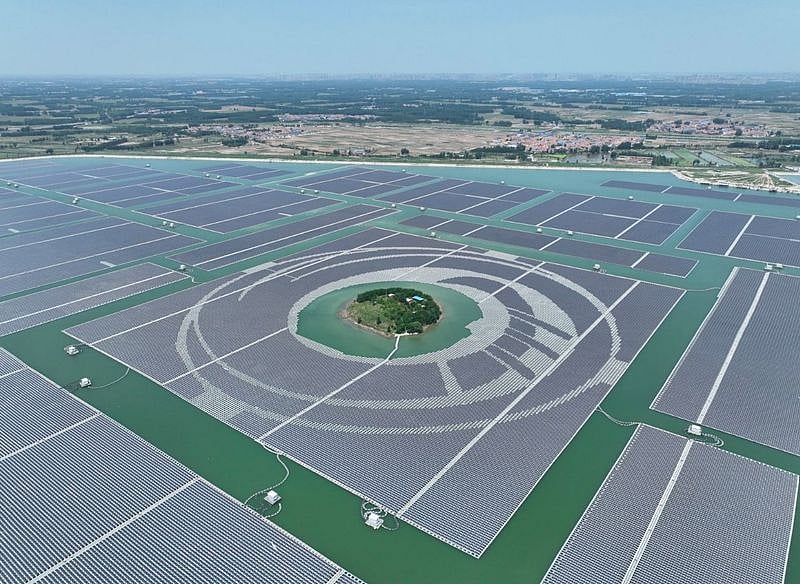
The Dezhou Dingzhuang floating solar farm in China.
Twitter | @MdemuPolycarp
China commands unrivalled dominance across key industries: renewables, EVs, critical minerals, supply chains, software, high-tech.
The Middle Kingdom is driving the unprecedented green revolution, with its tech and manufacturing edge, including the use of "dark factories".
It's EV and energy storage dominance, for example, stems from its upscaling new-energy batteries, accounting for 80% global battery production.
Even in software, China is fast catching up with Silicon Valley: HarmonyOS cockpits are now used in the latest Toyota/Nissan vehicle models.
China now processes 90% of rare earths and polysilicon, with a virtual lock on minerals/supply chains.
Following are 5 ways China's industrial edge, backed by clear policy, is helping the world transition to a renewable economy:
#1. Battery supremacy: Solid-state and cobalt-free tech
China dominates EV batteries, its core component, producing 80%+ of energy storage globally.
Result: Western carmakers now depend on China for power packs. Innovations like Buick's 6C high-voltage packs and Mercedes' cobalt-free, direct-cooled cells showcased at Guangzhou 2025, are all made in China.
Solid-state advances from CATL and BYD promise 1,000+ km range, slashing import reliance and flooding exports to Europe/Mexico, according to vlogger Electric Viking.
#2. High-tech cockpits and software overhaul
Software used to be the exclusive domain of America. How things have changed.
Now, Huawei's HarmonyOS powers Toyota BZ7 and Nissan Tiana cockpits — none of it Toyota tech.
VW has partnered with Xpeng, using the latter's battery tech and software, indicating a power shift from Europe to the east .
BMW's Momenta-assisted EX-3 and Audi's Huawei integrations make Chinese OS the global standard, eroding Western software edge, as per Car News China.
China's decades of investments educating its smartest young people in top US universities, especially in STEM, has eroded this edge.
Example: a few months after ChatGPT made a spectacular global debut, China's DeekSeek, with less compute power and resources, rolled out its own large language model (LLM), giving OpenAI (and Google) a run for its money.
#3. Robotics, AI factories, urban mobility
Xpeng's AI Day unveiled humanoid robots for assembly lines, enabling 6-month model cycles vs. legacy 8-10 years.
In the EV sector along, this ability to "hyper-iterate" crushes joint ventures, with Deepal/Changan rebadging Mazda 6E for worldwide sales at lower costs.
Xpeng demoed flying cars at AI Day, aligning with Joby/Archer but scaled via China's drone ecosystem. Guangzhou highlighted multimodal drives, positioning China to own air taxis by 2030 amid $6B market growth.
In the chips sector, this ability to innovate quickly could enable Chinese startups to catchup with more innovative companies like Nvidia and AMD.
#4. Renewables, flying cars and urban mobility
With solar power, as a core part of renewables revolution, China scaled incredibly fast. It also helps that China controls 90% global solar supply chains, especially batteries.
In the last five years (2021-2025 partial), China added ~600-650 GW of solar PV, dwarfing the world's ~450-500 GW total outside China.
H1 2025 alone saw China install 256 GW (67% of global 380 GW), with May's 93 GW equaling entire prior annual records, as per PV Tech.
US and European brands make money off Chinese-made renewables gear, but this brand advantage won't last long, as home-grown brands continue to compete and innovate.
Rooftop/distributed PV hit records (36 GW Q1 2025), policy-driven rushes like May's 93 GW pre-subsidy end. Its grid integration push is insane: Wind+solar hit 26% of power generation in May 2025, curbing CO2 1% H1 despite growth, as per Ember Energy
China's cumulative solar fleet grew from ~253 GW at end-2020 to ~887 GW at end-2024, taking China’s share of the global solar fleet from ~35% (2020) to ~48% (2024), as per Irena data.
By comparison, the US and Europe also grew substantially, but much less quickly in absolute GW terms.
The US rose from ~75 GW → ~176 GW (2020→2024); Europe from ~157 GW → ~336 GW.
China's key advantage in this space: It produces 95% of global polysilicon/ingots, enabling cheap exports.
By 2030, China's solar output could rival global nuclear; so the rest of world would lag without a similar scale.
“Rest of world” (all other countries combined) increased too, but China’s surge dominates the global increase: between 2020 and 2024 the world fleet grew by ~1,141 GW and China accounted for a very large slice of that growth, Irena reported.
| Year | China New Solar (GW) | Rest of World New Solar (GW) | China Share |
|---|---|---|---|
| 2021 | ~55 | ~120 | ~31% |
| 2022 | 87 | ~140 | ~38% |
| 2023 | ~217 | ~250 | ~46% |
| 2024 | 277 | ~300 | ~48% |
| 2025 (est) | 400+ (1,100 GW cumulative by mid-year) | ~200 (H1: 124 GW) | ~67%+ |
| Total | ~1,036 GW cumulative (2020-25) | ~1,010 GW cumulative | 50% |
Sources: PV Tech | Utility Dive
#5. Vertical integration
China's vertical integration, propelled by government support for strategic industries, fuels industrial ecosystems: EVs, chips, high-tech manufacturing, critical minerals, robotics/drones, and renewables.
Meanwhile, the rest of the Western world are trying to save legacy industries, including its centuries-old fossil-fuel based ecosystem.
Legacy allowed the West to lead in the last 200 years, but the tech world has moved on. It's a deliberate choice to step back, a harbinger for tougher things to come for old industries facing inevitable disruption.
Europe reached ~20% new-car EV share by 2023–24 vs the United States, where less than 2 in 10 new cars were PEVs in 2024 (EV sales growth also slowed in the US in 2024 vs 2023), China's EV penetration in 2025 hit 56% (from 5.8% in 2020), while joint ventures' share plunged to 32%.
It shows China has moved the fastest, as per International Energy Agency data. China’s price competition and policy support (including 2024 trade-in & stimulus measures) have contributed to the rapid PHEV uptake, that fewer companies are investing in new petrol stations.
China's vertical integration—controlling raw materials to final assembly—gains unmatched supply chain supremacy through "industrial clusters," where factories cluster with tiered suppliers (raw materials, components, logistics) in concentrated zones like Shenzhen (electronics) or Changzhou (solar), slashing lead times by 50%, cutting costs 20-30%, and boosting resilience via shared expertise and economies of scale.
These advantages are currently the envy of the world, and can no longer be ignored.
Sign up for the Daily Briefing
Get the latest news and updates straight to your inbox
Network Links
GN StoreAbout Gulf NewsTerms & ConditionsReach by GNSitemapContact usPrivacy PolicyGN FocusHave your sayWork with usAdvertise with usGulf News epaperPrinting Services
Download our app
© Al Nisr Publishing LLC 2026. All rights reserved.