Bitcoin sinks below $70,000 as Middle East conflict sparks risk selloff
Despite recent price weakness, institutional participation remains deeper
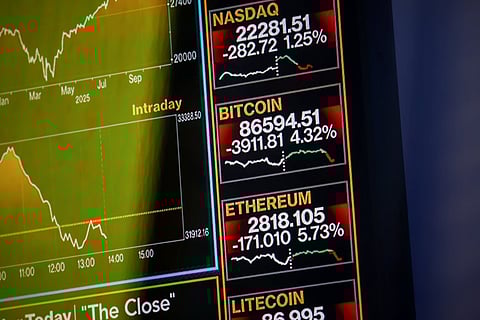
Dubai: Bitcoin fell sharply after briefly reclaiming the $70,000 mark, retreating in tandem with global equities as escalating conflict in the Middle East drove investors out of risk assets.
The world’s largest cryptocurrency dropped as much as 4.4% to $66,348 and was trading around $66,800 in early New York hours. The selloff intensified alongside a broad risk-off move in Europe, where the Stoxx Europe 600 Index slid more than 3%, marking its steepest two-day decline since April. Asian markets also weakened, with the MSCI Asia Pacific Index suffering its worst two-day slump in nearly a year and South Korea’s Kospi posting its sharpest fall since August 2024.
Stay updated: Get the latest faster by downloading the Gulf News app now - it's completely free. Click here for Apple or here for Android. You can also find it on the Huawei AppGallery.
Oil prices spiked amid fears of supply disruption, while gold extended its recent rally before easing slightly. Investors continued to rotate toward traditional havens following the US and Israel’s strikes on Iran and Tehran’s threats to disrupt shipping through the Strait of Hormuz.
Digital gold narrative tested
Bitcoin’s pullback has again raised questions about its role during geopolitical shocks. The cryptocurrency has often been described as digital gold, yet its reaction to acute conflict has mirrored broader risk sentiment.
Hani Abuagla, Senior Market Analyst at XTB MENA, said Bitcoin initially acted as a real-time gauge of fear when tensions flared.
“As cryptocurrencies trade 24/7, Bitcoin was the first asset to reflect investor sentiment when tensions flared up in the Middle East over the weekend. It initially acted as a real-time barometer of fear, with an increase in volatility and liquidations. However, the scale of these liquidations was far smaller than past events, signalling a more cautious positioning backdrop.”
Sustained spikes in oil and gold prices can indirectly influence Bitcoin. Higher oil prices raise energy, transport, and production costs, increasing inflationary pressures. When combined with upside surprises in data such as U.S. producer prices, it could reinforce a “higher for longer” interest rate stance from the Federal Reserve, which could weigh on risk-sensitive assets, including cryptocurrencies. Similarly, increased risk aversion could lead capital flows toward gold and other safe-haven assets and out of risky assets.

He added that earlier deleveraging helped stabilise the market.
“The heavy deleveraging seen in February reduced excess speculation, allowing the market to absorb geopolitical stress more efficiently.”
Vijay Valecha, Chief Investment Officer at Century Financial, said Bitcoin’s holder structure has shifted materially in recent years.
“Bitcoin still has a leveraged call option component during business-as-usual periods, but it is acting as a macro hedge in the acute first stage of a geopolitical conflict shock. It has not yet achieved safe-haven status like gold or Treasuries. But it is notable that Bitcoin has not sold off for 12 straight days amid a risk-off event.”
The token’s ability to avoid a prolonged collapse, even amid heavy volatility, reflects lighter positioning and reduced retail leverage compared with previous cycles.
Negative funding rates signal crowded shorts
Funding rates in Bitcoin futures have turned sharply negative, indicating that short sellers are paying to maintain bearish bets.
Abuagla said the shift reflects a market that has swung from optimism to caution.
“Negative funding rates in Bitcoin futures point to a market that has swung from excess optimism to excessive caution. This reflects a prevailing bearish sentiment.”
Bitcoin is experiencing an extreme in one-sided derivatives market piling, with funding rates “extremely negative”. This means that shorts are over-eager to be bearish, and are “paying” longs to keep their positions open, rather than the opposite. This is confirmed by a wave of long liquidations on the move down, suggesting that most leverage is now concentrated in shorts.

Valecha described the positioning as extreme. “This means that shorts are over-eager to be bearish, and are paying longs to keep their positions open.”
He noted that such episodes have historically preceded sharp counter-moves driven by short covering, though sustained upside would require stronger and persistent ETF inflows.
Oil spike raises inflation pressure
Energy markets have become the central transmission channel for risk. Oil’s surge has revived inflation concerns and complicated expectations for US monetary policy.
Abuagla warned that sustained energy price spikes could weigh on crypto through tighter financial conditions.
“Higher oil prices raise energy, transport, and production costs, increasing inflationary pressures. When combined with upside surprises in data such as US producer prices, it could reinforce a higher for longer interest rate stance from the Federal Reserve, which could weigh on risk-sensitive assets, including cryptocurrencies.”
Valecha pointed to historical patterns linking oil shocks to crypto weakness.
“When oil prices started rallying in late 2021 and peaked near $120 in 2022, Bitcoin prices, which were above the $60,000 mark, witnessed a steep decline and fell below the $20,000 level.”
If tensions around the Strait of Hormuz persist, inflation expectations could remain elevated, bond yields may rise and liquidity conditions could tighten further.
Institutional buffer, but not immunity
Despite recent price weakness, institutional participation remains deeper than in prior downturns. Valecha cited strong ETF inflows over the longer term and rising corporate holdings as evidence of structural demand.
“These developments surely suggest that some form of buffer during large macro-driven selloff periods, distinct from previous market cycles.”
Abuagla added that institutions can cushion volatility but cannot fully shield the market from global shocks.
“Institutional participation provides an important buffer for Bitcoin, but it does not fully protect prices from broader risk aversion.”
Bitcoin’s latest slide shows that it continues to trade within the broader risk complex during acute geopolitical stress, even as its market structure becomes more mature. Whether it reclaims momentum will depend less on short-term volatility and more on how energy markets, inflation expectations and global liquidity evolve in the weeks ahead.
- With inputs from Bloomberg.