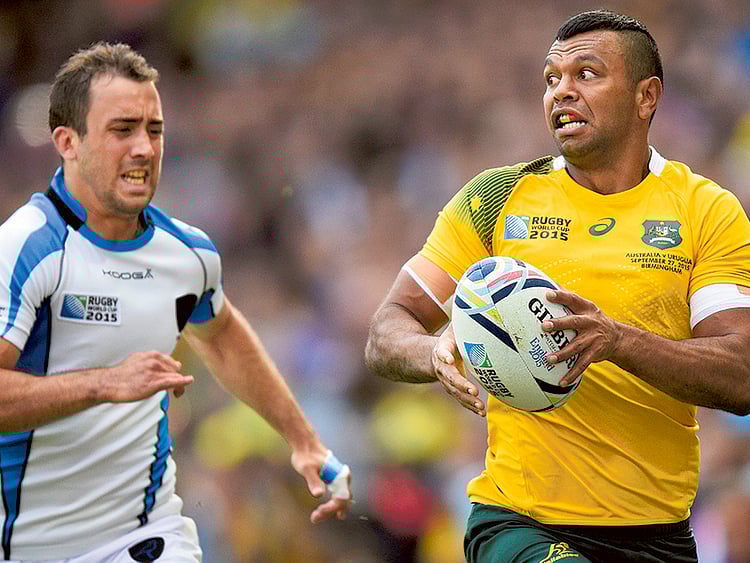
There are some fascinating turns and tangents springing off the branches of Kurtley Beale’s family tree.
The Beale side of his family comes from a convict deported to Australia aboard the 1789 Second Fleet for stealing a sheep. But Beale has been researching his Aborigine ancestry in particular.
His interest was sparked after the 2011 World Cup, in which he was on course to become one of the players of the tournament before a hamstring strain ruled him out of the semi-final against New Zealand. He was aware of his origins, but knew very little of them, other than being classified among a handful of indigenous players to have pulled on the Wallaby shirt.
So, after the tournament, he journeyed to the Tiwi Islands north of Darwin and swam in a crocodile-infested watering hole as part of a voyage of discovery.
The more he explored, the more the acute became his sense of not knowing who he was or where he came from. But Beale, 26, has made some progress.
Born in Blackwood in New South Wales, he is a member of the Darug tribe, while his mother is from the Kamilaroi tribe. There is still much to learn. A lot of indigenous history is located in oral traditions rather than in paperwork and search engines — and if not maintained properly it can simply disappear after a couple of generations.
“There’s so much history behind it and it is so hard to knuckle down because there are so many diversions and language barriers, different tribes and different people coming from different states,” Beale said.
“It is really hard to talk about it because it is still the unknown. Finding out as much as I can about that is important to me. The more I discover that identity, the more secure I feel about myself and in what I am doing.”
There have been great Aborigine sporting champions in the past, notably Cathy Freeman and Mark Ella, the former fly-half. Beale, though, stands alone as the sole indigenous player in this squad. Physically, Beale says, indigenous kids compare just as well to those of Pacific Island origin — the paradox is that comparatively few progress as professionals.
“I think it is the fear of the unknown,” Beale said. “A lot of indigenous people are comfortable being around family. That’s where their security comes from. You see a lot of athletes when they do have the opportunity they don’t go through with it because they are homesick. The talent is all there but that insecurity of not believing in themselves for whatever reason holds them back.
“Being an indigenous person and being in the position that I am, I feel I can be a certain role model for these kids coming through to give some advice and support. I get a lot of satisfaction from that.”
The idea of Beale as a role model may seem ludicrous to some. A year ago, the Australian Rugby Union announced it was investigating Beale over his conduct towards Di Patston, the former team manager, involving offensive text messages.
For a few weeks, he thought that he had played his last game for the Wallabies. In the end, he was fined £24,000, which went towards the Lloyd McDermott Development Team that promotes indigenous talent within Australian rugby. Even now Beale’s sense of shame and sorrow over the incident is palpable.
“It was a silly mistake, something that I look back on now and pinch myself over,” Beale said. “I feel embarrassed. As you grow up, you become more aware of your actions and what those actions do to those people around you. I guess that’s what you call maturity. Everyone learns different things, which might come earlier or later in your life. I have accepted that fact. That’s definitely helped me understand a few things that have troubled me in the past.”
The text message episode allowed both Beale and the ARU to make a fresh start. After Ewen McKenzie resigned as coach, his replacement, Michael Cheika, immediately rehabilitated Beale into the group.
Even if Sunday’s 65-3 victory against Uruguay was just his second start under Cheika, it is clear how much Beale values him as a coach and a person.
“He’s made a huge impact,” Beale said. “He is definitely a guy who knows how to get the best out of his players. He is up front and honest. He knows how to get respect. That’s important when given the job in a short period of time with the World Cup around the corner. It is a really good culture and something that I am very lucky to be a part of.”
It is Beale’s misfortune that there are fellow world-class talents in his preferred positions in centre Matt Giteau and full-back Israel Folau. Still, expect him to play an important, if not match-defining, role as an impact replacement against England on Saturday.
In Cheika’s system, every player is expected to fulfil certain duties attached to the position and then add something extra — what he calls the player’s “music”.
“It is up to us as individuals to understand our roles within the team and to bring our music,” Beale said. “I like to get my hands on the ball as much as I can and try to create space for the guys around me. It is something I look forward to each day at training — understanding what each player’s got, understanding their music and trying to add in and remix it.”
— The Daily Telegraph
Sign up for the Daily Briefing
Get the latest news and updates straight to your inbox
Network Links
GN StoreDownload our app
© Al Nisr Publishing LLC 2026. All rights reserved.