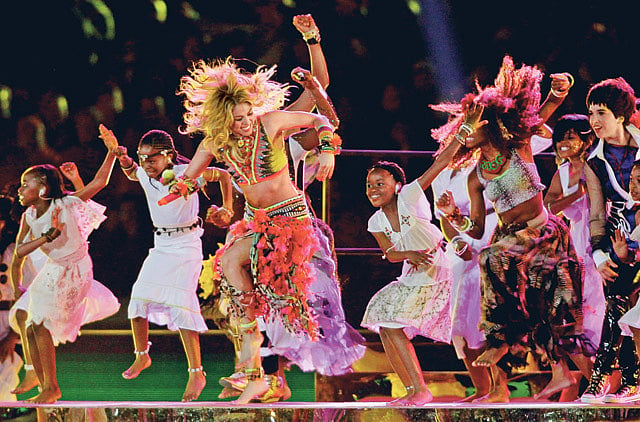
Johannesburg: The World Cup unveiled a new South Africa to the rest of the planet, upending stereotypes and nightmare scenarios about a country that proudly showed off its modern accomplishments.
The highlight of the closing ceremony was the appearance of a Nelson Mandela, his arrival drawing thunderous applause as he was driven onto the pitch.
South Africa's first black president rode next to his wife Graca Machel in an open-air vehicle, flashing his world-famous smile to hundreds of millions of viewers around the world.
Images of the world's best footballers, ecstatic fans and top stadiums ruled headlines usually clouded by South Africa's painful apartheid divisions and staggering crime and poverty still afflicting millions.
"The world has seen this country in a different light," President Jacob Zuma boasted.
The first World Cup on African soil has also rubbed off on the rest of the continent, often written off in shades of despair, as 17 states mark 50 years of independence from European colonial powers.
Newspapers from around the world have declared the World Cup a "win for all of Africa", "a big successful party", and a "well-organised Cup" as visiting celebrities gushed about the host nation.
Euphoria mood
Within South Africa, the experience was compared to the euphoria experienced 20 years ago when Nelson Mandela walked out of an apartheid prison and set the nation on the path toward full democracy, with elections he won in 1994.
"To just present a new South Africa that we dreamt about when Mandela walked out of prison in 1990 becoming a reality in 2010, and that was special," said the top World Cup 2010 organiser Danny Jordaan.
After the kick-off on June 11, dire warnings overseas that tourists would need stab-proof vests and private bodyguards quickly slipped away in favour of images of a multi-racial nation celebrating together in modern cities.
"The explosion of national pride and the unity that has been displayed by all South Africans is an invaluable benefit of the tournament," Zuma said.
In a country where the median age is 25, most South Africans alive today had little first-hand experience of apartheid which forced races apart, but sharp divisions still exist.
Crime is justifiedly a national pre-occupation, with an average 50 murders a day, but most violent crime takes place among the poorest South Africans in shantytowns far from the typical tourist vista.
South Africa's poor also experience the greatest struggles getting an education, accessing public services and finding a job — which give the country the world's biggest gap between rich and poor.
For the middle and upper classes, the World Cup created an incentive to mingle across racial lines — to take trains and buses together, to sing and blow vuvuzelas in the stands.
Sign up for the Daily Briefing
Get the latest news and updates straight to your inbox
Network Links
GN StoreDownload our app
© Al Nisr Publishing LLC 2026. All rights reserved.