Morocco's forward Zakaria Aboukhlal celebrates after he scored Morocco's second goal during the Qatar 2022 World Cup Group F football match against Belgium
Can Morocco reignite their 2022 magic at the 2026 FIFA World Cup?
Can the Arab country shock world football once again?
Last updated:
4 MIN READ
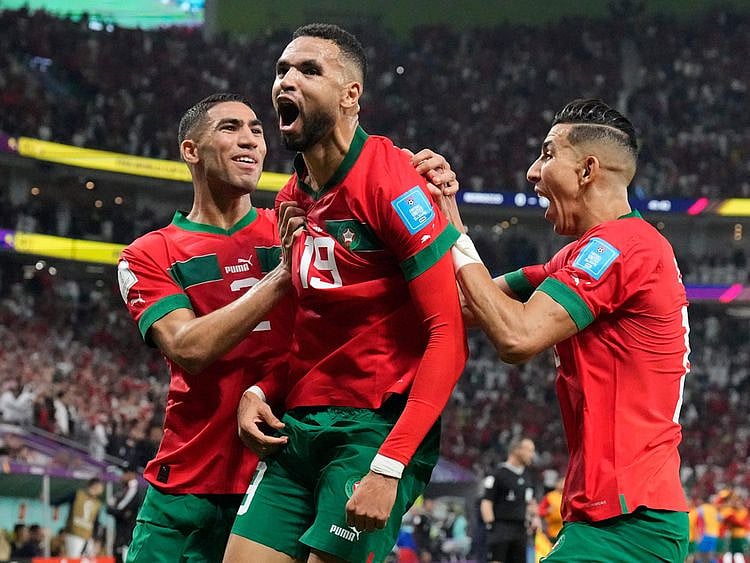
Morocco's run to the semi-final of the 2022 World Cup is one of football's biggest underdog stories
AP
Dubai: A record eight Arab nations will head to the World Cup, but much of the spotlight will fall on Morocco as they prepare to step onto football’s biggest stage carrying hopes of replicating their historic 2022 run.
Before the previous World Cup in Qatar, Morocco had qualified for the tournament just five times, with their best-ever performance coming in 1986 when they reached the Round of 16, meaning expectations were relatively modest heading into the 2022 competition.
Topping the group
The Atlas Lions were up drawn in Group F alongside Croatia, Belgium and Canada, a group which fans favoured Croatia and Belgium to progress from.
Led by head coach Walid Regragui, Morocco, began their group stage journey with hard-fought 0-0 draw with Croatia before stunning Belgium 2-0, a result that announced them as the tournaments dark horses.
Goals from Romain Saïss and Zakaria Aboukhlal, combined with standout performances from Achraf Hakimi, Sofyan Amrabat and goalkeeper Yassine Bounou, set the tone for their historic campaign.
In their final group game, Morocco beat Canada 2-1, with Hakim Ziyech and Youssef En-Nesyri finding the net, as they topped the group to reach the knockout stages for the first time in over 30 years.
A historic penalty shootout
Morocco faced a monumental challenge in the Round of 16 as they took on Spain, a side stacked with elite European talent including Manchester City’s Rodri and Barcelona duo Sergio Busquets and Pedri.
While Spain were not quite the all-conquering force that lifted the World Cup in 2010, there was still a strong belief that their control, experience and technical quality would eventually be too much for an emerging Morocco side.
As expected, Luis Enrique’s team dominated possession, circulating the ball relentlessly and completing over 1,000 passes, while Morocco stayed compact, disciplined and difficult to break down.
Morocco's players celebrate after the penalty shootout win over Spain
Clear chances were limited, with Spain struggling to break through a well-organised back line led by Saïss and Nayef Aguerd, while Bounou produced key saves, including a strong stop from Dani Olmo and a late intervention on a dangerous free-kick.
Even as Spain pushed late, hitting the post through Pablo Sarabia in the 123rd minute, Morocco held firm.
As the game went to penalties it was their captain Hakimi who delivered the decisive moment, confidently chipping home the winning penalty to seal a historic 3–0 victory on penalties and a place in the quarter-finals.
Leaving Ronaldo in tears
Morocco carried their momentum into the quarter-finals where they faced Portugal, another European heavyweight boasting world-class experience and one of the greatest players to ever play the game in Cristiano Ronaldo.
With a place in the semi-finals on the line, the Atlas Lions once again defied expectations, producing another disciplined and fearless performance on the biggest stage.
Despite Portugal’s quality and sustained pressure, Morocco stood firm defensively and struck the decisive blow just before half-time, when Youssef En-Nesyri rose highest to power home a superb header and give his side a historic 1–0 lead.
Portugal's Cristiano Ronaldo left the pitch in tears after defeat to Morocco
From there, Morocco defended with everything they had, with Bounou again playing a crucial role in goal as Portugal threw men forward in search of an equaliser.
The pressure intensified late on, but Morocco held their shape, showing remarkable resilience to protect their lead until the final whistle. The result saw them become the first Arab and African nation to reach a World Cup semi-final, writing another unforgettable chapter in their history.
The win caused Portugese heartbreak, with Ronaldo left visibly emotional and in tears as he walked off the pitch.
Could Morocco reach the same heights?
While Morocco were ultimately knocked out of the 2022 World Cup in the semi-finals by France, it was still an incredible achievement, but with the 2026 World Cup just days away, the question is: can they do it again?
The country arrive with a very different feel around them compared to their historic 2022 run. Regragui is no longer in charge, having stepped down after a turbulent period that followed their Africa Cup of Nations final defeat to Senegal, with Mohamed Ouahbi taking over, a coach expected to bring a more progressive and attacking identity.
Regragui was often criticised for being too cautious despite the success, but Ouahbi is likely to shift Morocco into a more fluid 4-1-4-1 system that can evolve into a 4-3-3, placing greater emphasis on wide play, quick transitions, and delivering quality crosses into the box.
Mohamed Ouahbi led Morocco’s U20 side to a FIFA U-20 World Cup title in 2025
One of the most intriguing storylines will be how Ouahbi integrates emerging talents like 18-year-old midfielder Ayyoub Bouaddi, a highly rated prospect who has already captained France’s U21 side.
His inclusion signals a clear intent to evolve the squad rather than simply rely on the core that made history in Qatar.
However, new systems take time to settle, and Ouahbi has had limited opportunity to fully imprint his philosophy.
While Regragui himself was only appointed shortly before the 2022 tournament and still guided them to the semi-finals, repeating that kind of rapid success is never guaranteed.
Drawn in a group alongside Brazil, Scotland, and Haiti, Morocco could be expected to progress even more convincingly than they did in 2022, when they topped a group featuring Belgium and Croatia.
Now, the challenge feels different as the team aim to not just surprise the world again, but to confirm they belong consistently among the elite.

Rob is an experienced sports reporter with a focus on digital publishing. He holds both an undergraduate and master’s degree in sports journalism and has hands-on experience in presenting and commentary. Rob has previously worked in the communications teams at Premier League clubs Everton and Brentford FC. While football is his main passion, he enjoys all sports and loves sharing his enthusiasm with anyone he meets.
Sign up for the Daily Briefing
Get the latest news and updates straight to your inbox
Network Links
GN StoreAbout Gulf NewsTerms & ConditionsReach by GNSitemapContact usPrivacy PolicyGN FocusHave your sayWork with usAdvertise with usGulf News epaperPrinting Services
Download our app
© Al Nisr Publishing LLC 2026. All rights reserved.