Why ethnolinguistic loyalty runs Philippine politics — what it means for the Marcos-Duterte split
Marcos-Duterte breakup exposes the power — and peril — of identity politics
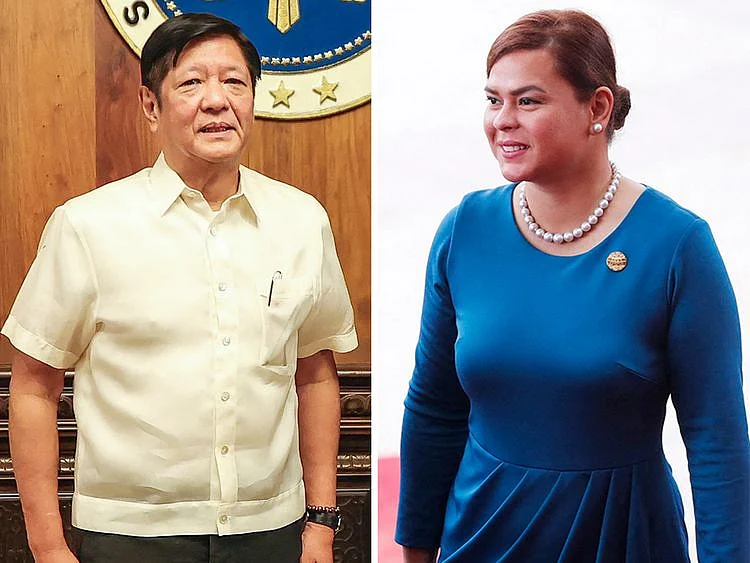
Manila: Unlike many mature democracies where party platforms or class often dominate voting behaviour, Philippine elections continue to be shaped by ethnolinguistic identity.
Under the veneer of pluralism, strong undercurrents of regional loyalty and political dynasties reign supreme across the archipelago.
Political scientists have repeatedly found that a candidate's regional and linguistic affiliation remains one of the strongest predictors of electoral success — even after accounting for age, education and income.
Why ethnolinguistic loyalty is unusually powerful
The Philippines has more than 180 ethnolinguistic groups spread across an 7,641-island archipelago with historically fragmented regional identities.
Political parties are generally weak and highly fluid, meaning voters often rely on more durable identities — language, region and family networks — as cues for political trust.
Researchers trace this pattern back to the post-war period.
Studies by Carl Landé, Kent Eaton, Temario Rivera and Julio Teehankee describe how “bailiwicks” (“baluarte”) developed around regional, provincial and linguistic communities, becoming reliable vote-delivery systems for national candidates.
For example, the northern region (Ilocos) belongs to the Marcos family, the South belongs to the Dutertes.
Nothing and no one can do anything about it.
The pattern has survived democratisation after 1986 because political parties remain largely personality-based rather than ideological or transactional.
The result is that presidential candidates often begin with an enormous “home-region advantage” before campaigning nationally.
Ethnicity matters more than demographics
Recent empirical studies reinforce this conclusion.
A 2022 study in the Journal of East Asian Studies found that non-Tagalog ethnic identity was the single strongest predictor of sustained support for Rodrigo Duterte, outweighing education, age, gender and income.
The authors characterise Duterte as an “ethnopopulist” whose appeal combined regional identity with anti-Manila rhetoric.
Duterte, in one of his anti-Manila speeches, characterised even the presidential palace as an undesirable rodent-infested place.
Similarly, a 2023 Pacific Affairs study examining Ferdinand Marcos Jr.'s victory concluded that three variables best explained the 2022 outcome:
support for Rodrigo Duterte;
positive views of Ferdinand Marcos Sr.; and
ethnolinguistic identity.
The researchers found that age, education and income were far less important than these identity-based factors.
Why the Marcos-Duterte alliance became nearly unbeatable
The 2022 "UniTeam" effectively united the country's two largest regional political strongholds.
The Marcos family has historically dominated the Ilocano-speaking "Solid North," while the Dutertes command deep loyalty across much of Cebuano-speaking Mindanao and significant parts of the Visayas.
Rather than competing for overlapping constituencies, the alliance combined complementary electoral bailiwicks.
Political scientists argue this geographic and ethnolinguistic coalition—combined with Duterte's popularity—was central to the landslide victory. Survey data show many voters also viewed the alliance as representing continuity with the outgoing Duterte administration.
Why the split is politically costly
Once those regional blocs begin competing against each other, several consequences follow:
The previously unified electoral machine fragments.
Campaign resources become divided.
Regional elites must choose sides.
Opposition candidates gain opportunities in multi-cornered contests.
National vote shares become much less predictable.
Because Philippine elections are won through simple plurality rather than runoffs, a fractured dominant coalition can lose even while retaining large individual voting blocs.
The recent scholarship on the fragmentation of the Marcos-Duterte alliance notes that Philippine politics traditionally revolves around temporary coalitions among elite families. Once those coalitions dissolve, electoral uncertainty rises sharply.
What this means for federalism
The persistence of ethnolinguistic politics strengthens both sides of the federalism debate.
Supporters argue federalism could:
give stronger regional governments greater autonomy;
reduce long-standing complaints about "Imperial Manila";
better reflect the country's cultural and linguistic diversity.
Critics argue the same political dynamics could:
entrench regional dynasties;
strengthen local political machines;
widen inequalities between richer and poorer regions;
fragment the nation, institutionalise identity politics instead of reducing it.
Many scholars therefore argue that decentralization alone cannot solve governance problems unless accompanied by stronger political parties, anti-dynasty reforms and more accountable institutions.
What comes next
Looking toward future elections, several scenarios emerge:
Marcos and Duterte camps remain divided. This produces a highly competitive three- or four-way national contest in which regional vote splitting becomes decisive.
One camp successfully expands beyond its traditional bailiwicks. Victory would require building support outside its ethnolinguistic base.
A new coalition forms. Philippine politics has historically favored pragmatic alliances over rigid ideological blocs, making new electoral combinations possible before future presidential races.
Bottom line
Academic research increasingly suggests that ethnolinguistic identity is not merely a cultural feature of Philippine politics — it is one of its strongest electoral predictors.
The Marcos-Duterte alliance succeeded because it united two of the country's largest regional political bases under one ticket.
Their subsequent rupture removes one of the most formidable electoral coalitions in post-1986 Philippine politics and reopens the electoral map to intense regional competition.
Whether future leaders seek to rebuild broad cross-regional alliances or deepen regional identities will shape not only the next elections but also debates over federalism, decentralisation and the future structure of the Philippine state.
Network Links
GN StoreDownload our app
© Al Nisr Publishing LLC 2026. All rights reserved.