Lawmakers vote on the two impeachment complaints against Philippine President Ferdinand Marcos Jr as insufficient in substance at the House of Representatives in Quezon City, Metro Manila on February 4, 2026.
Roots of poverty: Dynastic politics in the Philippines — ideal vs reality
Two-in-one challenge: Study shows poverty directly correlates with dynastic politics
Last updated:
6 MIN READ
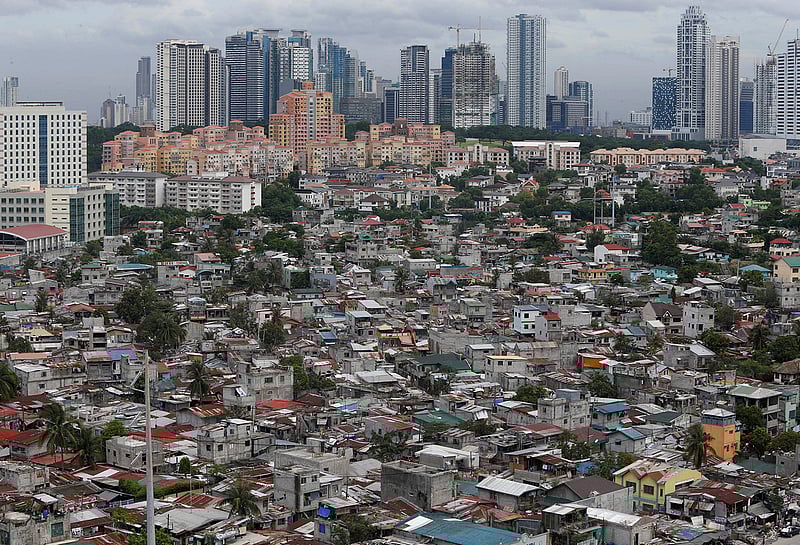
Beneath the gleaming towers of Makati (financial district of Manila, where glass and steel rise as symbols of growth, lie communities of makeshift homes — fragile, crowded, and too often forgotten.
In the shadow of prosperity, a harder truth persists: studies have shown that entrenched political dynasties in the Philippines are closely tied to enduring poverty—where power remains concentrated, and opportunity struggles to reach those who need it most.
REUTERS
Manila: The Constitution of our Republic speaks plainly: that the excess of political dynasties must be restrained by law.
Yet, like a many-headed hydra, they endure. Sprouting in every province, like an out-of-tune Karaoke singer — ubiquitous, loud, proud.
Accepted as the common order of things.
It has been nearly 40 years since the ratification of the 1987 Charter, and still this solemn command lies unattended.
Thirteen Congresses have come and gone. None delivered the measure required to fulfill this duty.
To the ordinary Filipino, political dynasties have become as familiar as the turning of the tri-seasons in this tropical land (rainy, dry, elections) — no more questioned than the "Kristo" at the centre of cockfighting, the national pastime.
Still 6 in 10 Filipinos favour a ban on political dynasties, a poll shows. But currently, the Philippine government is neither about democracy, nor what the people want.
And what was meant to be checked by law has instead been endured as "fate".
Turns out that Filipinos are forever tied to dynastic politics.
What are political dynasties?
Political dynasties in the Philippines involve families dominating elected positions across generations.
One study shows dynasties control about 80% of local governments here.
These clans use wealth, patronage, name recognition — often capturing entire local government units like governors, mayors, and councilors.
Different members of the family take turns to skirt around the three-term limit set by the 1987 Constitution and the Local Government Code, which restricts local elective officials (mayors, governors, councilors) and House representatives to a maximum of three consecutive 3-year terms (9 years total) for the same position [after this, they must rest for at least one term before running again].
For dynastic families, "rest" does not exist.
Effects on local governance
Dynasties undermine meritocracy, kill transparency and those who call for it.
They deliver ineffective governance, as family interests take priority over public welfare.
This is known as "elite capture". Result: Pretend public service, direct correlation with poverty, says one recent study.
More to it: City and municipal mayors have operational supervision and control over the Philippine National Police (PNP) units within their jurisdiction.
Members of entrenched political dynasties capture local structures, reducing accountability as relatives fill key roles, fostering nepotism.
What's true in the local level is also true at the national.
Examples
#1. President Ferdinand "Bongbong" (BBM) Marcos Jr serves concurrently with his elder sister Imee, a senator, while his son Sandro serves as the majority floor leader in the House of Representatives. Plus Matthew Marcos Manotoc (Governor of Ilocos Norte, nephew of BBM), Angelo Marcos Barba (Representative of Ilocos Norte's Second District (cousin).
Marcos' cousin Martin Romualdez, was speaker of the House, who quit his post after he was implicated in the multi-billion flood-control scam.
#2. Rodrigo Duterte, former President (2016–2022) and long-time Davao City mayor; his daughter Sara Duterte-Carpio is the current Vice President; son Paolo Duterte is Representative for Davao City's 1st congressional district; another son Sebastian "Baste" Duterte is the current Mayor of Davao City; while Omar and Rigo Duterte (Paolo's children) serve as a 2nd District Representative and City Councilor, respectively.
#3. Four sets of siblings (Tulfos, Cayetanos, Ejercito/Estrada, Villars) currently sit in the 24-member Senate. Most of them are from Manila, while the Philippines is actually made up of 18 regions spread over 7,641 islands.
#4. In Dinagat Islands, the Ecleo clan holds governor, vice-governor, and multiple mayoral seats, sidelining checks and balances.
A 2022 study in Political Dynasties, Business, and Poverty in the Philippines finds dynasties persist in poorer areas.
This reduces economic growth and deters public goods provision. They promote self-serving policies, entrenching poverty traps through "rent-seeking".
80%
percentage of provincial governors, who belong to local political "dynasties".
Dynastic politics is a phenomenon deeply entrenched nationwide, with about 80% of provincial governors and 67% of House representatives coming from political dynasties (Source: PCIJ).
These families leverage name recognition, resources, and social influence to maintain control, often sidelining potential challengers.
Dynastic politics subverts democratic participation. It creates a cycle of underdevelopment.
Two key studies shed light on the implications of this dynastic rule.
A 2016 paper from the Ateneo School of Government defines political dynasties as families with multiple members occupying positions simultaneously or successively, often using tactics such as alternating offices to circumvent term limits.
Dynasties as 'brands'
The study highlights how these dynasties resemble established brands, securing voter loyalty and sustaining influence akin to business trademarks.
Example: In Camarines Sur, every school building, gym or public market built using taxpayers' money are marked with the family name of a political clan. The provice, rich agricultural province larger than Dubai in land area, is among the country's poorest.
In Sorsogon, a province 600km south of Manila, where every lamp post is etched with big a bold letter bearing the first letter of the family name of the incumbent governor. His whose wife is also the city mayor; one daughter is a city councilor, and two others are mayors of different towns.
Without a robust anti-dynasty law — and a clear prohibition against the culture of “epal,” where officials brand public works as personal benefaction — the cycle of rent-seeking will only harden, calcifying like a poorly-set bone.
By allowing the rapacity of local dynasties to run unchecked — and without the safeguard of a whistleblower protection law — the Philippines risks dimming any real prospect of emulating Singapore’s rise.
The effect of this culture?
No genuine political competition. Restricted leadership opportunities.
Well-connected clans ruling the roost, many of whom are also linked to contractors feeding off taxpayers' money via the "tongpats" (kickbacks) system facilitated by the Department of Public Works and Highways (DPWH).
Result: Subpar infrastructure.
67%
percentages of House of Representatives members in 2025 coming from political dynasties
Dynasty = poverty
Another significant work, published in 2022 in the journal "Political Dynasties, Business, and Poverty in the Philippines," investigates the relationship between dynasties and socioeconomic outcomes.
It finds that they tend to persist especially in poorer provinces, suggesting that poverty helps entrench dynastic rule rather than dynasties directly causing poverty.
The study indicates a complex mutual reinforcement where limited political options contribute to poverty traps, while dynasties secure their hold by controlling scarce resources and patronage networks, perpetuating socioeconomic inequality.
In practice, dynastic politics often result in a political elite whose interests diverge from those of the general populace.
The concentration of power and wealth can stifle administrative responsiveness, breed corruption, and inhibit reform-minded leaders from gaining office.
Dynastic culture
Understanding the dynastic culture is vital to grasp the challenges of political reform and democratisation in the Philippines: it reveals how familial networks shape governance, influence policy-making, and affect socioeconomic development across the archipelago.
Dynastic politics, i.e. the lack of meritocracy, can directly explain the bad quality of Philippine roads, ghost flood-control system, and poor infrastructure.
Addressing this issue remains key to opening up political space and fostering more inclusive, accountable leadership.
Impact on public services
Dynastic rule leads to poorer service delivery, including inferior infrastructure, health, and education.
The Asian Institute of Management's 2012 study shows dynasty-dominated districts have lower human development, higher deprivation, and inequality, with "fattest" dynasties in the poorest regions.
Lawmakers conduct a hearing on the merits of impeachment complaints against Philippine President Ferdinand Marcos at the House of Representatives in Quezon City, Metro Manila on February 4, 2026.
Key consequences
Corruption curge: Local officials face most graft indictments, as dynasties shield kin from oversight.
Loss of meritocracy: Qualified outsiders, including youth, are excluded, degrading leadership quality.
Inequality: Resources favor dynasty strongholds, exacerbating spatial divides.
Way forward
Poverty and dynastic politics feed each other.
Until one is broken, the other will endure. The 1987 Constitution already mandates anti-dynasty reforms, but without enforcement, real, honest-to-goodness political competition remains locked out.
At its core, the problem runs deeper: a system shaped by patronage, not merit. Changing that culture is the hardest battle. It's like asking Filipinos, especially in the rural areas to quit "sabong" (cockfighting).
But it’s not impossible. Stronger voter education and strict term limits can chip away at entrenched clans and open space for capable leaders.
In the end, the path forward is clear: no meritocracy, no progress.
Until competence replaces connections, the cycle of dynasties and underdevelopment will persist.
Sign up for the Daily Briefing
Get the latest news and updates straight to your inbox
Network Links
GN StoreAbout Gulf NewsTerms & ConditionsReach by GNSitemapContact usPrivacy PolicyGN FocusHave your sayWork with usAdvertise with usGulf News epaperPrinting Services
Download our app
© Al Nisr Publishing LLC 2026. All rights reserved.