Filipino teenagers gathered at an outdoor event. The Asian nation has many of the ingredients needed to become a regional hub: a large English-speaking workforce, an established electronics industry, a growing digital economy, improving connectivity and a strategic location between the major technology markets of East and Southeast Asia.
Philippines’ AI hub push faces skills, power generation and jobs test
Manila’s AI ambitions hinge on skills, infrastructure and investment safeguards
Last updated:
6 MIN READ
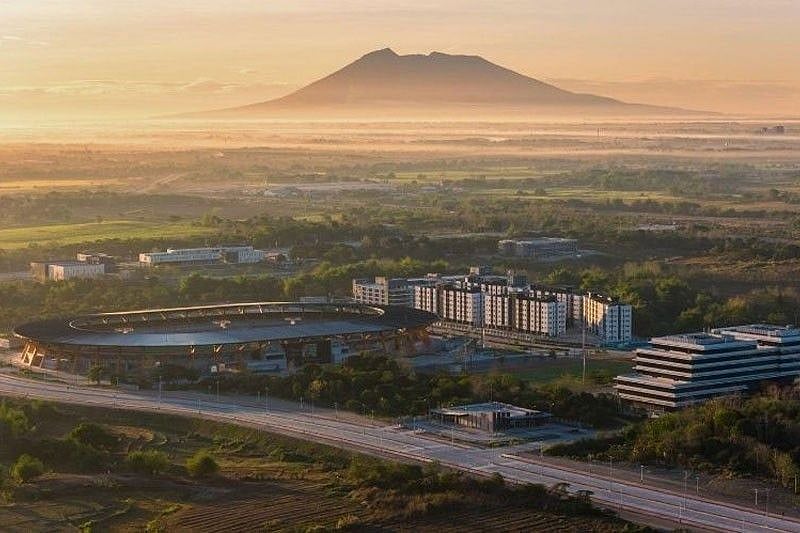
A view of the New Clark City in Tarlac, a former US military base about 1 hour north of Manila, set to be transformed into an AI, chips and critical minerals processing hub. The hub's governing framework is also being developed as per the Bases Conversion Development Authority (BCDA). The planned project has kicked up a massive debate in the Philippines.
New Clark City | BCDA
MANILA: Does the Philippines have what it takes to be an artificial intelligence (AI) and advanced technology hub in Southeast Asia?
The Asian nation has many of the ingredients needed to become a regional hub: a large English-speaking workforce, an established electronics industry, a growing digital economy, improving connectivity and a strategic location between the major technology markets of East and Southeast Asia.
But having the ingredients is not the same as having the infrastructure, talent and industrial depth to compete with Singapore, Malaysia, Vietnam and Thailand, an industry expert said.
The question for the Philippines is no longer whether it can participate in the AI boom.
Get it: Fast, verified news for FREE ... download the Gulf News app — simply click here
Donald Lim, president of the Management Association of the Philippines (MAP) told the local channel Bilyonaryo that the country is “very much behind” in AI compared with leaders such as the US, India and China, but sees "Pax Silica" as a critical test of whether the Philippines can attract AI investments and move up the value chain.
A key test, he said, is whether the country can move beyond being a consumer and service provider of AI into becoming a place where AI systems, hardware and advanced industries are actually built.
The government is betting that it can.
In June, President Ferdinand Marcos Jr. ordered agencies to fast-track investments and incentives for semiconductor and AI companies, with the administration explicitly seeking to turn the Philippines into a semiconductor and AI hub in Asia.
That ambition received a major boost in April, when Manila and Washington announced plans for a 4,000-acre "AI-native industrial acceleration hub in Clark", designed to bring together semiconductors, critical-minerals processing, advanced manufacturing and AI.
The opportunity is substantial.
So are the obstacles.
Pax Silica, an ambitious US-led technology, manufacturing and critical minerals hub set to be located next to Clark International Airport about 100km north of Manila. The Philippines is a major producer of critical minerals like nickel, most of it is exported to China where it's processed and re-exported as finished products (EV batteries, stainless steel).
Pax Silica: A test bed for AI investment
Pax Silica is a US-led coalition launched in late 2025 to secure supply chains for semiconductors, AI infrastructure and critical minerals, with the Philippines among more than two dozen signatories.
Under the plan, a 1,619-hectare (about 4,000-acre) "AI-native industrial hub" is proposed for New Clark City in Tarlac, projected to attract $40 billion to $70 billion in investments over 30 years and generate 130,000 to 190,000 direct jobs.
BCDA President Joshua “Jake” Bingcang has said "hyperscale" data centres will not be part of the Pax Silica site, though smaller facilities to support semiconductor firms may be built.
Lim said the absence of large data centres does not rule out an AI hub, since AI spans a long value chain beyond assembly to higher-order tasks.
Economic stakes and regional competition
The push comes as the Philippines seeks to catch up with Asean neighbours that have made deeper inroads into AI.
Singapore, for example, has seen AI contribute more than 18% to its GDP, prompting an upward revision of its 2026 growth forecast to between 4.5% and 5.5%.
By contrast, Philippine growth projections for 2026 remain in the 3.5% to 5.5% range, according to the Development Budget Coordination Committee.
The proposed Pax Silica industrial and tech hub in the Philippines covers an area of 4,000 acres, which is equal to about 1,619 to 1,620 hectares. It is planned within New Clark City in Tarlac, 1 hr by car north of Manila, as part of the Luzon Economic. The hub is designed as an AI, semiconductor, critical minerals and advanced manufacturing economic security zone.
Lim warned that the Philippines is often omitted from lists of Asean countries targeted for AI investment, and stressed that missing the current wave could leave the country behind as 17 to 20 nations compete in the same initiative.
Jobs, labour and the AI transition
A central question is how AI will reshape the Philippine labour market, where services account for 63.8% of exports and many workers are employed in roles vulnerable to automation, from caregiving to driving.
Lim acknowledged that robots and AI systems are increasingly handling tasks once done by nurses, security personnel and search-and-rescue teams.
He argued, however, that efficiency gains could expand business and create new jobs even as some roles disappear.
Workers at an electronics factory in the Philippines. While alliances shift, national interest stays the same. Policiymakers should adopt strategies that create jobs, improve efficiency, build skills, strengthen supply chains, and raise competitiveness.
He cited estimates that while up to 1.9 million jobs could be displaced by automation, around 2 million new positions may be created as industries expand and move up the “intelligence ladder.”
The challenge, he said, is to avoid training graduates merely to compete with machines on routine tasks, and instead emphasize critical thinking, creativity and foundational skills in English and math.
Agriculture and education: Where AI could help
In agriculture, AI can help farmers make better decisions on planting, irrigation and pest control by analysing soil, water and harvest data, even if they do not operate drones or advanced equipment themselves.
The Philippines, with a land area 7x bigger than the Netherland, has a lot of idle land due to land speculation as real property taxes are very low, making it cheap for owners to hoard vacant properties while waiting for land values to rise.
Currently, Local Government Units (LGUs) often fail to actively assess or collect the legal idle land tax (which can add up to an extra 5% under the Local Government Code) due to a lack of political incentives, clear inventories, or digital mapping tools.
Speculators intentionally leave agricultural lands uncultivated while hoping to secure lucrative future reclassification or land conversion into commercial hubs, industrial zones, or residential subdivisions.
Many rural plots are abandoned or left unmanaged because owners have migrated to cities or abroad as Overseas Filipino Workers (OFWs), choosing to treat the title as a family savings certificate rather than a productive asset.
Meanwhile, many smallholders still lack basic connectivity, so the precondition for AI — internet and digital infrastructure — must be addressed first.
Education challenge
On education, experts argue that schools were designed for an era of scarce information, whereas today information is ubiquitous.
Lim said the focus should shift from teaching AI tools per se to building critical thinking, self-understanding and communication skills, with AI introduced more substantially at the high school level when students begin coding and complex prompting.
He agreed with policies in some developed countries that restrict mobile phones and laptops in elementary classrooms, calling them a major distraction.
Support with 'guardrails'
Despite objections from some groups, MAP has expressed full support for Pax Silica, subject to “certain guardrails.”
Lim welcomed public debate and opposition as a way to surface risks and implementation challenges, but said the initiative still “makes sense on paper” because of the potential for knowledge transfer, job creation and broader economic activity around the hub.
He framed Pax Silica as one of the country’s biggest opportunities to bring in investment at a time when the national budget faces a large deficit and domestic business alone cannot generate the needed revenue.
“We cannot afford to be picky,” Lim said, urging the Philippines to welcome investors while putting in place rules to protect national interests.
Outlook for growth and inflation
On the near-term economic outlook, Lim said he is not optimistic that the Philippines can fully recover from a slow first half of 2026 without a significant increase in government spending and construction activity.
If public outlays remain constrained, and interest rates remain high, he warned of a potential crunch for businesses and support sectors, adding that inflation may rise and growth stall before a possible rebound in the following year.
Lim’s message to the private sector is to “act normal” and avoid banking on a sudden sales recovery, while preparing for a tighter 2026 and looking ahead to an election-year boost in 2027.
Network Links
GN StoreAbout Gulf NewsTerms & ConditionsReach by GNSitemapContact usPrivacy PolicyGN FocusHave your sayWork with usAdvertise with usGulf News epaperPrinting Services
Download our app
© Al Nisr Publishing LLC 2026. All rights reserved.