Pax Silica in the Philippines: Beyond the noise, let's ask better questions
From land and labour to AI value chain: will Filipinos move beyond being suppliers?
Filipinos have been debating the proposed Pax Silica project with remarkable intensity.
The discussion has reached beyond economists, engineers, policymakers, Tiktokers — even Cardinal Pablo Virgilio David has weighed in.
In a Facebook post, Cardinal David asked important questions: "Will Pax Silica help build Filipino scientific capability, technological innovation, and industrial resilience? Or will it primarily serve the strategic interests of others while Filipinos provide the land, natural resources, water, energy, tax incentives, and labour?"
He continued by stressing that these are legitimate concerns — not because the country should oppose foreign investment, but because any genuine partnership should strengthen the nation that hosts it.
He further cited Pope Leo XIV's Magnifica Humanitas, arguing that the central question is not what artificial intelligence (AI) can accomplish, but what kind of human beings we are becoming.
Technology, he wrote, must remain the servant of humanity — not its master.
Those are fair and necessary questions.
If a project of this scale proceeds, Filipinos deserve transparency, technology transfer, meaningful participation by Filipino scientists and industries, responsible environmental stewardship, fair labour standards, and a clear roadmap that moves the country beyond simply exporting raw materials or cheap labor.
These should not be optional — they should be the minimum expectations.
Yet the debate should not stop there.
The Philippines is already part of the AI economy, whether we acknowledge it or not.
AI is not waiting for us.
The real question is whether we intend to participate meaningfully or debate over its ups and downs, and settle for being merely consumers of technologies developed elsewhere.
Context, perspective
Context is important.
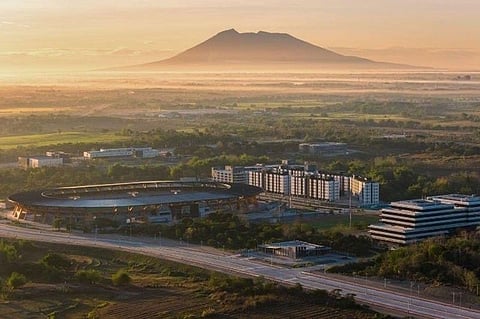
The proposed Pax Silica hub in Tarlac would occupy about 16.2 square km (roughly 1,620 hectares). By comparison, Burias Island — between mainland Bicol and Masbate — covers approximately 435 square km, making it roughly 26 times larger than the proposed site.
Perspective matters.
Catholic Filipinos love their bishops, priests, and the Church. Their moral voice has an important place in public discourse.
It is also worth remembering that many agricultural lands across the Philippines remain underutilised because of limited investment, fragmented ownership, land speculation, absentee ownership, and high production costs.
The Philippines' land area is seven times bigger than the Netherlands. But land alone does not generate prosperity.
Productive use does.
Likewise, the Catholic Church itself has long recognised the importance of responsible stewardship of assets.
Across the country, dioceses, archdioceses, and religious congregations, too, own significant properties, many of which have been developed into schools, hospitals, commercial centres, housing developments — or leased to generate sustainable income for pastoral and charitable missions.
UST, Asia's oldest university and predating Harvard by 25 years, is run by missionaries. Some dioceses have also held investments in major Philippine corporations over the years, including BPI and San Miguel.
These are prudent decisions that help sustain the Church's mission of evangelisation, education, healthcare, and social services.
Now consider Singapore.
Singapore is a city-state with limited land and virtually no natural freshwater sources.
Yet it has become one of Asia's premier digital infrastructure hubs, hosting dozens of data centres with an estimated combined capacity exceeding one gigawatt.
It also continues investing heavily in AI, cloud computing, semiconductor manufacturing, and digital connectivity.
Singaporean companies have likewise invested in the Philippines, including in telecommunications and digital financial services (Globe Telecom and GCash) that themselves depend heavily on data centres.
Now, the debate in Singapore has largely focused on improving efficiency, expanding renewable energy, developing advanced cooling technologies, and ensuring long-term competitiveness.
Rising environmental concerns surrounding data centres — including electricity and water consumption — are legit. But the train has left the station.
The Philippines already hosts more than 40 operational data centres. This is why the Pax Silica discussion matters.
It forces us to ask difficult, but necessary, questions:
Can we negotiate better terms for Filipinos?
Can we require technology transfer and workforce development?
Can we protect our environment while welcoming investment?
Can we ensure Filipinos move up the AI value chain instead of remaining suppliers of land and labor?
These are better questions than simply asking whether we should reject the project outright.
Nation-building takes more than sloganeering
Social media makes it easy — for both genuine critics and paid propagandists — to reduce complex national issues into slogans.
Nation-building is harder.
Consider Bonifacio Global City: One reason BGC experiences significantly less (or no) flooding is not because it receives less rain, but because engineers designed an extensive underground stormwater detention system beneath Burgos Circle capable of temporarily storing approximately 22,000 cubic meters of rainwater, before gradually releasing it.
Complex problems often have engineering solutions.
High electricity costs, water efficiency, environmental protection, AI infrastructure, and industrial development are not mutually exclusive goals.
They require competent planning, transparent governance, sound regulation, and political will.
Ultimately, the debate over Pax Silica is bigger than one project or data centres alone. It is about what kind of country the Philippines wants to become.
We can continue debating until opportunities pass us by. Or we can ask tough questions, negotiate wisely, demand accountability, and then build.
Knowledge is important. But nations progress because people are willing to act.


