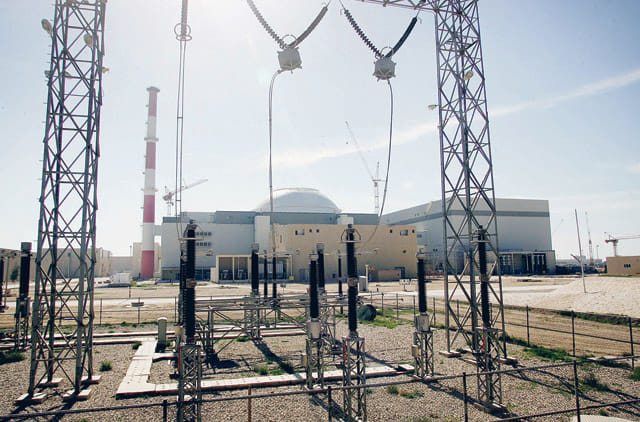
Three decades separate the shipping of nuclear fuel rods to Iraq's Osirak reactor, supplied by France in 1981, and the operationalisation of Iran's Bushehr nuclear reactor last month. In this time, the Middle East has witnessed tumultous events, in which both these countries were involved.
The Iraqi nuclear reactor was bombed and destroyed by Israeli planes while the Bushehr reactor in Iran was inaugurated amidst pomp and celebrations. The ceremony was broadcast around the world on satellite television channels.
While Israel destroyed Iraq's reactor, it only stated that it did not approve of the Iranian one. It is remarkable that the production capacity of the Iraqi reactor was 40 million mega watts, while that of the Iranian reactor is 1,000 million mega watts.
Today, Israel and other nations appear to be mere observers.
There is nothing new about Iran's nuclear ambitions. Back in the 1970s, the Shah of Iran, Mohammad Reza Pahlavi, enjoyed limitless backing from the West and acted as though Iran were a regional superpower, thus needing to sustain and enhance its military might. Iran set goals and targets to obtain the capacity to generate electricity through 20,000-million-watt nuclear reactors by 2000. This was done in agreements with western companies. This involved the construction of two 1,200 million watt reactors in Bushehr. However, the reactors were never built at the time.
The present Bushehr reactor was built by Russia for the production of electrical power, under the supervision of the International Atomic Energy Agency (IAEA). The US and its western allies did not object to the building of the reactor because it did not pose a threat to anyone.
However, Iran is now in a position to use the reactor to develop nuclear technology and train scientists to eventually build the bomb.
Hence, the nuclear reactor may become a source of anxiety to some countries if Tehran decides to withdraw from the nuclear Non-Proliferation Treaty (NPT), or to back out of the agreement with Russia which obliges Iran to return the used fuel without tampering.
It is then that the Bushehr nuclear reactor will start to worry the West because Iran will have another source for fission material (Plutonium 239), derived from the used fuel.
If that happens, Iran will no longer need Russia to supply it with fuel bars, because the Uranium 235 rate in these fuel bars does not exceed 3 per cent. Iran has succeeded in enriching uranium to this rate.
Fuel bars are placed inside the reactor for three to four years, and some of these bars may be replaced annually, where the interaction of neutrons and the Uranium 238 isotope result in 97 per cent plutonium in the fuel.
According to nuclear engineering experts, the Bushehr reactor will be able to produce a quarter tonne of plutonium annually, which is enough to produce 30 atom bombs of the type dropped by the US on Nagasaki during the Second World War.
But such concerns seem unwarranted if we take some technical aspects into account.
The major obstacle to using ready plutonium in the nuclear weapons industry is the existence of the Plutonium 240 isotope at a very high rate, which is not reliable in the nuclear industry, because of the high fission nature of the isotope.
Yet, this obstacle can be overcome by enriching the plutonium.
This procedure is highly similar to the uranium enrichment process, but the difficulty is in the unavailability of plutonium's chemical and physical information, when compared to the availability of such information on uranium.
These concerns are understandable and justified, because the relationship between Iran and the international community is not a friendly one. Nor is the relationship good for the stability of the region.
Some in Iran's ruling establishment have called for the country to withdraw from the NPT after tensions arose between Tehran and the IAEA regarding the uranium enrichment issue.
New enrichment plants
These tensions continued after Iran announced on August 16 that it is about to build 10 new uranium enrichment plants in fortified mountainous regions around the country. Construction begins next March.
Iran's nuclear policy has given rise to international suspicions about its true intentions regarding its nuclear programme.
The Iraqi experience proved that trying to obtain nuclear weapons did not enhance the country's national security. In fact, the opposite happened in Iraq, as the country was targeted by the international community and in the end, a major war toppled the regime.
The international community does not oppose legitimate use of nuclear technology for peaceful purposes. But will Iran back off from its hardline position?
Moreover, where is Iran heading after Bushehr?
Dr Mohammad Akef Jamal is an Iraqi writer based in Dubai.
Sign up for the Daily Briefing
Get the latest news and updates straight to your inbox
Network Links
GN StoreDownload our app
© Al Nisr Publishing LLC 2026. All rights reserved.