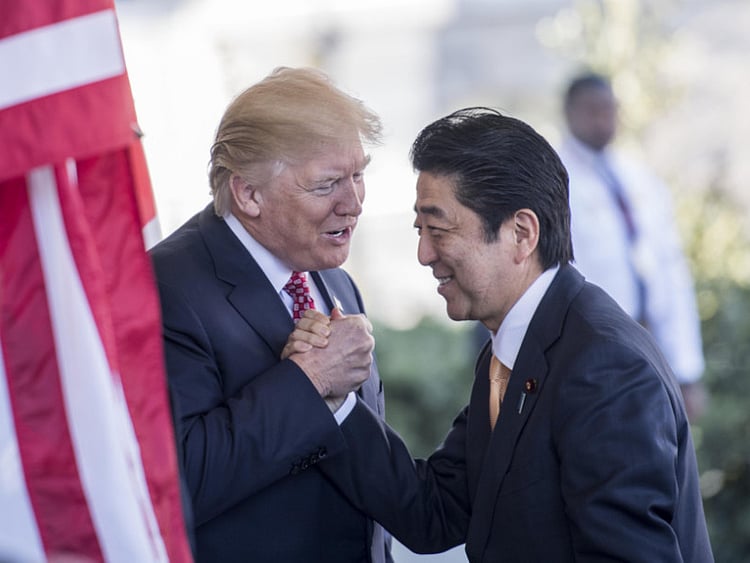
When United States President Donald Trump shakes hands, he frequently pats the other person on the top of their hand. One couldn’t help noticing this when he met Japanese Prime Minister Shinzo Abe, because during the 19 seconds that they were shaking hands, Trump managed to pat Abe’s hand no less than six times. Patting someone’s hand in this way pretends to be an affectionate gesture of approval, but its real purpose is to remind the other person who’s actually in charge. It’s what psychologists call a “status reminder”.
Another way that Trump reminds people of his superior status is by patting them on the arm or back during or after the handshake, and if the other person is so bold as to pat him back, he trumps them by producing an additional, terminal pat. Trump instinctively understands the rules governing patting — which are that the more important person reserves the right to pat the less important person, and if mutual patting occurs, has the right to execute the final pat.
But the most peculiar thing about Trump’s handshake style is his habit of pushing people away or, more commonly, pulling them towards him during the handshake. The news clips are full of examples of Trump pumping people’s hands and then yanking them towards him. When Trump greeted Justin Trudeau this week, there was every expectation that he’d try to strong-arm the Canadian Prime Minister. But Trudeau had been well-briefed, because as Trump extended his hand, Trudeau stepped right up to him, grabbing his right arm with free left hand. This, and the fact that Trudeau had managed to invade his personal space, made it virtually impossible for Trump to remind Trudeau who was really in charge by giving his hand a good yank.
So why does Trump feel the need to physically manoeuvre people like this, and what does it say about his character?
There are several possible explanations for Trump’s “yank-shake”. One is that Trump has an irresistible urge to bring people closer to him, to get them on side, and this expresses itself in his habit of pulling people towards him. In support of this explanation it’s worth noting that there are occasions when, having pulled someone towards him, Trump will switch to a more intimate upright handclasp, which of course requires even closer proximity.
Another explanation for the “yank-shake” is that it enables Trump to impose himself on the situation by catching the other person unawares and doing something that they hadn’t anticipated.
There are ways that people can subvert the vital symmetry of the handshake — for example, by applying a vice-like grip, pumping the other person’s hand too vigorously, or rotating the wrist so that your own hand ends up on top and the other person’s underneath. These little attempts at oneupmanship are still acceptable, even though they lie outside the letter of the law.
But there are at least two good reasons why we can’t apply the same leniency to the “yank-shake”. First, it involves a really dramatic departure from normal practice and people’s expectations; and second, it doesn’t allow the person whose arm is being yanked to reciprocate and do the same thing to the yanker.
It’s hard to escape the conclusion that Trump’s attachment to it lies in the fact that it enables him to take control and impose himself on the person whose hand he’s shaking. However, by doing so, he displays his disregard, possibly even his contempt, for the sacred symmetry of the handshake and the precious opportunity that it offers us to treat each other as equals. There’s no way that Trump can yank people’s hands and still claim to uphold the principles of egalitarianism.
— Guardian News and Media Limited
Peter Collett is a psychologist and body-language expert.
Sign up for the Daily Briefing
Get the latest news and updates straight to your inbox
Network Links
GN StoreDownload our app
© Al Nisr Publishing LLC 2026. All rights reserved.