UAEU launches smart mushroom farm to boost food security
IoT-powered project turns date palm waste into sustainable food solutions
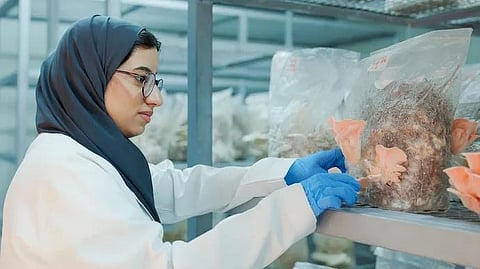
United Arab Emirates University (UAEU) has launched a Smart Mushroom House at its Al Foah Research Farm, aiming to support food security efforts and give students hands-on research experience.
The new facility uses Internet of Things (IoT) technologies to help grow mushrooms in controlled conditions. It is part of the university’s wider work to support the UAE’s National Food Security Strategy 2051.
Developed by a research team from the College of Agriculture and Veterinary Medicine, the project focuses on turning date palm waste and other organic materials into useful growing substrates for mushrooms.
Get updated faster and for FREE: Download the Gulf News app now - simply click here.
Officials said the initiative supports sustainable farming in dry environments like the UAE, while also promoting the idea of recycling agricultural waste.
Smart farming system
The Smart Mushroom House allows researchers to control temperature, humidity, lighting and ventilation through smart systems. It includes three cultivation tents and a central incubator, which helps simulate different climate conditions.
This setup allows multiple types of mushrooms to be grown at the same time under ideal conditions.
The facility can handle up to 600 cultivation bags per cycle, producing around 20 to 30 per cent yield depending on the mushroom type.
Current research focuses on several varieties, including oyster mushrooms, lion’s mane, turkey tail and king oyster mushrooms. The team is also working on growing local desert truffles under controlled conditions.
Researchers are also studying ways to use mushroom by-products in other areas, such as food products and sustainable materials.
Supporting Emirati students
A key part of the project is supporting Emirati students through practical research.
The facility is currently linked to one doctoral project and three undergraduate projects. UAE national students Maitha Al Dhaheri, Reem Al Mutairi and Al Yaziya Al Nuaimi are actively involved.
Their work focuses on improving mushroom production methods and finding the best growing materials suited to local conditions.
Some of the research has already been presented to the UAE National SDG Committee. In another achievement, student Ghalia Abdulla Al Khateri won second place at the Emirates Agriculture Conference for her work on using agricultural waste for mushroom production.
Local focus and outreach
The design of the Smart Mushroom House focuses on using local resources and protecting native species, especially desert truffles.
The team has already harvested oyster mushrooms, which were shared with the university community as part of awareness efforts.
Beyond research, the project also includes training programmes for students, farmers and others interested in sustainable agriculture.
Officials said the initiative shows how agricultural waste can be turned into useful food products, while supporting innovation in farming.
They added that the project reflects UAEU’s role in developing practical solutions for food security, especially in dry and desert environments.


