Food and food processing among UAE’s top investment opportunities, says economy minister
From dates to AI logistics, ministers outline how food can deliver higher value
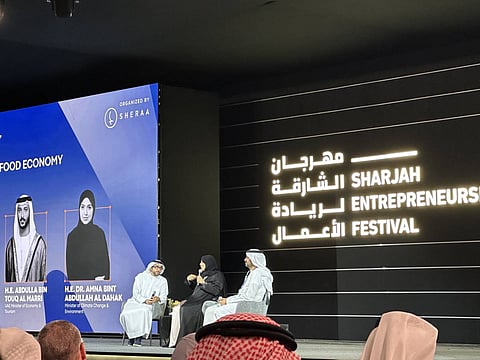
Dubai: Food and food processing now sit at the very top of the UAE’s strategic investment agenda, with the sector offering some of the fastest and most scalable value creation opportunities across the economy, according to Abdulla bin Touq Al Marri, UAE Minister of Economy and Tourism.
Speaking during a panel at the Sharjah Entrepreneurship Festival 2026, Al Marri said the sector now sits at the centre of economic planning as consumption patterns shift and supply chains face rising pressure.
“My message to the investors, the entrepreneurs, to those who are there at the moment, food and food processing is the number one strategic investment opportunity for you guys to do,” he said. “Everything you need is there. The UAE has the capacity of infrastructure, trade, the sea pass, the imports. You can do a lot of things.”
Where value is actually created
The opportunity, Al Marri argued, lies less in growing food and more in what happens after it leaves the farm. Raw produce captures only a fraction of its economic potential unless it is processed, packaged and positioned for global markets.
“If you take one kilo of cucumber, it’s worth very little,” he said. “If you pickle it, put it in a jar and sell it as a finished product, it’s Dh20. That’s food processing.”
Dates offered a clearer illustration of how processing transforms a traditional product into an export business. While the UAE is widely known for date production, much of the value today sits in nutrition products sold abroad. “When I go to Germany, there are date-based products on the shelf produced from the UAE,” he said, referring to protein bars and functional foods using local inputs.
The same logic applies across crops and livestock. Tomatoes can move into paste and sauces, while alternative proteins and processed foods command margins far beyond raw output. “One kilo of tomatoes can become paste, sauces or other products, and suddenly you are talking about twenty times the value,” he said.
Why food is now strategic
The renewed focus is tied closely to food security. The UAE currently imports more than 90% of its food, a dependence the government is seeking to reduce by building domestic processing capacity alongside trade and logistics.
“Food security is not separate from economic opportunity,” Al Marri said. “They are linked.”
My message to the investors, the entrepreneurs, to those who are there at the moment, food and food processing is the number one strategic investment opportunity for you.

To support that shift, the government has launched the UAE’s first food and food processing cluster, now led by the private sector and approved by Cabinet. More than 50 companies are involved in the initial phase, supported by initiatives spanning farming, logistics, insurance and cold storage.
Food and food processing now lead the Ministry of Economy’s national cluster strategy, ahead of space, financial services, data and tourism.
Why Sharjah sits at the centre
Mapping work carried out across the country has positioned Sharjah as a key hub for the cluster, driven by inter-emirate connectivity, logistics infrastructure and proximity to processing activity.
“Sharjah is number one when it comes to logistics, connectivity and the ability to process food,” Al Marri said, pointing to the emirate’s role in linking farms, processors and export markets.
Changing diets and generational shifts have also pushed food higher up the policy agenda. “Food used to sit in the background of economic planning,” he said. “Today, with the way people eat and how food is produced and processed, it’s at the forefront of what we focus on.”
Fixing what holds farms back
One of the biggest constraints remains regulation at farm level. “Today, you cannot always have cold storage or processing on a farm because it becomes a different commercial activity,” Al Marri said. “We need to rethink how farms operate so they can produce, process and add value without facing violations.”
That rethink, he added, requires coordination with local governments and municipalities, alongside education for farmers ready to move beyond basic production models.
Bringing innovation to the ground
From the climate and environment perspective, the priority is ensuring technology reaches those producing food on the ground, according to Dr Amna Bint Abdullah Al Dahak, UAE Minister of Climate Change and Environment.
“We need to listen to farmers, fishermen and primary producers and understand their challenges before we design solutions,” she said. “Innovation has to start from what is happening on the ground.”
The sector spans traditional farms and highly controlled, technology-driven systems. Creating a shared community allows farmers to learn from each other while giving researchers and entrepreneurs real-world environments to test solutions.
That approach supports the Emirates National Agriculture Exhibition and Conference, which brings farmers, policymakers, researchers and private companies into direct conversation, combining technical expertise with peer-to-peer learning and education tracks aimed at younger generations.
Food processing now sits at the intersection of security, technology and value creation, offering investors a sector where policy direction, infrastructure and market demand are already aligned.