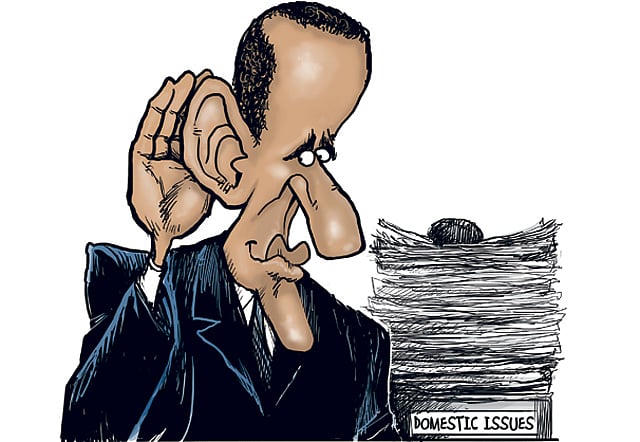
Over the last few months it has been easy to get the impression that official Washington has lost interest in foreign policy. This is not only because unemployment and health care often seem to be the only thing anyone in the US capital is talking about.
Nor is it solely because some of US President Barack Obama's recent overseas trips (such as his attendance at the Copenhagen climate summit) have received surprisingly little coverage at home. It is not even because foreign affairs barely rated a mention in Obama's first State of the Union address.
Perhaps the most telling sign that America's collective attention has turned inward has been the ‘national security' debate of the past few weeks. This has ostensibly been about Al Qaida and whether the terrorist threat America faces is markedly greater now than it was under former US president George W. Bush.
In practice, however, the national discussion has focused mainly on whether accused terrorists should be tried in military or civilian courts. Much of that debate, in turn, has revolved around which sort of trial represents a lesser threat to public safety.
Even by US standards this has been a remarkably inward-looking discussion.
The question for those of us who follow, and care about foreign policy, is whether this is necessarily a bad thing. There is a reason why diplomacy usually takes place behind closed doors: the public square is rarely the best place to settle complex, often emotional, issues of war and peace. Political leaders must always, of course, be able to defend — and build support for — their policies, but that does not mean that hashing out every detail of every negotiation as the whole world watches makes a lot of sense; not, at least, if the point of the exercise is to reach an actual deal.
In the Middle East, in particular, one can argue that there has been more to the administration's first year than meets the eye. US Special envoy George Mitchell's peace missions have yielded little of substance, but still represent more American engagement than the Israeli-Palestinian conflict has seen in years. More importantly, they have helped keep the peace process on life support, however tenuously.
On Iran, one can criticise the Obama administration from the left for failing to offer sufficient support to President Mahmoud Ahmadinejad's opponents, or from the right for failing to draw a line in the sand over Iran's nuclear ambitions.
But a case can also be made that getting talks with Tehran started at all was something of an accomplishment granted the current political climate in both Washington and Tehran. It is also worth noting that, unlike some of his political opponents, Obama seems to sense that a full-on American embrace of Iran's opposition would do their cause more harm than good.
Finally, there is the question of tone. Beginning with the mere fact of his election, extending through his inaugural address to last June's speech in Cairo, Obama has sought to change the way America engages with the world in general and the Middle East in particular. There is an admittedly ephemeral quality to this, but was not Bush's manner in dealing with the region one of the things that so enraged many Middle Eastern observers?
Not enough progress
Where, then, does all of this leave us? Is Obama moving fast enough for many in the Middle East, changing enough things in concrete enough ways to send the message that he really is a different sort of American leader? Clearly the answer to that question is ‘no'. Yet just as many of Obama's most fervent supporters in the United States invested unrealistic hopes in the man, so, too, did many of his admirers overseas.
More than one Middle Eastern friend has asked me in recent months how Obama actually differs from Bush. Where the region is concerned the answer is twofold:
First, though it is hard to see from a distance, the single most significant difference between the Obama and Bush administrations may be their attitudes toward government. Bush and the people around him were dismissive of the bureaucracy in general and regional experts in particular.
Obama may not agree with every policy analysis the permanent government sends to his desk, but he appears to have an innate respect for expertise per se. He does not see career policy experts as his enemies.
Second, there is that change in tone. Tone, of course, is not policy, but it carries weight. Tone matters. Today's Washington may be a far cry from what many of this newspaper's readers would like: but it is a Washington far more willing at least to listen to their concerns.
That, in the end, has to count for something.
Gordon Robison, a writer and commentator who has lived in and reported on the Middle East for two decades, teaches political science at the University of Vermont.
Sign up for the Daily Briefing
Get the latest news and updates straight to your inbox
Network Links
GN StoreDownload our app
© Al Nisr Publishing LLC 2026. All rights reserved.