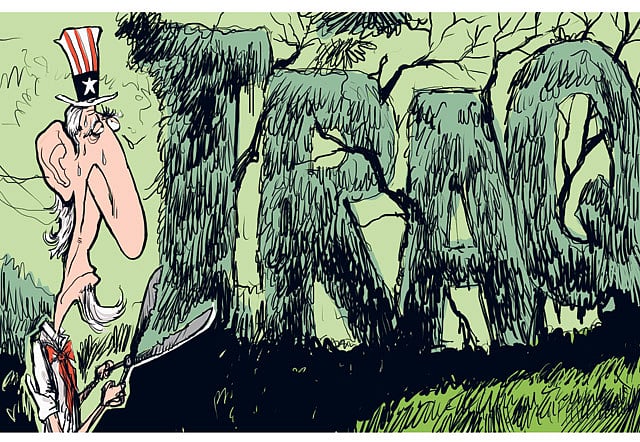
Today marks the seventh anniversary of the US invasion of Iraq, which coincides with special circumstances that came about as a result of the recent elections in the country.
The elections resulted in a new reality in that the forces of change have grown to an extent that worries the conservative forces that have occupied Iraq's key offices over the past seven years. This has motivated the latter to set up a variety of obstacles to prevent the winners of the election from forming a government.
This is a good time to contemplate the past seven years of Iraq's political process, which has been influenced by both the US and Iran. The US and Iran are locked in a struggle both inside and outside of Iraq. However, the struggle inside Iraq is indirect as it is waged by Iraqi politicians from different blocs and parties, each representing one camp or the other. These people do not have Iraq's interests at heart.
The US occupation of Afghanistan and Iraq is reminiscent of the colonialism displayed by countries such as Britain, France, Italy, Belgium, the Netherlands, Spain and Portugal in the past, which extended Europe's influence to the rest of the world, until the first and second decades of the 20th century. Armies and fleets invaded other countries, setting up systems to rob the wealth of those nations and change their cultural features.
So what are the outcomes of the US invasion of Iraq?
Repercussions
Iraq is not a small country that can be occupied easily, as in the case of Central America's banana republics. Occupying a country such as Iraq has dangerous repercussions regionally and internationally because Iraq is a wealthy country with distinguished natural and human resources, as well as a culture and history that mark it as the cradle of civilisation.
The US explanation for the invasion of Iraq soon collapsed, and as a result the international community became convinced that Iraq's possession of weapons of mass destruction was a lie fabricated by the Bush administration to sway US and global opinion and so seek legitimacy for an illegitimate campaign.
As a result, the America's reputation and its international status have been greatly diminished. This is especially so given that the Bush administration, which waged the war against Iraq, alleged that the US carried an international message to be delivered to the people of the Middle East.
However, that was not the only damage done to the US.
Invading Iraq after Afghanistan weakened the US military apparatus and undermined the country's financial abilities. It also reduced the America's ability to interfere in other countries around the world because of the huge financial and human loss that resulted and will continue to burden the US Treasury for a long time to come. The invasion is directly responsible for the decline in US taxpayers' living standards.
This military exhaustion has also affected the US political stance regarding many issues around the world. US diplomatic options with regard to major international issues have been limited.
The US military has also been depleted, and those threatened by it no longer take it seriously. It has lost popular support at home, and it is now more difficult to persuade allies to join it in fighting American causes.
In turn, Iraq is no longer a force in the region. This has damaged regional equilibrium. Iran took advantage of this situation by assuming military superiority in the region, leading to concerns all over the Middle East and not just among its immediate neighbours.
This has further complicated issues at a time when the US grip on the world has weakened, leading its traditional allies to worry about its future stability and causing them to become increasingly suspicious about its intentions.
The fruits of seven years spent in Iraq are very disappointing. Iraq has not emerged stronger and its sovereignty is in question, with around 100,000 US troops still on its soil. Moreover, Iraq's neighbours dictate its policies. Unprecedented corruption is eating away at the country, security is lacking, violence is unabated and disintegration is a very real threat. And worst of all, Iraq is still bound by Chapter VII of the United Nations Charter, indebted and isolated.
Arabs have not been properly represented in Iraq since the downfall of the Saddam regime. The current government ignores most Arab inputs because the US is determined to prevent other Arab nations from participating in Iraq's affairs.
Dr Mohammad Akef Jamal is an Iraqi writer based in Dubai.
Sign up for the Daily Briefing
Get the latest news and updates straight to your inbox
Network Links
GN StoreDownload our app
© Al Nisr Publishing LLC 2026. All rights reserved.