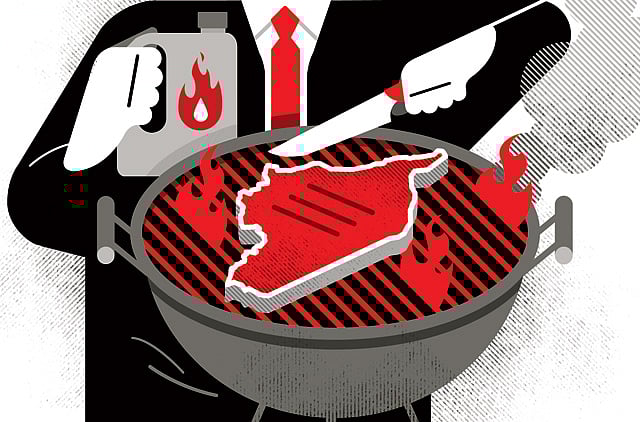
The bloody conflict in Syria is well into its fourth year with no conclusive course apparent. On the contrary, the conflict is likely to uninterruptedly continue, bloodier and uglier, with almost a total absence of any reasonably acceptable compromise in the foreseeable future. It is the most atrocious war and has tragically become now the longest civil strife in the world since the Second World War.
The country is ruinously impoverished, with the estimated number of those who have been killed so far reaching the 200,000 mark. The once promisingly flourishing economy lies now in ruins. Infrastructure and assets have been systematically destroyed with more than half of Syria’s population living below the poverty line. The latest internationally independent reports suggest that the country’s Human Development Index has fallen back to where it stood in the late 1970s. It has been estimated that even with average annual growth of five per cent, it would take Syria three decades at least to restore its 2010 GDP value level.
Chilling reality
Additionally, the seriously dangerous threat of the so-called Islamic State of Iraq and the Levant (Isil) in vast areas of Syria and across the entire eastern region along the border with Iraq is creating a completely new reality and deeply entrenching itself in these heavily Sunni-populated areas. Basically, the border between Syria and Iraq, created and drawn in 1922 following the defeat of the Ottoman Empire by the new colonial powers, France and Britain, has widely disappeared. Most of the joint territory is unfortunately run by the Isil, which has declared the area as their Caliphate state.
Unlike other heads of states of the ‘Arab Revolution’ countries, Syria’s Bashar Al Assad and his ruling clique, including members of his family, decided to face up to the Syrian uprising in March 2011 and used bloody methods, including chemical weapons, to quell it. Both Tunisia’s Zain Al Abideen Bin Ali and Egypt’s Hosni Mubarak quickly listened to the people’s demands for a regime change and relinquished their role as heads of states (thanks mostly to the neutrality of both countries’ armies, unlike the Syrian army, which was purposefully built as a regime force). Even the tribal leader and army officer-turned-president Ali Abdullah Saleh of Yemen was eventually forced to leave his post to a coalition government. Libya’s Muammar Gaddafi tried to cling to power, but he miserably failed, and was killed in the desert like a rat.
Remorseless push
Only Al Assad out of the five heads of states who chose confrontation rather than reconciliation with his people is around. He flatly refused, with the full support of Russia and Iran, to reconsider his government structure and decided to go all the way down the killing route. He went even further by allowing his intelligence apparatus to help create extreme Islamist groups to fight off the opposition forces led by the newly formed Free Army Syrian Army, when they unleashed about 3,000 hardcore criminal Islamists from prisons to establish a counter militia to the opposition.
From the beginning of the war, Syria’s media largely claimed that extremists, “directed and paid by foreign conspirators”, were leading the opposition. When the war started, there was no hard evidence for Al Assad’s claim. Reasons behind the uprising were evidently the wide scale of poverty and humiliations imposed by a corrupt and authoritarian regime for longer than four decades. But now, Islamist militia sadly dominate the armed opposition in vast numbers. The moderate and secular-minded Syrian opposition has been marginalised partly by their incompetence and partly by the failure of the international community to give them substantial aid and real help at an early stage of the Syrian war. These groups were hugely let down by the same powers that had previously encouraged them to launch the revolution and lead the uprising against the Al Assad regime’s brutality.
The regime has largely succeeded in creating a culture of fear where ordinary Syrians, particularly the various minorities, including Alawites, Leventine Christians, Kurds (Sunnis, Shiites, Yazidis), Imami Shiites, Esmailis, Druze, Turkmen, Circassians, Kabarda, Armenians, Assyrians, Chaldians and Syriacs feel the urgent need for the regime’s protection in areas remaining under Al Assad’s control. With the imminent threat of Islamist extremists, the choice for them is currently almost non-existent.
When asked by a BBC reporter whether he agrees with Western governments who are calling for Al Assad to step down, the Greek-Catholic Archbishop of the devastated ancient city of Aleppo, Metropolitan Jean Jeanbart, simply put it like this: if the government won the war, an army officer will rule the country. If the rebels won, it would be an Isil militant. Under the circumstances, I prefer Al Assad.
Archbishop Jeanbart undoubtedly reflects the view of a wide-ranging number of these minorities even though some of them strongly believe in a drastic change to establish a democratically elected government in Damascus.
But unfortunately, there is currently a trend in the international community, which is deeply engaged in a major reconciliation process with the major backer of Al Assad’s regime, Iran, to reassess the West relationship with Al Assad’s regime. Writing in last Tuesday’s Evening Standard, the former UK foreign secretary, Sir Malcolm Rifkind clearly stated that “sadly, [the Al Assad regime] is likely to become an unavoidable partner if the terrorists are to be defeated”.
Mustapha Karkouti is a former president of the Foreign Press Association, London.
Sign up for the Daily Briefing
Get the latest news and updates straight to your inbox
Network Links
GN StoreDownload our app
© Al Nisr Publishing LLC 2026. All rights reserved.