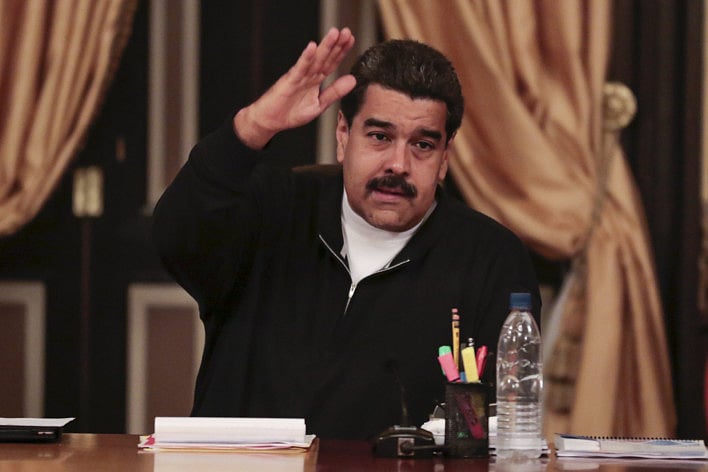
On December 6, Venezuelans went to the polls to elect their new national parliament, and the results were devastating for President Nicolas Maduro. The opposition is claiming to have won a two-thirds majority in the National Assembly; results are still coming in. What’s clear enough, though, is that the opposition has managed to take control of an important political institution for the first time in 16 years.
This marks a major shift. Since 1998, when then-newcomer Hugo Chavez swept to victory, the trend has run strongly in favour of his United Socialist Party of Venezuela. Under different names, the party has continuously expanded its control over political institutions, gradually transforming Venezuela into a semi-autocratic state. First it changed the Venezuelan Constitution to President Chavez’s liking. Then it took control of all branches of government, including Congress, the Supreme Court, the colossal state-owned oil company, the entire military, and the election regulation body. By 2004, chavismo started to take control of non-governmental organisations such as labour unions, firms, and private lands and began to eye public universities.
Until Chavez died in 2013, most Venezuelans didn’t seem to care that they were sacrificing liberal democracy. Chavez managed to conquer their hearts with his belligerent rhetoric and lavish social spending. So what if chavismo was taking control of all institutions, Chavez’s supporters argued. At least, they said, he was reversing two decades of economic contraction by using oil rents to generate the most impressive consumption boom in the history of Latin America. As a result, Chavez won almost every election he organised. His successor, Maduro, won as well (albeit by smaller margins). Both expanded the powers of the state to new levels.
Chavez’s opponents have not had it easy. One might expect them to have been helped by the country’s worsening economic collapse, but instead they have faced extraordinary obstacles. To understand why it has been so difficult for them to win, one must understand the nature of the beast they’ve been up against.
In his brilliant new book, The Politics of Uncertainty, Andreas Schedler explains that electoral autocracies — countries where the government allows elections but uses its dominance of key institutions to tilt the balance heavily in its favour — face permanent uncertainty. Because these elections are not accurate gauges of public opinion, and because dissent is discouraged through various legal and illegal-methods, such regimes can never be sure about their true levels of public support. Unlike traditional autocracies, they don’t respond to this uncertainty with outright repression, which could trigger a backlash (not to mention international condemnation). Instead, they opt for more subtle manipulation of institutions and media censorship. Schedler shows that this response makes it increasingly hard to defeat them at the polls.
The chavista regime followed this formula to the letter. Under Chavez, institutional manipulation took the form of what one might call “asymmetrical auditing”. The authorities ensured that state institutions would be exempt from any kind of audit, scrutiny, or limit, while subjecting non-state institutions to an inordinate amount of audits and controls.
Chavez and his successor thus concocted an incredibly elaborate system of control of private activities. Prices were controlled. Access to foreign exchange was controlled. Profits were controlled. If you got too big — whether as a firm or as an independent politician — the government placed you under intense scrutiny.
Maduro brought this asymmetrical institutional framework to a new extreme. The impunity of state officials grew. One of the biggest corruption scandals revealed that close relatives of the president and his wife received not only important government posts but also diplomatic passports, which they then used to traffic drugs. This produced widespread shock — but no investigations followed.
Meanwhile, Maduro expanded government auditing into new spheres of civic life. Not just business leaders but also prominent oppositionists and media companies were placed under investigation, brought to trial on false charges, and stripped of their property (sometimes their liberty as well). Under Maduro, more than 70 political prisoners have been sent to jail, including a former presidential candidate (Manuel Rosales), the leader of the largest opposition party (Leopoldo Lopez), and the elected mayor of Caracas (Antonio Ledezma). Tax audits on all opposition candidates were increased. Sometimes on very little evidence, these audits were used to justify stiff penalties, such as fines on firms and outright bans on politicians from running for office (Maria Corina Machado).
Even ordinary citizens started to experience auditing under Maduro. As scarcity grew, the government responded by establishing a rationing system. Suddenly, Venezuelans faced not just long lines to buy basic products, but also state agents assigning them numbers and watching their behavior at cash registers.
Maduro has also made ample use of the other tool mentioned in Schedler’s study: censorship of the press. The authorities have brought most traditional media under state ownership or control, especially in the countryside. As Franz von Bergen and I have written elsewhere, these subservient media outlets have effectively made the opposition invisible by neglecting almost all coverage of its activities.
Maduro has even extended censorship to the economic realm. According to economist Anabella Abadi, Maduro’s government has systematically removed basic economic data from public view. The authorities presented their last official figures for GDP, imports, and inflation rates at the end of 2014. Numbers on scarcity and unemployment were last published in January 2014; the most recent poverty statistics date back to 2013. Even though the government has continued to make official statements on oil production, many experts say they don’t believe that data, either. And no one has taken figures on state spending at face value since Chavez took power.
By voting so overwhelmingly for the opposition — and with the largest turnout in a legislative election in 16 years — Venezuelans have started a process of rebalancing the country’s asymmetrical system of audits. For the first time since chavismo came to power, they are demanding that the powers-to-be verify that ministers do their jobs fairly, that the budget is spent according to established rules, that the president follow the law, and that the law reflect the wishes of more than just one man and his cronies.
What we are witnessing is an uprising against asymmetrical information. Venezuelans have taken to heart Amartya Sen’s dictum that the beauty of democracy is its ability to “generate information,” not just about what voters want, but also about what states do. The fact that the opposition won in even traditional bastions of chavismo (e.g., the states of Barinas, Falcon, Monagas y Trujillo) shows how widespread this movement has become.
Despite this achievement, it’s important to note that the December 6 election also showed that millions of Venezuelans still like chavismo — at least 40 per cent of the voters. How can a regime with such a dismal record of economic management and human rights gain so many votes?
The answer has a great deal to do with both nostalgia and fear. Many chavistas still miss their deceased leader, and others are afraid of what the opposition could do to them. But there is another powerful reason: In the Venezuelan welfare state — unlike the social-democratic welfare states of Europe and North America, where social welfare is provided based on need — you receive state benefits based on the degree of your loyalty to the state. Political scientist Michael Albertus has recently showed, for example, how the government uses voting data to assign land grants.
Charles Tilly famously argued that the modern European state emerged in the middle ages as a result of a racket. A feudal lord would fabricate an external security threat, then offer ordinary people “protection” against that threat in return for tax payments and pledges of loyalty. The Maduro approach to welfare provision is Tillian with a twist. The state creates a threat (by implementing policies that ruin the economy), creates a myth about this threat (economic oligopolies are producing “economic warfare”) and then offers consumption goods as protection, on one condition: Cast your vote for chavismo!
This system emerged into full view during the last months of the election campaign. As inflation and scarcity spiked, Maduro responded by handing out flat-screen TVs, construction materials, washing machines, even bags with groceries.
In short, Maduro has become the leader of a state that faces zero checks on its own power even as it relentlessly audits non-state actors. This state responds to increasing uncertainty about its political power by closing off more and more of its activities to public scrutiny. It creates (and tolerates) economic ruin by misguided policies such as price controls while offering privatized consumption goods and subsidies in return for political loyalties.
In the end, however, as we have seen, the desire for information and democracy has trumped the regime’s ability to purchase votes. And remarkably, this revolution for information has been quite peaceful.
Sign up for the Daily Briefing
Get the latest news and updates straight to your inbox
Network Links
GN StoreDownload our app
© Al Nisr Publishing LLC 2026. All rights reserved.