Playing host to the 16th summit meeting of the states of the Nonaligned Movement was a long-awaited occasion for Iran, which was used as an opportunity to show the world that the Iranian regime was not isolated in the international arena. The meeting that took place in the last week of August was attended by only 29 heads of state, while the rest of the 120 nonaligned member states were represented by either their respective foreign ministers or lesser-ranked officials — a clear indication of the reluctance of important members to risk shoring in political uncertainty.
Tehran consecrated its efforts to win over the Egyptian president to its side of the argument, since Egypt is the largest Arab country and leading Arab Spring state. And because Egypt is currently led by an independent government mostly comprising members of the Muslim Brotherhood and which has — theoretically, at least — a common ground with the ideology of Iran’s Islamic Republic.
That assumption was not baseless. Mohammad Mursi, the head of the republic of Egypt, who was in Makkah, two weeks earlier, suggested that a quadripartite of Egypt, Saudi Arabia, Turkey and Iran should join forces to find a peaceful solution to what is going in Syria and reject any foreign involvement there. Mursi’s idea was seen in Tehran as an asset to end the street fighting and find a way out for the Syrian regime without losing its influence there. Mursi’s initiative sent out a message to Iran that the new Egyptian policy was to look beyond the Arab conscience and present itself as an international power, effectively keeping Tehran out of any active involvement in working out a solution in Syria. This, notwithstanding the Egyptian president’s announcement in Makkah of the quadripartite initiative, which Tehran saw as a new era emerging in Middle East politics.
On the wrong horse
In his speech at the opening session of the summit in Tehran, Mursi began by honouring Abu Bakr and Omar, the first and second Caliphs of Islam. Later on, he referred to what was going on in Syria as an atrocity against the Syrian people and termed it as “politically and morally unacceptable”. Soon, the Iranians realised they were betting on the wrong horse and immediately the translators altered the words of Mursi, replacing the word Syria with Bahrain.
From that moment onwards, it was obvious that the gap between Egypt and Iran was still wide and the attempt by the Iranians to win over the big Arab country had fallen apart.
The 16th summit meeting of nonaligned countries in Tehran fell short of providing the Iranians with the great triumph that they had hoped for. So as a face-saving measure for the huge disappointment on the political front, the Iranian authorities immediately announced their biggest military manoeuvre in the Gulf. This was more of an attempt to reassure its allies in the region and to show that they had an alternative to politics and that was military power.
However, neither politics nor military manoeuvres will help the Iranian republic. Iran must realise that its main job still lies within its own boundaries and its primary responsibility is towards its citizens — not in fighting against the rest of the world. The lessons drawn from the uprisings in Arab countries like Egypt, Libya and elsewhere clearly show that nations need to respect the need of their people and what matters in the end is the home front and not military hardware.
Losing direct contact
Similarly, Iran should concentrate on its own backyard, ensuring freedom and a peaceful life for its people. The Arab uprisings have shown that those who neglected their home front faced their doom.
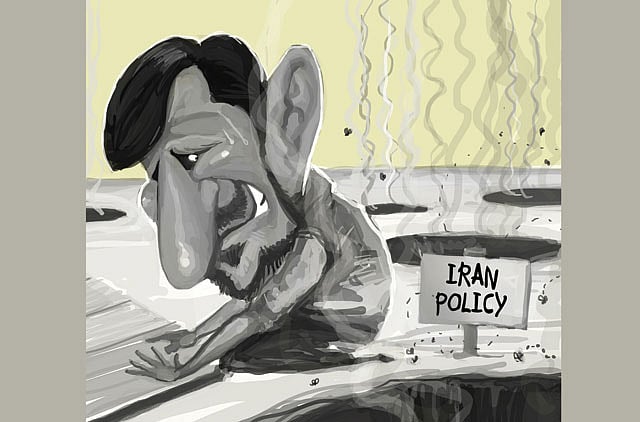
The best way forward for Iran now is to take a long, hard look at the policies adopted so far, particularly during the presidency of Mahmoud Ahmadinejad. Tehran was steadily moving towards a sort of rapprochement with its neighbours and the world during the tenures of Akbar Hashemi Rafsanjani and Mohammad Khatami, the two presidents prior to Ahmadinejad. However, ever since Ahmadinejad took office, things deteriorated. Tehran’s policy of aggression based on sectarian issues and soliciting of the Shiites in Iraq, Lebanon, Bahrain and Syria will serve no constructive purpose. In fact, Tehran is now on the brink of losing Syria and subsequently losing direct contact with Hezbollah in Lebanon and is bereft of any real ties with the Arab Spring countries, particularly Egypt.
The Iranian authorities should seriously review the strategy so far adopted in dealing with their neighbours, they should try to improve the lot of the Iranians who have suffered because of the wrong polices and mend their contacts with the Arab neighbours. After all, there is no guarantee that the spirit of Arab Spring will not reach Tehran next.
Mohammed Al Rumaihi is a professor of political sociology at Kuwait University.
Sign up for the Daily Briefing
Get the latest news and updates straight to your inbox
Network Links
GN StoreDownload our app
© Al Nisr Publishing LLC 2026. All rights reserved.