It was a strange year, full of unexpected events. The world is changing quickly. For centuries and decades there has been talk of the ‘world order,' the ‘global economic system,' the ‘relationships (clashes or alliances) between (organised and structured) civilisations.' But are these ways of looking at and describing the world still relevant?
Since 2008 the economic downturn has undermined the old order; it is impossible to tell if there is still a foundation or even a shared economic paradigm to which we can still refer. The traditional political power relationships seem scattered, while ‘the West', ‘Islam', or ‘Confucianism', as civilisations, seem to be under siege. The shared feeling is one of ‘doubt, fear and insecurity;' the common and natural reaction is to seek protection and reassurance in a sense of belonging.
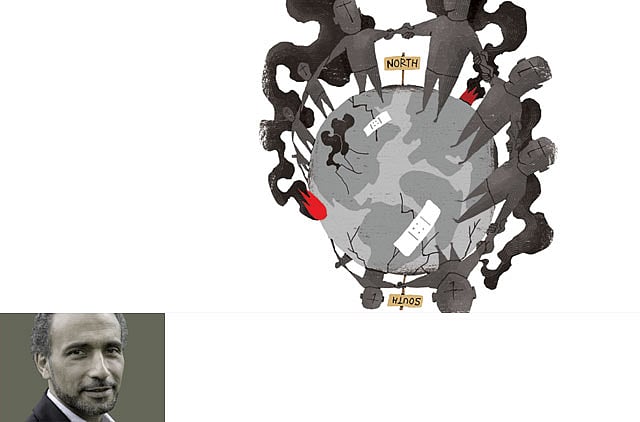
Some fall into a victim mentality, creating an ‘other' who epitomises all threats, real and imagined. In the midst of apparent global chaos, to create one's universe, an ‘us' to belong to, brings comfort. Things could be summarised thus: in 2011, people were searching for an ‘us,' a space and a meaning they could connect with. People, east and west, north and south, have been driven by ill-defined hopes much more than by structured ideologies.
In March the earthquake and the tsunami in Japan — which killed more than 15,000 people — reminded us that beyond our narrow and nationalistic concerns there are transnational realities that must be dealt with. Nuclear power stations are fragile; the energy they generate is potentially dangerous. The whole world is affected. The floods in Thailand and global warming (felt everywhere) are signs that beyond our specific identities, nations, our civilisations, we have common challenges that we must face together. Global chaos requires communication, synergy and courageous, concerted political actions. But there is no sign of political courage on the horizon.
The global economic crisis has affected all countries. In some, governments fell without the citizens being consulted. New unelected technocrats have taken over in Greece and Italy and bond rating agencies are expressing opinions and make decisions that have an impact on the political life and destiny of each and every industrialised country. No president, no prime minister or political party seems able to handle these new realities on their own: transnational dynamics are imposed on the US as much as on Russia, China or the emerging nations of South America and Asia. While people are looking for an ‘us' (something to belong to) the world is revealing our complete ‘interdependence': ‘us' is nothing without ‘you', ‘them'; the global us.
People on the streets of Spain, Greece, UK, US, etc, from the trans-national Occupy movement are calling for more justice, transparency and true democratic procedures. They feel alienated, disrespected; their social benefits and rights are slowly being eroded and lost. They do not see a future beyond the chaos and they realise that only a few people and institutions are deciding their future far from any democratic process. What is the point to vote if neither the citizens nor the elected people have an effective say about the final decisions. Who then is guiding us?
The western protests echoed the uprisings in Middle East and North Africa. In Tunisia, Egypt, Libya, Yemen and Syria people have been saying no to dictators. They call for social justice, dignity and democracy — the same democracy that is now being questioned, mistrusted and more and more often betrayed in the West. This is a transnational movement, some call it the Arab Spring, yet the awareness and the claims remain very nationalistic. Tunisians for Tunisia, Egyptians for Egypt, and so on and so forth: liberating national movements are creating this protective ‘us' for a while. But for a while only. Soon, in Libya, Egypt and Syria the regional and global challenges will be revealing the ultimate socioeconomic truth: to free a country is not enough; it is nothing, in fact, if the underlying economic power relationships are not challenged, reformed or simply rejected outright. A political so-called spring can lead to a cold economic winter. The streets of the South should listen carefully to those of the North and vice-versa: their ‘us' needs ‘them'. A true liberating movement must merge the hopes of the former and the disillusionments of the latter in order to produce a realistic alternative.
Last year revealed much. While the oppressed remain oppressed, and while the Palestinians are still forgotten, we must remain positive and full of energy. Peoples across the globe are saying "no;" they want to be treated with dignity. They might not know how to build a better future but the first step is to stand up and to speak out.
Let us hope 2011 will prove to have been a year of transition: beyond the Occupy movement, the Arab awakening, confronting the global environmental and economic crises — we can only hope people will understand how interconnected their fates have become. Paradoxically, in our global world, there will be no freedom for one country if all countries fail to understand their mutual dependence.
The South's dreams are connected to the North's resistant dynamics as much as the Japanese nuclear threat is related to our survival. Our world needs, beyond our scattered hopes, a new trans-national ideology. Our narrow ‘us' needs a new global ‘us' for the sake of ‘our' unique humanity.
Tariq Ramadan is professor of Contemporary Islamic Studies in the Faculty of Oriental Studies at Oxford University and a visiting professor at the Faculty of Islamic Studies in Qatar. He is the author of Islam and the Arab Awakening.
Sign up for the Daily Briefing
Get the latest news and updates straight to your inbox
Network Links
GN StoreDownload our app
© Al Nisr Publishing LLC 2026. All rights reserved.