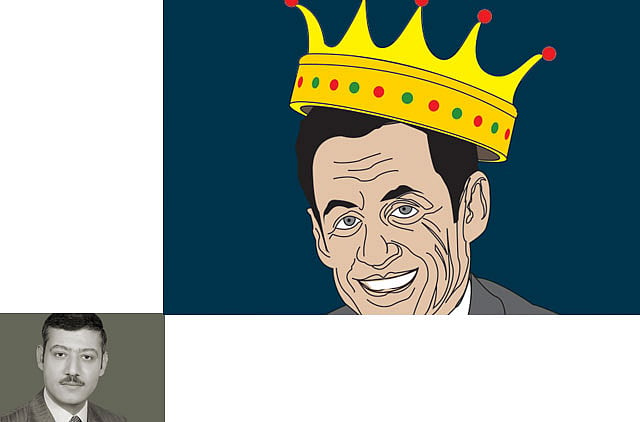
For the past few months, French President Nicolas Sarkozy has been trying to play a leading role on the international theatre but mainly in the Middle East. He led Nato's war efforts to remove Libyan leader Muammar Gaddafi and is taking an increasingly aggressive stand vis-a-vis the Syrian regime. Most analysts believe that economic incentives justify the French president's policy on Libya while attempting to re-establish his country's historic influence in Syria and the Levant in general.
In fact, assuming a leading role in world politics has always been Sarkozy's main concern even before he became president. His initial tool to realise this dream was the Union for the Mediterranean; a project that had been dubbed by most observers as vivid imagination.
The idea that 27 European states and 16 Mediterranean nations would come together to form one club was hard to perceive. Given the conflict of interests between these different nations the assumption was described as a bad idea. Regardless, for sometime Sarkozy continued to harness the project believing that he could succeed if enough incentives were offered. He had to deal with a bunch of problems, nonetheless. Several nations both in the EU and the Mediterranean had reservations.
In the EU, the reception of Germany and Spain was to say the least cold. Germany thought that the French proposal would exclude and may isolate the non- Mediterranean European countries. The Spanish on the other hand thought that the French project would undermine the Barcelona process, sponsored by Spain.
Opposition
Sarkozy then turned to the southern shores of the Mediterranean to convince the Arabs and the Turks that the project was worth trying. Israel did not have much to object. The Turks thought that the whole idea was envisaged to block their accession to the EU. Sarkozy was and remains a vehement opponent to Turkey's admission into the EU.
The Arabs have different concerns but their position was far from united. While Syria, Libya and to an extent Algeria opposed the project on the grounds that it would be used as a launching pad to normalise relations with Israel before solving the Arab-Israeli conflict, Egypt was content with Sarkozy's offer to share the presidency of the Union. Given Europe's dominant economic and industrial position, the Arabs were also concerned about a European hegemony within the Union.
Given the failed experience of the Barcelona process, some were also sceptical about what the new Union would contribute. Without solving the Arab-Israeli conflict, the Union for the Mediterranean, for many, would face a similar fate. Economic co-operation would evolve between countries that are still in a state of war. That was the fatal mistake of the Barcelona process. Moreover, given the world financial crisis and since the GCC countries were not included many wondered who would pay for the ambitious projects of the Union.
More important perhaps, a union would be successful only, some argued, if the different countries have similar political and economic systems and shared cultural values; i.e. democratic, liberal... etc. Europeans are democratic, industrialised, secular, liberal and rich. Most of the south Mediterranean nations are non-democratic, non-secular, underdeveloped and poor.
Given all these difficulties, the summit of the Union for the Mediterranean, which was held in Paris in July 2008, was hailed by the French media as a huge success for Sarkozy's diplomacy since he managed to bring together 43 nations from both Europe and the Mediterranean despite their differences, conflict of interests and even hostilities. Yet, since then the whole project seemed to have been put on hold; a total failure for a president who has always dreamt of playing a vital role in world politics. The French position on the Arab Spring is another attempt by Sarkozy to seek such a role and compensate for the failure of his earlier project. But with so many regional and international actors involved, Sarkozy is likely to take another blow. The US, Iran and Turkey, to name but a few, will certainly not allow him to infringe on their regional interests and sphere of influence. Sarkozy must hence find another place to realise his dreams.
Dr Marwan Kabalan is Dean of the Faculty of International Relations and Diplomacy, Kalamoon University in Damascus.
Sign up for the Daily Briefing
Get the latest news and updates straight to your inbox
Network Links
GN StoreDownload our app
© Al Nisr Publishing LLC 2026. All rights reserved.