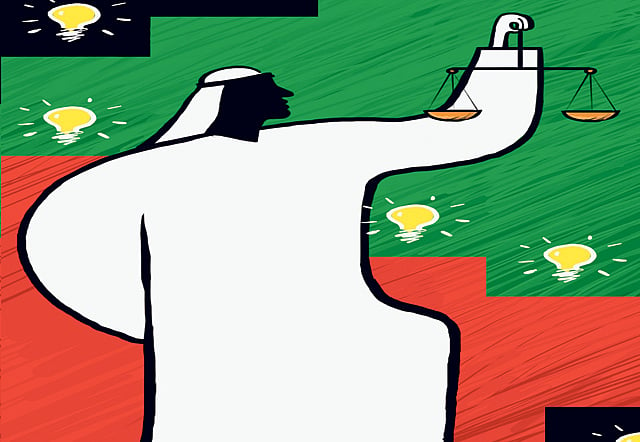
To achieve justice by enshrining the doctrine of the rule of law, to protect the law and rights, and to develop modern legislation that deals with the realities of our times — these goals are at the core of the strategy of the UAE's Ministry of Justice.
These strategies and the overall performance of the Ministry of Justice were the subject of debate at our last session at the Federal National Council (FNC).
The debate stemmed from a report presented by an FNC committee which indicated that the operational plans of the ministry lacked clarity and were insufficient to realistically execute its initiatives. In addition, it noted that there was an excessive overload of cases on federal judges which contributed to the deterioration of the quality of work being delivered. This burden is exacerbated by the fact that these same judges also have an excessive amount of administrative tasks that they must carry out.
The FNC report also found serious weaknesses in the human capital components of training, Emiratisation and the overall ability of the ministry to attract talent into its field. This was largely due to the inconsistency in remuneration, which was considered relatively low, and the overall lack of a practical human-development strategy. Together these led to a low number of entrants into the field and low retention rates.
The report also found a discrepancy in the rulings between the federal court and the local courts due to differences in the application of the law.
Finally, the FNC highlighted that the Federal Supreme Court was not independent from the Ministry of Justice, which controls both its administration and its finances, thus preventing the Supreme Court from truly carrying out its constitutional role. The ministry did not provide an answer to this last point.
For myself, when it came to the practical application of the ministry's goal of developing modern legislation, a goal that would encompass modernising existing laws, I had to pose a question — not just for myself, but for all women in our society: How would this goal impact the existing ‘personal status law' in the UAE?
Personal status law is legislation which essentially defines a woman's place in our society, by virtue of defining her rights as an individual. This is a law which, as far as I am concerned, does not fit within the spirit of the UAE's Constitution; a constitution which clearly speaks of equal rights for all UAE citizens, without differentiating between men and women. The personal status law has proven to be a serious challenge for women dealing with marriage, divorce, and custody, to name only a fraction of these challenges.
No follow up
The minister answered that there was a committee set up to study this specific law as they realise there are issues within it that need to be reviewed. Despite the minister's statement that the committee's work would be done within a week from our session, he provided no further details. We have heard nothing since.
The notion and practice of justice and rights are subjective; what is seen as a right in one country may be taboo in another. For example, while driving is a basic necessity and practice in most of the world today, it is illegal for a woman to drive in Saudi Arabia.
The interpretation of justice and rights is inextricably linked to education, culture and the religious interpretations of each society.
Nine years ago I wanted to be a lawyer, to work on family law and personal -status law, but after several months as a legal intern I realised that my battle was not going to be in the courtroom. My battle would be against mindsets, because some anachronistic practices that I witnessed in the courts and in certain legislation were a product of some mindsets in the judiciary that had enacted laws that were not always in line with the spirit of the UAE's Constitution.
What should be noted is that today the Ministry of Justice has been working hard to move its mandate forward, to push forth the vision of the UAE's strategy for the judiciary by "developing the needed regulations to ensure transparency, raising the standards of judicial staff, encouraging the recruitment of qualified UAE nationals and implementing international best practices." But without a doubt, the ministry has a long way to go.
In this context, the term we often hear is the need for an independent judiciary to ensure the rule of law, the balance of power and the protection of rights.
I will say undeniably that the existence of an independent judiciary in and of itself is not enough because what drives these institutions are the individuals behind them.
There is a saying in Arabic that only Allah is perfect, and so justice cannot be guaranteed if it is at the mercy of an individual or individuals. Therefore, not only is the need for an independent judiciary critical, but equally vital is the need for progressive judicial mindsets behind this system to ensure that we are building our judiciary upon eternally noble values. These values should above all seek to protect the Constitution, seek to deal practically and progressively with the realities of our time, and seek to protect the dignity and rights of each human being.
Najla Al Awadhi is a member of the Federal National Council.
Sign up for the Daily Briefing
Get the latest news and updates straight to your inbox
Network Links
GN StoreDownload our app
© Al Nisr Publishing LLC 2026. All rights reserved.