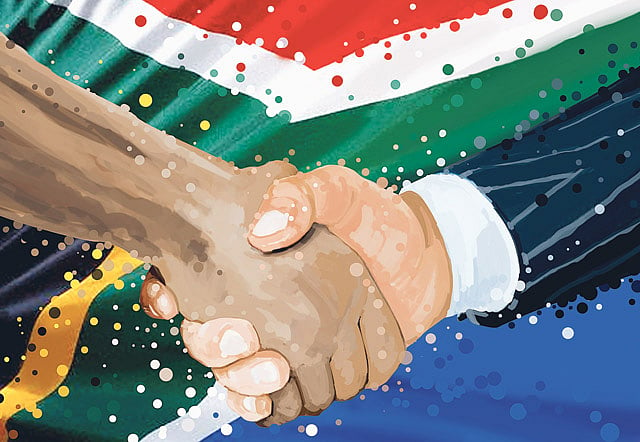
The period between February 2 and February 11, 1990, is appreciated as a pivotal point after years of struggle against apartheid and the beginning of democracy in South Africa.
I had just entered the fifth year of my exile at the ANC's headquarters in Lusaka, Zambia, in one of its leading strategy formulation and co-ordination bodies, the Political Military Council. On February 2, 1990, our offices were hushed while we listened over the radio to the speech by then president F.W. de Klerk.
As soon as we got copies of the text of his speech, we pored over it and looked at the possible implications of this move. When Nelson Mandela walked out of prison nine days later we went wild with joy. Spontaneous parties were held all over Lusaka as South Africans rejoiced with Zambians in what was seen as a triumph not only for South Africans, but for all Africans and democratic forces. Similar celebrations were held throughout South Africa and all over the world.
Much has been made about the ‘South African miracle', as if the end of apartheid was some immaculate conception. But like all conceptions it took hard work and lots of sacrifices — from many, many South Africans, black and white.
The years before February 1990 had seen unprecedented levels of mass and armed resistance against the apartheid edifice. International solidarity had ensured the regime had become completely isolated. Large numbers of white people were deserting the security forces, many joining the swelling ranks of the democratic movement. The apartheid government was also increasingly desperate in its response, using force to break up peaceful demonstrations, and arresting hundreds of activists.
With the leaders being released and the former exiles returning, the democratic movement quickly set about the task of ensuring a smooth transfer of power from the apartheid government. I was in the invidious position of being amongst the first of the exiles to return, in April 1990.
The four years from February 1990 that led to the first non-racial, democratic elections in South Africa on April 27, 1994, were in themselves tense as renegade elements of the security forces tried to destabilise the peaceful transition. During those four years I continued serving at ANC headquarters, co-ordinating the various publicity campaigns.
Tremendous patience
The miracle that we must pay tribute to is the deep patience the South African people showed through this last leg in the marathon to democracy. Madiba and the rest of the leadership matched their non-racial ideology with concrete actions, ensuring that we did not have a racial bloodbath.
Democracy has brought huge benefits to South Africa. The economy grew at historic levels over 20 quarters until the beginning of 2009. It has already come out of the mild recession it suffered at the beginning of last year. Millions were finally able to enjoy a decent roof over their heads when the most ambitious housing project in the world was rolled out. Access to education has become almost universal, while clinics have been rolled out in places where people previously had to travel days to get basic health services.
Highly competitive elections have been held every five years since 1994. South Africa has taken up a high-profile role in world politics, standing up for Africa and the developing world, for multilateralism and peaceful development.
All these positive developments have facilitated the return of many South Africans who were concerned about the direction of the country.
South Africans are all too acutely aware of the problems we face: shortage of skills; high levels of unemployment; economic woes; crime and HIV/Aids. As we look forward to hosting the 2010 Fifa World Cup from June 11 to July 11, we are aware of the many challenges we have already overcome. South Africans are uniting once again to pull off yet another miracle, Africa's first World Cup.
I have no doubt that 2010 will join 1990 and 1994 as major landmarks in the upwards and onwards development of our country.
This return to normalcy allowed many of us to return to our studies as well. In 2000, I completed the master's degree I had begun in 1985, but which I had suspended because of my exile. My supervisor arranged a surprise party with the professor who was my supervisor in 1985 to celebrate the only master's that took 15 years to complete.
Yacoob Abba Omar, writing in his personal capacity, is the South African Ambassador to the UAE.
Sign up for the Daily Briefing
Get the latest news and updates straight to your inbox
Network Links
GN StoreDownload our app
© Al Nisr Publishing LLC 2026. All rights reserved.