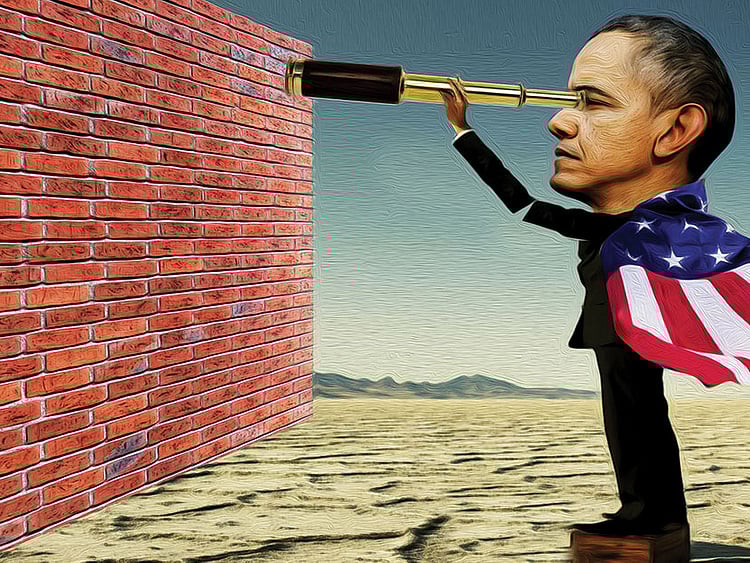
Two weeks ago John Kerry, America’s peripatetic Secretary of State, stopped off in France “to share a hug with all of Paris”. In the annals of American diplomacy, Kerry’s hug — even with its requisite reference to General John Pershing (“Lafayette, we are here!”) and James Taylor flown in from the 1960s to assure Parisians that “You’ve Got a Friend” — will probably rank with Jimmy Carter’s acknowledgment of the “admiration and love” said to define the relationship between the Iranian people and their Shah.
In short, it was a moment best forgotten — a vapid, profoundly silly event that is all too emblematic of statecraft in the Obama era. Seldom have well-credentialled and well-meaning people worked so hard to produce so little of substance.
Not one of the signature foreign policy initiatives conceived in US President Barack Obama’s first term has borne fruit. When it comes to making a fresh start with the Islamic world, responsibly ending the “dumb” war in Iraq (while winning the “necessary” one in Afghanistan), “resetting” US-Russia relations and “pivoting” towards Asia, mark your score card: 0 for 4. Kerry’s signature initiative in Obama’s second term — Israeli-Palestinian peace — has also sadly come to naught.
Yes, the Obama team “got” Osama Bin Laden. And it deserves credit for abandoning a counterproductive 50-plus-year-old policy toward Cuba and for signing a promising agreement with China on climate change. That said, the administration’s overall record of accomplishment is beyond thin, starting with that first-day-in-the-Oval-Office order to close Guantanamo.
Nor should we expect much in the time that Obama has remaining. Perhaps there is a deal with Iran waiting in the wings, but signs of intellectual exhaustion are distinctly in evidence.
“Where there is no vision,” the Hebrew Bible tells us, “the people perish”. There is no use pretending: If there is one thing the Obama administration most definitely has not got, it is a foreign policy vision.
All of this evokes a sense of unease, even panic, in circles where members of the foreign policy elite congregate. Leslie H. Gelb, former president of the Council on Foreign Relations, recently weighed in with a proposal for fixing the problem: Clean house. Bring in the visionaries.
In addition to offering his own slate of nominees, including several veterans of the storied George W. Bush administration, Gelb suggests regular consultation with Henry Kissinger, Brent Scowcroft, Zbigniew Brzezinski and James A. Baker III. These distinguished warhorses range in age from 84 to 91. By implication, only white males born before the Second World War are eligible for induction into the ranks of the Truly Wise Men.
At best, Gelb’s got it half right. When it comes to foreign policy, this president has indeed demonstrated a knack for surrounding himself with lacklustre lieutenants. That statement applies equally to National Security Adviser Susan Rice (and her predecessor), to Kerry (and his predecessor) and to incoming Pentagon chief Ashton Carter (and his predecessor).
They are all “seasoned” — in Washington, a euphemism for bland, conventional and utterly unimaginative. But a serious conception of where the world is heading and what that implies for basic US policy? Individually and collectively, they are without a clue.
Blindsided by September 11
I submit that maybe that is OK, that plodding mediocrity can be a boon if, as at present, the alternatives on offer look even worse.
You want vision? Obama’s predecessor surrounded himself with visionaries. Dick Cheney, Condoleezza Rice, Donald Rumsfeld and Paul Wolfowitz all fancied themselves large-bore strategic thinkers. Busily positioning the US to run the world, they were blindsided by September 11.
Unembarrassed and unchastened, they initiated a series of morally dubious, strategically boneheaded moves that added trillions to America’s national debt and helped fracture great expanses of the planet. Obama is still, however ineffectually, trying to clean up the mess they created.
If that is what handing the keys to big thinkers gets you, give me Susan Rice any day.
No doubt big ideas have their place — indeed, are essential — when the issues at hand are clearly defined. Yet, despite the overwrought claims of Gelb and others that America’s very survival is today at risk, this is not a time when Americans face a single overarching threat.
Instead, worrisome developments are brewing. Environmental degradation, the rise of China and other emerging powers, the spread of militant Islam, the precarious state of the global economy: All of these bear very careful watching, but none justifies embarking upon a let-out-all-the-stops offensive.
The abiding imperative is to discern, which requires careful observation and patience. In short, forget about strategy. And there is a further matter. Correct discernment assumes a proper vantage point. What you see depends on where you sit and which way you are facing. Those who inhabit the upper ranks of the Obama administration sit somewhere back in the 20th century, their worldview shaped by memories of Munich and Yalta, Korea and Vietnam, the Cuban missile crisis and the Berlin Wall, none of which retains more than tangential relevance to the present day.
You want vision? That will require a new crop of visionaries. The president (or his successor) should pick the brain of the Army captain back from multiple combat tours in Iraq and Afghanistan, the moral theologian specialising in inter-religious dialogue, the Peace Corps volunteer who spent the last two years in West Africa and the Silicon Valley entrepreneur best able to spell out the political implications of the next big thing.
A post-20th century vision requires a post-20th century generation. That generation waits in the wings and after another presidential election or two may indeed wield some influence. One should hope so. In the meantime, Americans should bide their time, amending the words of the Hebrew Bible to something like “Where there is no vision, the people muddle along”.
And as Obama and his team muddle toward their finish line, their achievements negligible, we might even express a modicum of gratitude. They managed to steer clear of truly epic disasters. When muddling was the best Washington had on offer, they delivered. They may even deserve a hug.
— Los Angeles Times
Andrew J. Bacevich is writing a military history of the war for the Middle East.
Sign up for the Daily Briefing
Get the latest news and updates straight to your inbox
Network Links
GN StoreDownload our app
© Al Nisr Publishing LLC 2026. All rights reserved.