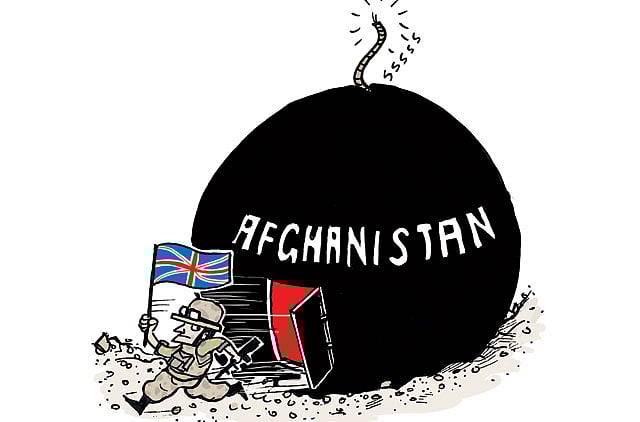
Senior UK ministers met on Wednesday for an urgent review of policy on Afghanistan. This is good news. US President Barack Obama staged a similar review on taking office and came within an inch of withdrawing. Perhaps British Prime Minister David Cameron could go that extra inch.
It is idle to pretend that Britain's 2006 expedition to bring Helmand under the control of the Kabul regime has anything but failed. General Sir David Richards was sent south four years ago by the then defence secretary, John Reid, with all the gung-ho recklessness of Gladstone's dispatch of Gordon to Khartoum. There was much nonsense about inkspots, hearts and minds, and "without a shot being fired". The British were openly contemptuous of American aerial bombardment and heavy-handedness.
Now, with 289 soldiers dead and hundreds maimed for life, the mission has had to be rescued by those same Americans. This repeats a similar six-year debacle in Iraq. The British army should undertake a complete reassessment of its counter-insurgency capacity. The Taliban remains in substantive control of all but a few population centres and the British force, already increased from 3,000 to 8,500, has had to be reinforced by 20,000 Americans under a US Marine general. No amount of spin from embedded journalists and others can claim that "we are winning in Helmand". This was meant to be another Malaya and it has been another Cyprus.
The British are reportedly being sent north to Afghanistan's second city, Kandahar — which, after nine years of occupation, is still under de facto Taliban control. Billed as the "next big military offensive", this prospect is awful, jeopardising thousands of civilians' lives. The city is under the leadership of Ahmad Wali Karzai, brother of Afghan President Hamid Karzai. When all agree that "there is no military solution to this conflict", what is the point of thousands of British troops marching on Kandahar?
The coalition ministers who travelled to this strategic morass a few weeks ago were in disarray. New Defence Secretary Liam Fox asserted that his troops were not in Afghanistan "to bring an education policy to a broken 13th-century country". They were there to ensure, somehow, "that the people of Britain are not threatened".
We have been told, over and again, that such much-heralded "final pushes", as against Sangin and Marjah, are the beginning of the end for the Taliban. Each is followed by a press barrage suggesting victory. Nevertheless, 77 per cent of Britons now reject the Afghan war.
Britain's government must clearly set out the continued purpose of the war and a strategy for achieving victory, if any. Fox's recent scepticism was refreshing. There is no question of "nation-building" in present-day Afghanistan, whatever it may suit the aid agencies to imagine.
Yet Fox's belief like Gordon Brown's that British soldiers are fighting "to keep the streets of Britain safe" is equally absurd. There has never been a shred of evidence that the Taliban wants to conquer Britain, any more than did Saddam Hussain. Such fanatics as do pose a terrorist threat are from Al Qaida, and they can operate from anywhere in the world. Nato's bombing of Pashtun villages and assassinating Taliban leaders has been no more or less effective in curbing terrorism than has placing British riflemen as target practice for Taliban fighters in the fields of Helmand.
So the question is how best to go. Intelligence agencies are already forecasting the endgame. The probable next move is of a gradual withdrawal to Kabul, propping up local governors with money and arms and negotiating with local Taliban sympathisers. Eventually the capital will be left as an isolated Nato protectorate, moderately secure but politically illegitimate. The Taliban will lob shells into western bases until Nato gets fed up and makes a Saigon-style exit.
Most Nato allies have already accepted this scenario, with only Britain and America clinging to the "we are winning" deception. The idea of creating an incorrupt and liberal democracy in the shadows of the Hindu Kush is already absurd. The talk is now of "talking to the Taliban". But with the Taliban and their allies effectively in control of two-thirds of the country, Nato is not in a strong bargaining position. The Taliban has made a precondition of negotiating with Karzai that "foreign forces" must first withdraw. This is blackmail, stipulating that the Taliban must win militarily before it will negotiate politically. But what is the alternative?
If Cameron cannot bring himself to admit the obvious, he should put himself in the vanguard of Nato's withdrawal lobby. There is no reason for more British soldiers to die on his watch. The least he can do is accelerate progress towards the inevitable end.
Sign up for the Daily Briefing
Get the latest news and updates straight to your inbox
Network Links
GN StoreDownload our app
© Al Nisr Publishing LLC 2026. All rights reserved.