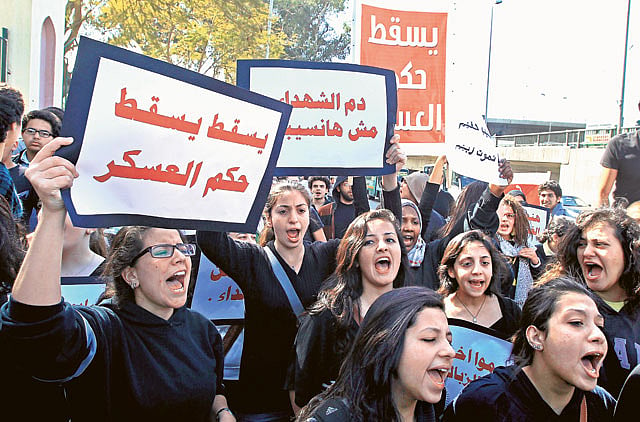
The rise of Islamists to power in the wake of the Arab Spring is causing alarm both in western circles, as well as among Gulf Cooperation Council states and secular regimes in the region. The trend is indeed clear; in Morocco, the Justice and Development Party (PJD) won 107 seats in the 395-member parliament. In Tunisia, the Islamists Al Nahda Party emerged victorious with 41 per cent of the votes. Perhaps the most ‘worrying’ success was that of the Muslim Brotherhood in Egypt. The party’s political wing, the Freedom and Justice Party, achieved a crushing victory, gaining 47 per cent of parliamentary seats.
There is no doubt that the Arab Spring has led to shuffling of the cards, placing the Islamist groups on top. But that is really about it; the cards have been shuffled, creating a new order, but the deck remains the same and the rules of the game haven’t been altered. Morocco, Tunisia and Egypt remain part of the same international landscape where the US hegemonic power stands supreme. The Islamists’ victory didn’t come as a surprise and the fact that the US has allowed them to taste the fruit of the election indicates that the US doesn’t expect any radical change to take place that would jeopardise its long-standing interests.
The basic question is how the agenda put forth by these Islamists groups differs from that of the secular ones. The answer is: not much. Long-held fears and assumptions about the destructive consequences that result from Islamists rising to power have proven largely inaccurate. This is not because those Islamists in power don’t hold radical ideas, indeed many probably do. But it is because those individuals understand that standing on the other side screaming for freedom and demanding an implementation of Islamic principles is different from actually being in power and having to somehow turn these theories to practice. The desire to obtain and retain power often outweighs ideological principles.
Fighting inequality
Indeed, there is no longer a need for speculation, the actions of the Islamists are loud and clear. The overwhelming evidence indicates that pragmatism will once again dominate, limiting ideological fervour to mere rhetoric. The PJD in Morocco has adopted safe issues, such as denouncing corruption and vowing to fight inequality, a message which doesn’t scream Islamist ideology but is frequently adopted by secular parties to harness popular support. The PJD didn’t outline its intent to impose Sharia law. Rather, it emphasised the need to cooperate with authorities in the fight against terrorism.
Similarly in Tunis, the secular constitution in place during the regime of ousted president Zine Al Abidine Bin Ali’s government will remain in force under Tunisia’s new Islamist-led government. In fact, Al Nahda leader Rashid Gannouchi highlighted the party’s intent to focus on issues pertaining to democracy, human rights and free-market economy.
The party went out of its way to assure observers that they will not be introducing Sharia or other Islamic concepts, but that religion will simply be limited to a brief reference to Islam in the first article of the constitution. This religious addition is symbolic, and has no real significance. Several western and democratic nations make a reference to God in their constitutions. These countries include Canada, Germany, Ireland, South Africa and Switzerland. And although the US federal constitution does not refer to God, the constitutions of 13 of its states do, including California, Florida and Pennsylvania.
Similarly in Egypt, there has been no declaration by members of the Freedom and Justice Party to replace secular laws with religious ones. The party has frequently emphasised its commitment to promoting women’s rights and extending equal protection to the country’s non-Muslim citizens. Sure there have been some attempts to ensure Islamist domination of the new parliament such as when Member of Parliament Mamdouh Esmail from the Salafist group made a call for prayer in the middle of a heated debate inside the chamber. But these acts are no more far-reaching than statements coming from US Republican presidential candidates.
Presidential hopeful and former Pennsylvania Senator Rick Santorum was quoted as saying “our rights come to us from our Creators.” Santorum emphasised that society has a duty to live according to God’s principles by insisting that “our civil laws have to conform with the higher power”. During the same forum held in the First Federated Church in Des Moines, Iowa, presidential candidate Newt Gingrich said the idea of having a president who doesn’t believe in God simply “terrifies” him.
The Muslim Brotherhood’s record reminds us that it is a very pragmatic organisation. Perhaps it can be best described as a political organisation that uses Islam as a campaign slogan rather than a genuinely Islamist organisation with a religious agenda.
The issue once again is how to reconcile religious teaching with the responsibilities of governing a state. The Islamists in Egypt can’t afford to experiment with turning Egypt into a religious state, and appease the public by taking bold steps. Egypt is not prepared to face international isolation and risk a termination of US aid, which it so desperately needs, in the name of ideology. The Islamist organisations didn’t promise, let alone act on, what the sceptics have long warned us of. The peace agreement with Israel remains intact, secular state institutions have not been dispensed with, ties with the ‘enemies of Islam’ have not be severed, and no action against boycotting products of the ‘infidels’ has been taken.
Any introduction of Islamic concepts in these revolutionary countries therefore will remain largely cosmetic. At worst, these changes will concentrate on social issues such as sartorial restrictions, alcohol prohibition and gender-segregated beaches — rather than on core issues. There will be no Islamic state, there will only be masses waiting to see how “Islam is the solution” promise works out in practice.
Thus far, the answer looks a lot like the one delivered under the regime of Hosni Mubarak. Instead of secular businessmen, the system is the same but with an Islamist twist, with newcomers such as the multimillionaire Khairat Al Shatar. The end result will surely be a grand disappointment for the public, which is exactly what is needed — a grass-roots Islamic organisation that successfully ascends to power, and has its chance to carry through on its promise to alter realities based on religious principles and fails. Perhaps this will finally lead the masses to stop dreaming of a religious solution to their problems, end idealisation of the past and finally drive them to look forward. Meanwhile, the signs indicate that — Islamists or not — business will proceed as usual.
Dina Khanat is a political analyst and Adjunct Professor, Humanities and Social Science, at Zayed University.
Sign up for the Daily Briefing
Get the latest news and updates straight to your inbox
Network Links
GN StoreDownload our app
© Al Nisr Publishing LLC 2026. All rights reserved.