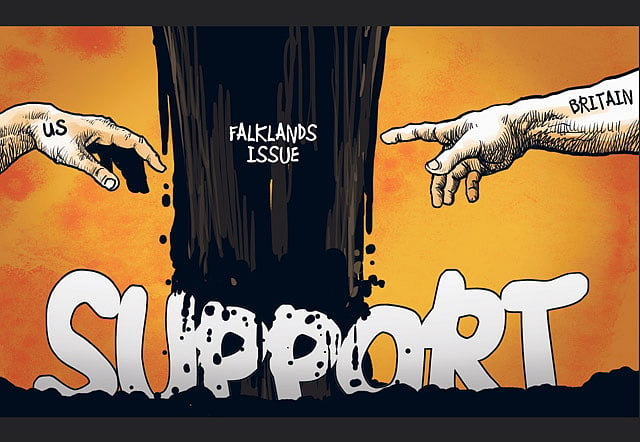
In times of trouble, it is always reassuring to think that Britain can count on Washington's support to get out of a fix. OK, so the Americans have an irritating habit of turning up late and then claiming all the glory, as was the case in the two World Wars.
However, even today, in the killing fields of southern Afghanistan, the arrival of 30,000 US Marines three years after British troops were first deployed to the region has immeasurably improved the chances of the Nato forces defeating the Taliban, as I discovered during my visit to Camp Bastion recently.
It is mainly to guarantee American support for freedoms that, alone among the major European powers, Britain has little hesitation in signing up to fight America's wars. In the past decade, more than 500 of British personnel have sacrificed their lives and thousands more suffered serious injuries in wars that were primarily of Washington's making.
From the moment Tony Blair declared that we would stand "shoulder to shoulder" with Washington in the immediate aftermath of September 11, Britain has committed its troops to places where other European powers fear to tread. In late 2001, the role played by British special forces was central to the success of the campaign against the Taliban. Two years later, an entire British division was committed to the war against Saddam Hussain. Today, Britain is the only European power prepared to contribute significant numbers of combat troops to what is supposed to be a Nato-led campaign in Afghanistan.
The argument advanced by successive British governments to justify this commitment is that in return for supporting the US in its hour of need, we can expect the same in return.
Extent of commitment
Yet, after last week's unwelcome and unnecessary intervention by Hillary Clinton, the US Secretary of State, in the latest spat over the Falkland Islands, one begins to wonder just how committed the Americans would be if Britain were to find itself seriously threatened. Would Washington be prepared to commit its military might to defend Britain's interests, or would it simply confine its response to firing a few barrages of cruise missiles? It was not that long ago that Washington was viscerally opposed to protecting any of Britain's interests. The formation of the League of Nations at the end of the First World War, with its commitment to guaranteeing the political and territorial independence of all states, was Woodrow Wilson's way of undermining the British Empire, while Britain's status as a world power to rival America finally ended with the humiliation of Suez.
Relations between the two countries have since improved, but only as long as everyone accepts that it is Washington, not London, that calls the shots. Even then, there have been occasions when it was unclear that Washington's support was guaranteed. Although Margaret Thatcher eventually won Ronald Reagan's support for Britain's liberation of the Falklands in 1982, the Americans were at first reluctant to back a campaign that had echoes of past imperial adventures and which they feared might damage their own interests in Latin America.
As John Nott, the defence secretary at the time, wrote, the Americans "were very, very far from being on our side".
Those sentiments were much in evidence last week, when Clinton took it upon herself to break off from a five-day tour of Latin America to try to ease the tensions that have once more arisen between Buenos Aires and London, this time over oil drilling rights in the South Atlantic. Cristina Fernandez de Kirchner, the Argentinian President, and her husband (and predecessor) Nestor, are known as the Clintons of South America, because of their love of the high life and their Left-leaning agenda.
While Clinton was no doubt made to feel very much at home in such a convivial environment, that does not excuse her support for Kirchner's suggestion that the Falklands issue be referred to the UN's decolonisation committee. This might be a legitimate course of action if the overwhelming majority of Falkland Islanders had decided that they no longer wanted to be British. But this is not the case. The inhabitants are immensely proud of their British heritage and have no desire to become Argentinians.
Anger
It has been suggested that the reason the Obama administration is proving reluctant to back Britain's case is anger at Britain's disclosure of sensitive intelligence files relating to the former Guantanamo detainee Binyam Mohammad and the release last year of Abdul Baset Ali Al Megrahi, the Lockerbie bomber.
But I believe this explanation is a red herring. A more likely explanation is that President Barack Obama and his advisers find it incomprehensible that, in the 21st century, Britain continues to maintain its sovereignty over a remote group of islands that lie thousands of miles from its shores.
And I fear that far from supporting their traditional ally, they will lend their support to any initiative that brings British influence in the South Atlantic to an end.
Sign up for the Daily Briefing
Get the latest news and updates straight to your inbox
Network Links
GN StoreDownload our app
© Al Nisr Publishing LLC 2026. All rights reserved.