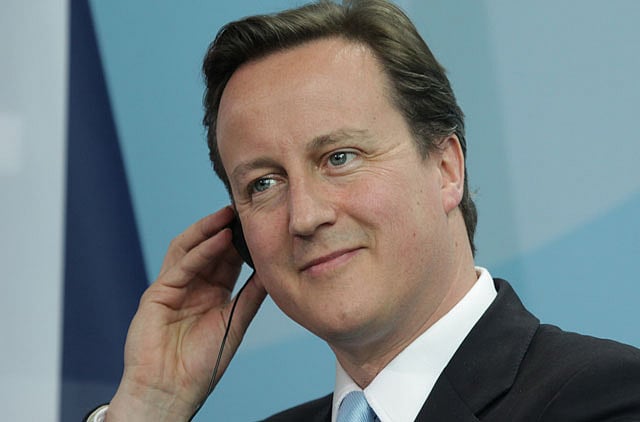
Wednesday marked the first anniversary of a minor political miracle. A year ago, British Prime Minister David Cameron stood on the doorstep of No 10 in the aftermath of former British prime minister Gordon Brown's ignominious exit, his mask of confidence disguising the uncertainty of his situation.
He had failed to win the election against a vastly unpopular prime minister battered by a crippling recession. It took a stroke of audacity to offer the Liberal Democrats concessions in exchange for a share of power, and without consulting his party. But all he had to go on was the affinity he had established with Deputy Prime Minister Nick Clegg, and his conviction that a coalition between like-minded leaders could govern effectively in the national interest. Even now, those who were involved in brokering that deal speak in tones of amazement at how quickly it was put together, and how long it has lasted.
Twelve months later, the coalition, though dented, is still intact. It has got to work on its central duty of restoring the public finances to credibility, while launching revolutions in the way public services are delivered. Its senior personnel remain in place, even if some prefer to posture. It has carried on with one war — and launched another — while presiding over sweeping cuts to the armed forces. It exudes a sense of purpose and competence that continues to withstand individual examples of incompetence or folly. While one cannot be certain that it will last until its self-imposed expiry date of 2015, there is no reason why it should not. Recent days have tested that presumption, of course. Since last Thursday's thrashing of the Liberal Democrats in local council elections, attention has focused on Clegg's travails and the likelihood of some sort of Liberal Democrat collapse that would force him from Cabinet and crash the coalition.
Privileged upbringing
The gamble of a year ago has paid off. There is a Conservative prime minister in Downing Street who, of late, sounds like a Tory. Their party confounded mid-term expectations to record outright gains in the English council elections. Cameron's personal intervention, backed by emergency City cash, delivered a decisive No against AV in the referendum on voting reform, and persuaded his party that he could be ruthless when required. It is the Chancellor George Osborne's task, as the elections strategist, to deliver a Tory majority in 2015.
Thanks to Cameron, that goal is considerably closer. With hindsight, there were plenty of clues around early on to suggest that Cameron meant business. From the very moment he walked into No 10, the prime minister approached his new role with a presumption of permanence. To begin with, he displayed that ‘born to rule' ease with his surroundings that comes from his privileged upbringing.
The Chancellor boasts of having rescued Britain from a sovereign debt crisis, but he will be measured on his ability to eliminate the deficit and restore the country to growth. Cameron cannot be certain that the Lib Dems will hold it together until 2015.
Clegg shows extraordinary resilience in the face of relentless attacks, but others around him appear near the end of their tethers. He has factored for the sudden resignation of big beasts such as Chris Huhne or Vince Cable, and is determined to keep the Coalition together at the very least until the legislation changing the parliamentary boundaries is implemented in 2013.
In the meantime, he will do anything to defend the Coalition agreement and keep the Lib Dems on board. The incentive is clear: if the share of the vote last Thursday were reproduced at a general election, Labour would be the largest party and the Tories would be out. Cameron also knows that the success of the past year has not yet been turned into a natural connection between him and the voters.
By any measure, the coalition has had an easy first year. Luck has played a part - and he is a lucky politician to have the ineffectual Ed Miliband against him - but so, too, has the determination of both he and Clegg to make it work, often in defiance of their parties. In the process they have achieved more than Blair managed in a decade. But the clear winner is Cameron, who has shown adaptability and drive, and acquired stature as a result.
—The Telegraph Group Limited, London 2011
Sign up for the Daily Briefing
Get the latest news and updates straight to your inbox
Network Links
GN StoreDownload our app
© Al Nisr Publishing LLC 2026. All rights reserved.