Science is a shared record. It is built by many countries over many decades and it does not particularly care who contributed which page. It cares only whether the page is new.
The harder question is where the missing pages are kept. For the opening chapter of the Solar System, the answer is inconvenient: mostly somewhere we cannot go
Most of what we want to know about the first few million years of the Solar System is preserved in the wrong place. It sits in the icy bodies of the Kuiper Belt, beyond Neptune, where it is cold enough to have kept intact the evidence of how water and organic material were distributed as the planets formed.
Water, methane, methanol and the organic compounds built from them survive as ice only at very low temperatures; any closer to the Sun and they boil off, the chemistry rearranging itself into something that no longer records its origins. Any material nearby that may have told this story has already been overwritten and that which remains sits in the icy bodies of the Kuiper Belt, so distant that reaching one is a commitment measured in decades. This is why so much of the early history of our own neighbourhood remains inferred rather than observed.
A page from a distant archive
269 Justitia is a page from a distant archive, misfiled somewhere we can reach. It is an asteroid, sitting in the belt between Mars and Jupiter, amid thousands of rocky objects that formed nearer the Sun and were shaped by an entirely different set of conditions. It does not look like them. It is among the reddest bodies ever observed there, and its spectrum more closely resembles the distant Kuiper population than its brethren in the main asteroid belt. It is possible that it formed in the outer Solar System, beyond the line where methane and methanol freeze, and migrated inward early in the Solar System’s history. The ice may have melted as it made its way inward, but now its surface is thought to be covered in complex organic material produced by the irradiation of that ice.
There are easier objects to study. Thousands of asteroids are better characterised, more predictable to approach, and far more likely to return a result that confirms what is already understood. Most of them would add to something we already know. 269 Justitia could settle whether outer Solar System material can be found without going all that way.
A journey to the Kuiper Belt would require a voyage of decades. Justitia is just eight years away. It is the shortcut science has been looking for: access to a class of material that has been effectively out of practical reach, on a timescale that research careers and funding cycles can accommodate.
5 billion km journey
To investigate the surface, the MBR Explorer spacecraft is scheduled to launch from Japan in March 2028. It will travel approximately five billion kilometres over eight years, using gravity assists at Venus, Earth, and Mars, and conducting close encounters with six other asteroids before arriving at Justitia.
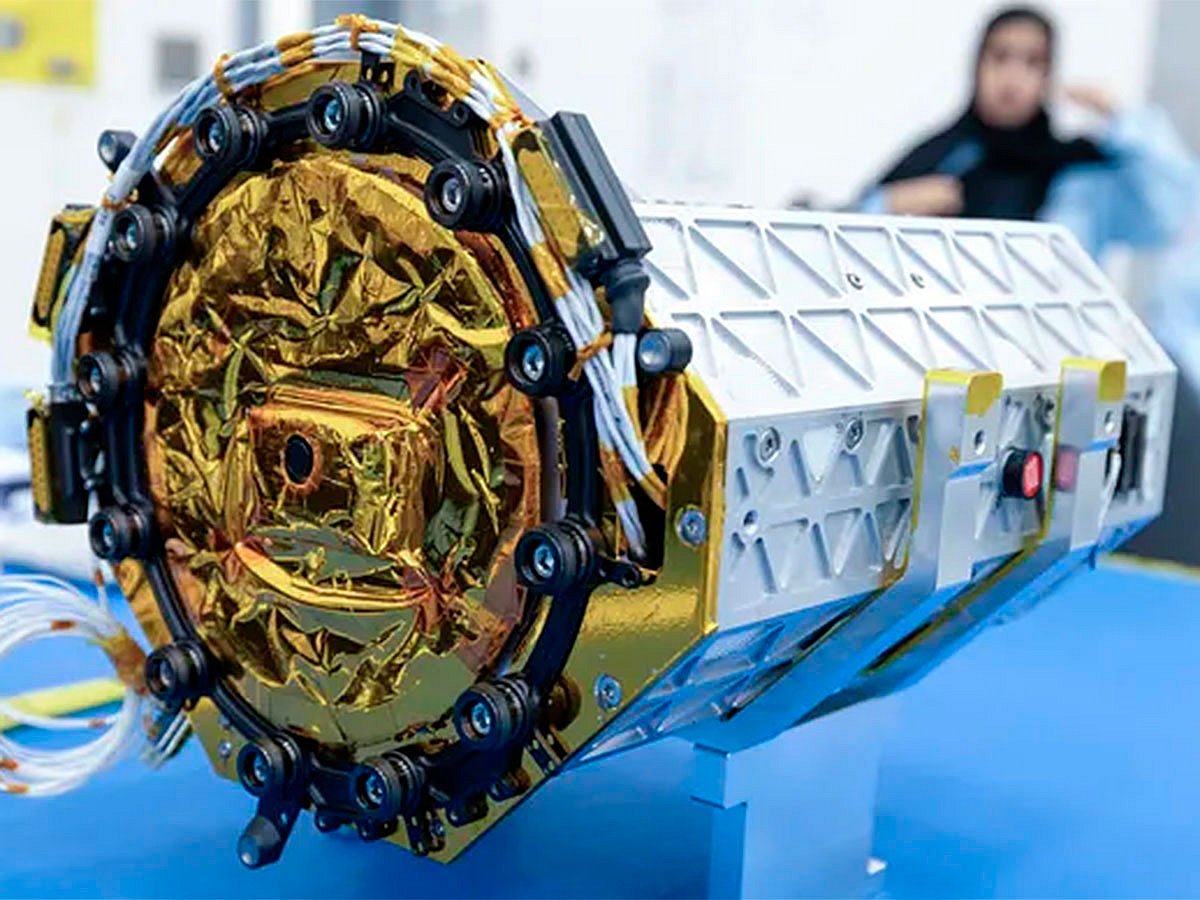
MBR Explorer is not designed to land on 269 Justitia. Instead, it carries a probe designed to separate from it. The probe is the only one of five scientific payloads built to operate independently. It will make contact with Justitia’s surface in early 2036 and return the closest observations of the campaign, operating autonomously throughout and receiving no commands after launch
Justitia may not be the only one. If outer Solar System material migrated inward once, it stands to reason other bodies may have joined it, hiding among what look like ordinary rocks. Finding them means ceasing to treat the belt as a single population and paying attention to any odd ones out, the objects whose colour or composition does not quite fit their surroundings.
Whatever is learned from such objects belongs in the shared record: published, archived openly, and available to researchers anywhere. The same logic holds well beyond asteroids. A science programme that starts from what it can already build ends up studying what is already understood. Start from the question and the instruments and the people follow, because there is no other way to get to the answer. Decide what you want to know and the rest follows.
Sooner or later, a red object that spent most of its existence somewhere else will be examined up close. That is a new page in anyone’s book.
Dr Elias Tsoutsanis is Chief Researcher, Propulsion and Space Research Centre, Technology Innovation Institute (TII)
Sign up for the Daily Briefing
Get the latest news and updates straight to your inbox
Network Links
GN StoreDownload our app
© Al Nisr Publishing LLC 2026. All rights reserved.