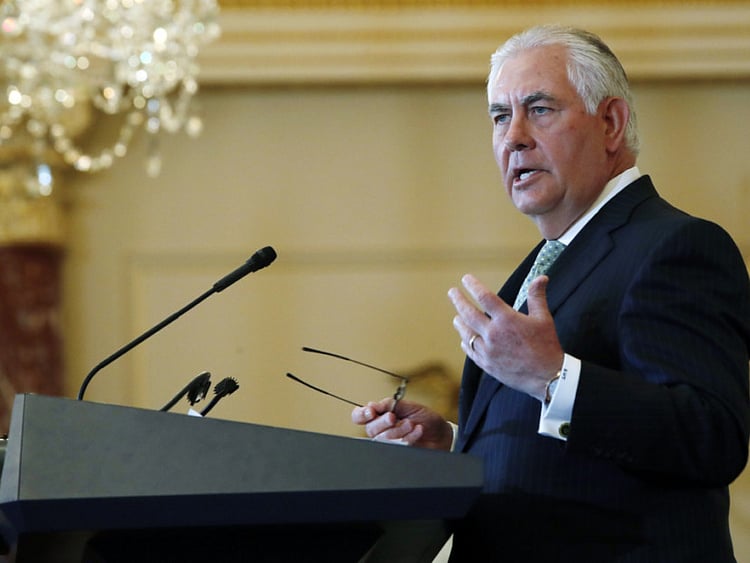
July could be a pivotal month for Donald Trump’s presidency and Rex Tillerson’s tenure as the United States Secretary of State, to say nothing of American history. Between the G20 summit in Hamburg, Germany, Trump’s highly-anticipated meeting with Russian President Vladimir Putin and a new level of threat coming from North Korea, sure-footed, knowledgeable diplomacy is in high demand and more important now than at any time since last year’s US presidential election.
Generally, I have been a fan of Tillerson. He is an adult in the room and, importantly, seems immune from all the barking that takes place in Washington. Tillerson is steady, is knowledgeable and moves at his own pace, but that pace, or the lack of a faster one, has become a source of criticism.
Washington thinks of itself as so vitally important that empty blocks in the federal bureaucracy’s organisation chart can only mean that a vital government function is not being carried out.
I have my doubts.
The truth is, the US State Department, like every other executive department, suffers from redundancies and make-work jobs. But there is such a thing as needing good people to do important jobs.
For his part, John J. Sullivan, the recently-confirmed deputy secretary of state, is getting good reviews. As per Tillerson’s instruction, Sullivan is already working to reorganise the State Department and empower the best career Foreign Service officers.
In the coming weeks, the Trump administration will soon learn whether the slow pace of filling top political appointments at the State Department is affecting the quality of America’s diplomacy and the ability to implement and communicate the United States’ foreign policy. We may be about to find out if Trump’s State Department is prepared to manage important international events and potentially historic challenges.
With the whole world watching, the G20 meeting was expected to cast in stone America’s allies’ opinions of the president and his team. It is quite likely that Putin has formed his core impression of President Trump, following their meeting on the sidelines of the G20 summit on Friday and determine whether his US counterpart is serious or if he can be easily manipulated.
And, finally, the US president will have to listen to his team’s advice on North Korea, decide on a course of action and then explain it to the rest of the world.
Nothing thus far in the Trump presidency has had such downrange consequences as any of these three events. And all eyes are on Tillerson.
Personnel matters aside, Tillerson has won the respect of key world leaders and that of Trump. Considering just how often he and the president speak, it is that much more likely that Trump will defer to his secretary of state and perhaps even suppress some of his own instincts to freelance, ad-lib or, worst of all, recklessly tweet when mature patience is required.
And yet, while Tillerson has performed effectively and maintained the confidence of the president, some of his recent interactions with others in the White House have left wounds that have yet to heal.
It remains to be seen just how long such a dichotomy can last.
So, as this week unfolds, there is a spotlight on Trump, Tillerson and the American president’s team. Much is at stake and I cannot remember a time when there was more uncertainty about the dependability and quality of America’s actions, resolve and personnel.
— Washington Post
Ed Rogers is a columnist for Washington Post.
Sign up for the Daily Briefing
Get the latest news and updates straight to your inbox
Network Links
GN StoreDownload our app
© Al Nisr Publishing LLC 2026. All rights reserved.