Meeting the professor who wants students to focus on empathy while using AI
Why ethics, empathy, humility and ability to communicate matter in a world of AI
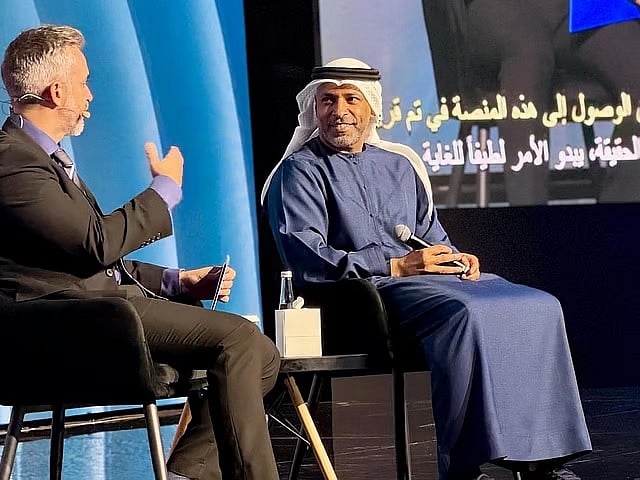
Journalists are much happier asking questions from behind a notebook than from on a stage. Give us a microphone, bright lights and a countdown clock and you will often find journalists wondering why they said yes.
I actually said yes twice at AI Everything in Abu Dhabi this week, hosting two on-stage sessions on behalf of Gulf News, which was a media partner for the cutting-edge conference.
In both sessions I was out of my depth but delighted to be in the technology deep end and frantically paddling. The guests on stage - and many of those in the crowd - are at the forefront of the AI revolution, far ahead of my dabbling with Claude and ChatGPT.
Despite this skills gap, I didn’t wonder once about saying yes as I had so many questions about what is happening in this space. Selfishly, I was also keen to find out what I should be doing to catch up.
On the way home, the conversation I kept thinking about was the one with Professor Ebrahim Al Hajri, President of Khalifa University, on how we educate the generation growing up with AI. I went in well prepared, with notes, a detailed profile, and some additional questions provided by my friend Claude (come on, I had to ask AI for an AI conference).
Early on, he told the audience that the university's in-house AI platform had cut the time lecturers and teachers spend on admin, class preparation, setting exams and grading by 60 per cent.
You could feel the room doing the mental arithmetic on their own inboxes and calendars. I certainly was. That would help me squeeze a coffee break in every now and again.
Like many, I worry about what this means for the job market, but Prof. Embrahim’s point was that the time goes back to people, so professors can do more research, spend more time with students and contribute more to society. That's a far more interesting reason to use AI than shaving a few minutes off a spreadsheet, although I’ll happily take that as a perk.
Every student at the university gets an AI assistant loaded with their course material from first year through to graduation. I pictured it as a little friend who helps to guide you through courses while also helping university staff to provide the best experience for students. It makes a lot of sense and I wish the chaotic, 18-year-old Mark had a similar tool.
As a manager in a fast-changing industry and a father of two boys, I also have concerns about how relevant education is in a world of AI. Prof. Ebrahim explained that the university starts with what the job market needs graduates to be and builds the curriculum backwards from there. It sounds obvious when you hear it. I imagine that means that we will see courses changing and adapting quickly year-to-year as the goalposts continue to move.
Near the end, I asked which skills matter most in a world full of AI. I half expected him to say something around engineering or critical thinking. He said ethics, empathy, humility and the ability to communicate with other people. I could see that he really meant it.
I found that reassuring. Machines and agents can mark papers, set agendas and pull in research. They won't notice the student at the back who is having a terrible week. Or a young person trying to find themselves as they move into adulthood.
That still needs a teacher, and on the evidence of our conversation, the teachers are about to get a lot more time to do it.
Sign up for the Daily Briefing
Get the latest news and updates straight to your inbox
Network Links
GN StoreDownload our app
© Al Nisr Publishing LLC 2026. All rights reserved.