Sabrine: On the beaten track
Enamoured with the darbuka, Sabrine swapped the corporate jungle for a more rhythmic life
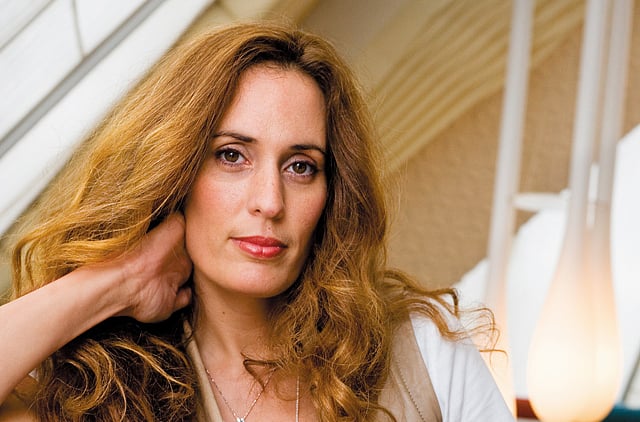
It couldn't have been a more befitting setting for our rendezvous: The eclectic shades and sounds of Persia Persia in Wafi Mall created a quaint backdrop perfectly harmonising with the tale of Sabrine's musical escapades.
Within minutes of our meeting, she perfected her bronzed hair and played the darbuka notes for our flashbulbs. Once the shots were finalised, she settled in among a pile of coloured cushions, animatedly narrating tales of her life on the darbuka track.
It's been a little over a decade since a fun trip with her musician friends to Sinai in Egypt saw her introduced to the darbuka. "It was like a retreat of sorts, where all we did was read, meditate and play music. Everyone would gather at night to play the oud and other instruments. That's when I saw the darbuka," she says. "And it was instant attraction."
She returned to Cairo, bought two drums, abandoned her high-flying corporate life and let the darbuka dictate her future. "It was difficult to give up all that I had worked for and walk in a different direction. Psychologically it was demanding. Even my parents doubted my decision." But Sabrine's struggles panned out for the better. "My parents called me crazy then, but not any more."
Sabrine claims her progress playing the darbuka was rapid, because of her sheer willpower. "I took a break from my job for a few years to practise percussion. During this phase I was introduced to Indian music and the tabla. I was fascinated by how Indian musicians practise 14 hours a day. It deeply influenced my thinking. For me, nothing else mattered but my darbuka."
Her determination held her in good stead. "I was extremely focused. I went into a zone where only music mattered. I used to look up to top musicians, hoping that I'd be able to achieve what they did."
Besides lessons from Turkish percussionist Misirli Ahmet, she was also motivated by Indian tabla maestro Zakir Hussain's fine mastery. "He's not ethnic, yet he knows his ethnicity. I also followed Bismillah Khan [Indian shehnai maestro]." Indian music has impressed her so much that she plans to travel to the country soon. "Percussion in India is in the top league. The techniques are of a higher level and they [musicians] play a whole range of rhythms, unlike anywhere else."
Despite being an ardent music lover [Bob Dylan, Dire Straits, Santana and Oum Kalsoum are some of her favourites], Sabrine's foray into the world of music was unplanned. So Darbuka Heat took shape unwittingly. "It's a result of my interactions with different musicians during journeys to different cities. That's why the record is so diverse. These are artists I knew, or the new ones I met, who liked what I did and wanted to be part of it. Each track is of a different genre and atmosphere." Since the album wasn't made in a traditional way, it took Sabrine a year and a half to produce it. "I'd do two to three songs and then take a break, travel to Turkey, meet a musician and ask if he'd like to be on the record. Even my Spanish neighbour [who is a professional singer] did a track for me."
Sabrine claims Darbuka Heat opened up a new world of music for her. "It allowed me to meet more people and engage in fusion music. There are still a lot of things I want to discover. I want to travel more and create new collaborations."
She says there was no company backingher album. "It was my first productionand I didn't know where it [Darbuka Heat] would fit, how it would be placed, or howI would sell it."
Apart from tracing her evolution as an artist, Darbuka Heat also echoes a strong message. "It's a journey about democratising the darbuka, because it's stereotyped as an instrument used for belly dances. I wanted to change that perception. I wanted to show that it can be modern and jazzy and even play Western beats."
Until the darbuka charmed Sabrine, she hadn't played any other instrument. And now she prefers to stick exclusively to the instrument.
Despite a smooth beginning, Sabrine is quick to allude to the evils of piracy. She talks at length about how it stunts the growth of new musicians. "Music is a difficult career, financially. The world is a bit unconcerned about what the artists go through, not realising that when people don't buy music, the artist starves. The younger generation remains ignorant about how their actions are killing talent and abusing music. It's a shame that a lot of popular musicians have to borrow money to live."
With a mixed bloodline, she hopes her album, "an interpretation of passsion", will be the voice of the world. "I'm half Egyptian, half French. One of my grandparents is Syrian. So, I want my music to be global."
For now, she's going to sit back, enjoy her music and wait for her record to travel the world. "I want Darbuka Heat to go out and bring back good news."
The album
Darbuka Heat can best be described as a colourful album, with variances and flavours inspired by Sabrine's travels to Egypt, Turkey, Austria, Spain and Hungary.
The album is a collection of hot darbuka beats with some of the world's most talented musicians, including Misirli Ahmet, dZihan & Kamien, Cay Taylan and Aly Fathallah. It's a collection of different genres - house, tribal, lounge, jazz and even ethnic, bound together byt he darbuka.
Released by EMI Arabia, the album is available at virgin megastores.
Did you know?
The darbuka is also known as a doumbek, dumbelek, derbocka and darabukka. This goblet-shaped hand drum is a prominent percussion instrument in the Middle East.
Sign up for the Daily Briefing
Get the latest news and updates straight to your inbox
Network Links
GN StoreDownload our app
© Al Nisr Publishing LLC 2026. All rights reserved.