Richard Cartwright, with his wife Penny.
Posters in Abu Dhabi: Shop owner shares his 50-year story of making people smile
Richard Cartwright, the owner of Posters, shares his journey with us
Last updated:
8 MIN READ
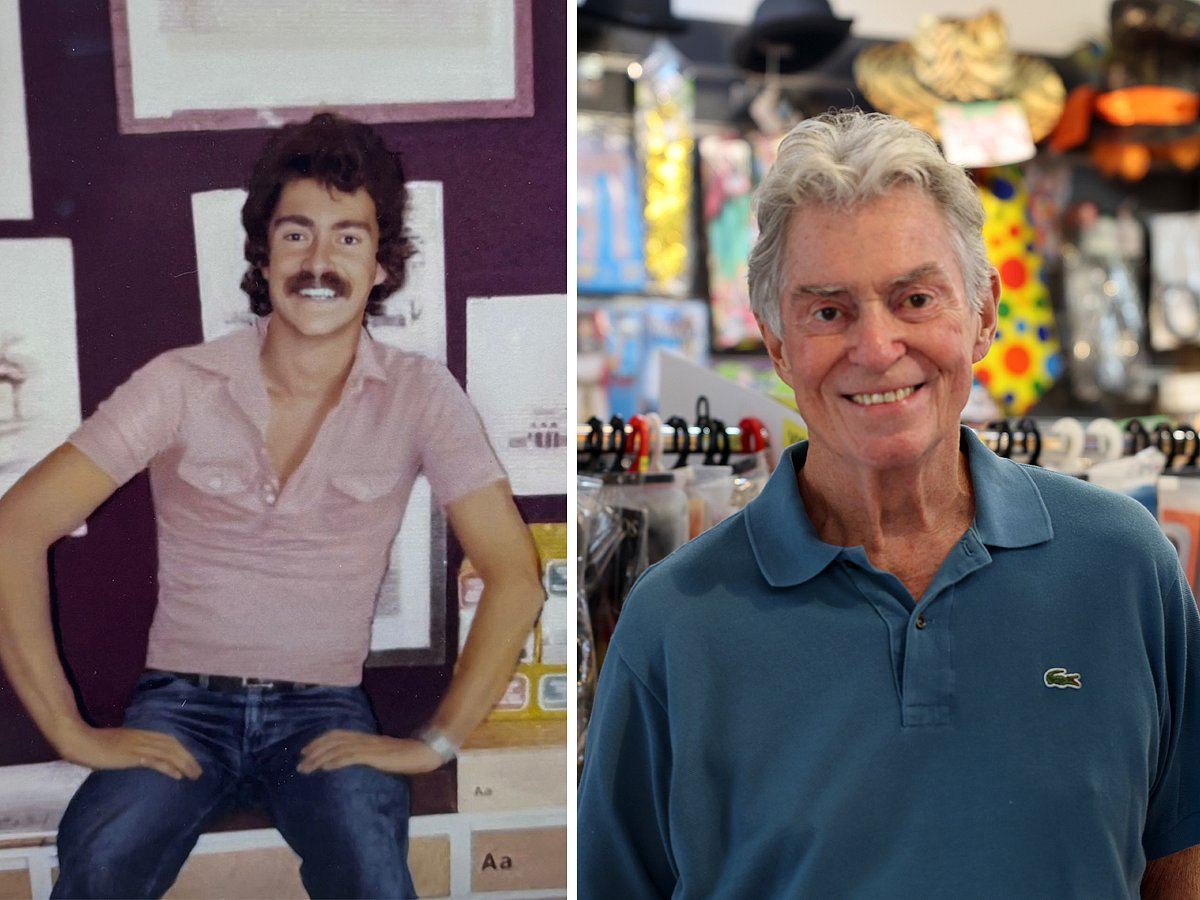
Richard Cartwright, the owner of the Posters shop in Abu Dhabi.
Richard Cartwright has a quiet sense of humour.
It is sprinkled lightly through his conversations and stories, and yet you find yourself unable to stop smiling. Soft-spoken and gentle, the owner of Abu Dhabi’s sturdy Posters doesn’t mind taking playful jibes, mostly at himself. It could be something as simple as recalling a pitch to an agency and describing himself as 'someone who wore roller skates' at the time, or making a cow sitting in front of a shop just as entertaining.
This clear-eyed humour isn’t conscious or by design, and it’s this special quality that wafts through his shop as well. Nothing ever tries too hard, yet you can feel the gentle touches of an old, childlike wonder. My assortment of curious knick-knacks that include quirky coasters with rhymes, One Piece Mug and a puzzle would agree. Behind us, ghoulish masks lurk, along with a box of ‘treasure’, and games like Monopoly, promise a return.
It all spells joy, fun and a quaint vibrancy, and that’s what the Cartwrights have been building for past 50 years.
After climbing the winding staircase of Posters, we sit and Cartwright shares his story.
He’s a storyteller, even if he might not agree. Every incident he recounts carries hidden chuckles, echoes of laughter from years gone by.
Before Posters, before the posters
It has been a pleasure, he observes. He arrived in 1975, as a designer, working for a local company.
The shop didn’t come first. A graphic designer by training, Cartwright joined another company that wasn’t strictly design at all, but an antique shop. He was sponsored at the time, and they began doing small amounts of design work, little by little. It was a slightly difficult existence, he admits—earning just enough to eat well. “Suffered a little bit,” he notes.
Cartwright arrived in 1975, as a designer, working for a local company.
Discovering Letraset — and a lucky accident
While working in design, he noticed a major gap: they didn’t have Letraset, the dry-transfer lettering sheets designers relied on before computers to compose headlines and layouts by hand. So he travelled to England to pitch for the agency.
“They said they’d never seen anyone as ridiculous as me — I had roller skates on at the time, so I wasn’t very professional,” Cartwright recalls. Eventually, representatives from Letraset came to the UAE. At first, they made it clear they didn’t usually appoint agents in the region. But after discussions, Cartwright secured the agency, and soon opened a shop on Electra Road selling graphic art materials.
As Letraset was one of the most essential tools for designers at the time, other graphic materials companies quickly followed. “They started chasing me to be their agent,” he says. “I was a bit shocked by that.”
Cartwright walking through Posters, in Abu Dhabi.
‘It all came together'
Cartwright remains modest. He doesn’t believe that there was a master plan as such or that there was anything particularly clever or intelligent in what they had achieved, it all fell into place with a little bit of luck.
Well, like the song from My Fair Lady would agree, with a little bit of luck, you can run amok.
And in his own way, he did, quietly carrying on for over five decades. “We had the shop, so people used to come in and ask us to do design work, and we would do a lot more design work in the shop. We had a flat above the shop and we did more design there.”
We were famous for fun. And that’s what we were doing. Selling fun.”
The joy of the silly and the strange
It was around the time he met his wife, Penny, that they had a realisation, what Cartwright calls the ‘White Wall’ syndrome. As he explains it, people would arrive in Abu Dhabi, move into a flat, and be met with nothing but white walls. And if you tried to hang a picture, it simply disappeared into the blankness. “They were just introducing posters as an art form in England at that time and artists were then either making posters to advertise exhibitions or making posters to make the artist more famous.”
So, these art posters took off, and they started to do them and then they opened up another shop called Posters.
Here, they started doing picture framing and cards. “We were sort of enjoying it. I was enjoying it more than the graphic art materials. And what did we do next? With the posters and things, we were enjoying it so much. I actually found when we're selling sticky letters it's boring really,” he says.
There was magic in the silly, kooky and fun. The world always needs it.
And Cartwright wanted to build on the idea. “We started going to some trade shows in England and we started buying fun things or silly things or crazy things and I loved it,” he says, adding that they just began buying unusual things to make life fun. “We were famous for fun. And that’s what we were doing. Selling fun.”
Fun finds its footing
Indeed, they breathed joy and amusement.
Gradually, Posters began turning into a shop of gifts and novelties. It was the best time, as Cartwright says. And gradually, another idea bloomed.
The fancy dress.
“As fancy dress was very American, it hadn’t taken off here. But somehow, it fitted in. Halloween fitted in well, especially for those after a very hot summer and everybody is exhausted. Halloween came along, and it was the official time for a party.”
They imported the costumes in. “It was easy. It was so easy and we were doing so well, but then everybody else thought that it’s easy, and so they did the same thing.” Other companies started following suit, which Cartwright waves as ‘it’s what happens in life’. “You can take it as a compliment or you can take it as a bit of a nuisance.”
As I try to earnestly note the timelines of Posters, he breaks it down the dates of the branches. They began in 1982, and in 1992 they opened the current Abu Dhabi branch, and closed the first. In 2003, they began opening in the malls. The first one was Al Wata and then Dalma, Mushrif and then Deerfield. “And we also had another small framing shop. So at the peak we had six shops and then we gradually started to close them down.”
Always room for one more idea
No doubt, keeping up a photo-framing shop filled with posters and joy for over 45 years isn’t easy. Competitors everywhere. So, how does he keep up with competition? “Well, I don’t know whether I really do keep up with competition. Well, I mean, I keep my eyes open.”
There’s something that will always inspire him, he knows that. “Next week, I’ll go to a trade show in England, just to enjoy the cold weather. But I think that maybe, I might get inspired by something. Usually, I find something and think this might change everything.”
He likes work. “And if I didn't work, I don't know what I'd do. I suppose go on holiday?” He muses. Yet as he points out, if you go on holiday all the time, you get bored with holidays.
There’s something more exciting when he goes to work. “I'll see if I can find something a bit interesting. And if so, maybe we can change posters a little bit with something, with a new kind of idea that nobody else has.”
Maybe he will miss it, or maybe, it will be a useless idea, he reflects. But we won’t stop trying. “We will try to find something new.”
His dedication isn’t just to ideas; it’s to the people who have walked through his doors over the decades.
Generations of loyal customers
A brand that has lasted so long has welcomed generations of loyal customers. “We have had some lovely customers that come and go,” he reveals. He doesn’t want to share too much as he frankly explains that he feels a ‘bit like a doctor and some things that should be kept private’.
But he does share a few secrets with us: He recalls in the earlier days, how they would sell items such as stink bombs. “And I think some of the kids did things like took stink bombs to school. They closed the school for a day, which is very naughty. People come back and tell. I didn't know that at the time,” he chuckles slightly.
A cow roaming in front of Trett Seeker, Cartwright's first job in the UAE.
Abu Dhabi as it once was
He loved it then, and loves it just as much now. Back in the 1980s, he remembers Abu Dhabi as just an island, where animals roamed freely, like cows, camels and goats. He shows me a photo of a cow sitting in front of the shop, back then. “Cows used to come and feed off the rubbish bins in the evening,” he remembers.
Sometimes, if you walked off the streets, you would just be greeted by sand and little houses. “The old Abu Dhabi was truly lovely…we just had a few main roads. And in the early days, when Penny came along and we had children, we would take the children out. You would push the pushchair along, but there are no pavements, and you would be pushing through the sand,” he remembers.
When you’ve lived in a place for so long, you don’t really notice when it all changes. It shifts slightly, little by little, and before you know it, the sand vanishes and you’re in a metropolis, as Cartwright reflects. You know, things do change and we go along with them. Yet he also sees the beauty in it, the joy of living among so many different nationalities, and the richness of a city that continues to grow.
Even as the city changed, memories remained. And Cartwright has memories of boating along in Sadiyaat. A time, when they would pack up tents and take big speakers. There would be a small bonfire. There would be music, and they would be dancing and happy. “We were in paradise. We were free, and in those days, you could go to any island. Nobody would ever think about anything. “
Network Links
GN StoreAbout Gulf NewsTerms & ConditionsReach by GNSitemapContact usPrivacy PolicyGN FocusHave your sayWork with usAdvertise with usGulf News epaperPrinting Services
Download our app
© Al Nisr Publishing LLC 2026. All rights reserved.