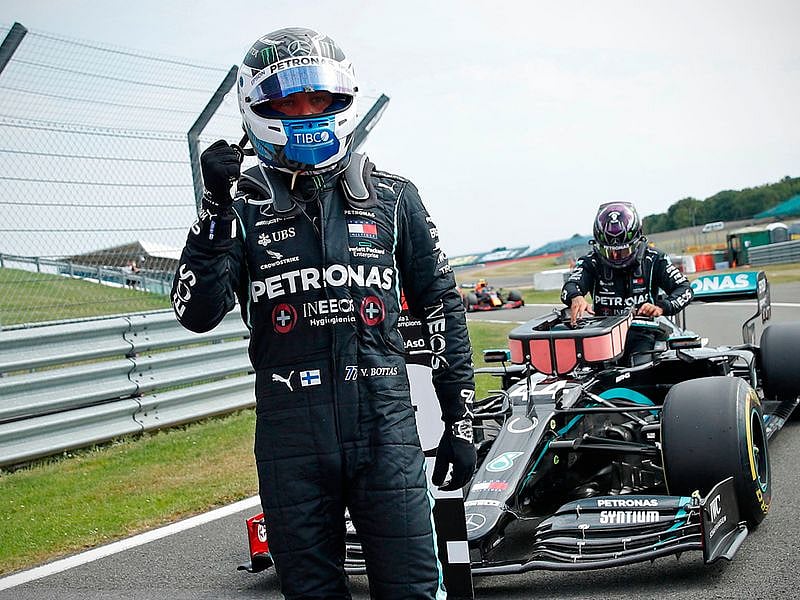
Ferrari's British driver Lewis Hamilton gives a thumbs up prior to the Formula One Hungarian Grand Prix at the Hungaroring racetrack in Mogyorod near Budapest, Hungary, on July 26, 2026.
From Benetton to Gucci: How fashion raced into Formula 1
Long before the paddock became a runway, fashion had been seeping into F1
Last updated:
7 MIN READ
AFP
To be a racing driver, you had to fit a certain shape: go to bed at 10 PM, dress a certain way, Lewis Hamilton once told Esquire. And, after years of arriving at the circuit in team kit, he had a more pointed complaint: “For most of my career, every driver arrived in team kits designed by people outside of fashion; the clothes were horrendous.”
Hamilton had had enough. Wearing the same team clothes for much of the season, he said, made him feel terrible. So he asked if he could arrive at the track in his own clothes and change into his team kit later.
The answer, initially, was no.
So Hamilton pushed back.
“It took a long time to get the bosses to agree. I basically had to break the rules,” he said. Eventually, tired of waiting for permission, he just turned up at the paddock in his own clothes.
And just like that, the team kit had competition.
Today, the journey from the paddock gates to the garage is practically a fashion event in itself. Drivers arrive in designer looks, luxury brands court them, fans dissect their outfits and photographers are just as interested in what happens before the race as they are once the lights go out.
So, long before the paddock became a runway, fashion had already been mooring through Formula 1's history, from a clothing brand that bought its own team to designer collaborations, luxury partnerships and drivers who have become as recognisable for their wardrobes as their racecraft.
The difference now is scale.
So here's the truth: The paddock remains a sporting arena, naturally. But it is also a celebrity hotspot, a luxury showroom and, increasingly, a runway with a very fast car park.
So how did fashion and Formula 1 go from a few logos on a racing suit to one of motorsport's most glamorous partnerships?
First came the racing suit. Then came James Hunt.
According to Formula 1.com, in the early years, clothing was primarily about survival. Racing suits needed to protect drivers from fire, heat and the considerable dangers of hurtling around a circuit at terrifying speeds.
Style was, understandably, not the first concern. Yet, as F1's influence expanded, the drivers were becoming stars, of a different kind. And this power to take outfits seriously, was seen in James Hunt.
As the portal Russh notes, James Hunt was the anti-uniform driver. He enjoyed the scruffy, rebellious look. T shirt, jeans, the undone attitude, and the sort of effortless cool that deserved years of think pieces.
Yet he drove a point home: The driver was the brand. There's more power to him, than just the person inside the car. And then along came his then-wife, Suzy Hunt, who brought her own touch of glamour to the races. Polished style, tailored dresses: It all helped establish the Grand Prix as a destination for fashion as much as motorsport.
Together, they helped put forth the idea: If you are going to be seen at an F1 race, you might as well be seen properly.
Benetton and the logos
Hunt proved that a driver could become a fashion statement. Benetton went one step further: it made the fashion brand itself the star.
Benetton first arrived as a sponsor in the early 1980s before buying the Toleman team in 1985. When Benetton Formula took to the grid in 1986, fashion had officially moved from the sponsor boards into the team garage.
Under team principal Flavio Briatore, the team grew into a championship contender, with Michael Schumacher winning back-to-back Drivers' Championships in 1994 and 1995.
The idea: A fashion brand did not have to be a spectator in Formula 1.
Benetton had proved that a fashion brand could move from the sponsor board to the team garage. Nike had a different idea.
Why stop at dressing the driver when you could turn his feet into a collector's item?
When Nike gave Michael Schumacher a sneaker moment
By the 1990s, the relationship between sport and sneakers was already becoming a global phenomenon. Nike had helped turn athletes into cultural icons, and Formula 1 was increasingly interested in the same crossover. And that's where Michael Schumacher entered.
After joining Ferrari in 1996, Schumacher partnered with Nike, which supplied his custom racing footwear. The collaboration eventually produced the Air Zoom Schu, a limited-edition sneaker featuring a carbon-fibre sole and details associated with the seven-time world champion.
It was a distinctly 1990s idea: Take the footwear of an elite athlete, add a dash of technology and turn it into something fans could covet.
Formula 1 had found its sneaker culture.
Ayrton Senna, Sergio Tacchini and the original sportswear crossover
Long before tennis players became fashion ambassadors and athletes routinely appeared in luxury campaigns, Sergio Tacchini was already exploring the space between sportswear and Formula 1.
According to Formula 1, In 1984, the Italian brand partnered with Toleman, the team for which a young Ayrton Senna was making his F1 debut. The brand appeared on the teamwear and Senna's helmet, but it was his performance at the Monaco Grand Prix that made the association particularly memorable.
Starting 13th on the grid in torrential rain, Senna charged through the field to finish second. The race became one of the early chapters in the story of how he proved his mettle.
Sergio Tacchini, meanwhile, had found itself attached to one of the sport's most iconic emerging stars.
It was an early example of something that now seems obvious: The right driver can turn a brand partnership into cultural history.
German Ferrari driver Michael Schumacher talks with his team director Jean Todt (R) on the pitwall during the first free practice session, April 30, 1999 at the Imola racetrack, two days before the 19th San Marino Grand Prix.
The paddock becomes the runway
For decades, team clothing was largely about team clothing. Drivers wore uniforms. Sponsors got their logos. Everyone went home.
Today, the modern F1 driver can be an athlete, celebrity, influencer, brand ambassador and fashion personality before breakfast. And few have done more to accelerate that transformation than Lewis Hamilton.
By 2010, Hamilton was already moving beyond the standard driver wardrobe, bringing tailored pieces, fitted blazers and designer denim into his off-track style.
According to notes from Grazia, Hamilton's style is difficult to put in one box, which is precisely the point. Streetwear's slouch, luxury's polish, sharp tailoring and the occasional theatrical flourish all make an appearance. But his best looks tell stories.
At the 2025 Met Gala, for instance, he wore an all-white look designed by Grace Wales Bonner and embellished with cowrie shells, drawing on their associations with spiritual protection in African culture. At Abu Dhabi Grand Prix, meanwhile, his outfits appeared to chart a more personal transition: white looks gradually giving way to Ferrari's unmistakable rosso corsa red as he prepared to leave Mercedes for his new chapter with Ferrari.
And so, Hamilton has become as recognisable in a designer look as he is in a racing suit. These days, fans may be just as invested in the question of what he is wearing as they are in what he is driving, as Vogue Business once noted.
And Hamilton is far from alone. Drivers such as Charles Leclerc have become fixtures of the luxury and celebrity ecosystem, while the global popularity of Netflix's Drive to Survive has introduced the personalities of Formula 1 to audiences who may previously have struggled to tell a pit stop from a pit lane.
The result: Fans are now watching the paddock as closely as the track.
Sometimes, the most important question before lights out is not who has pole position.
It is: who is wearing what?
And fashion, naturally, has noticed. So, once the drivers became brands in their own right, the sport's relationship with fashion was bound to become bigger, bolder and considerably more expensive.
Luxury brands and the sport
The modern F1-fashion relationship has moved well beyond a logo on a racing suit. Luxury houses and fashion labels are no longer content to simply watch from the sponsor boards. They want a place in the garage, a collection in the shops and, increasingly, a starring role in the sport's identity.
Ferrari has developed its own fashion division, Ferrari Style, taking the racing marque into the luxury lifestyle space. Aston Martin has worked with Tom Ford on custom team clothing, while other partnerships have brought luxury watches, technical apparel and designer collaborations into the paddock.
McLaren has released collections with Reiss, while Perfect Moment has collaborated with the BWT Alpine Formula One Team.
And then there is Louis Vuitton, which became the official partner of the Formula 1 Louis Vuitton Monaco Grand Prix in 2026, a partnership that feels almost inevitable given the race's long-standing reputation for glamour.
Fashion, also wants the asthetic. And that's where, Chanel enters.
Chanel understood the assignment
Chanel's 2023 Cruise collection offered one of the clearest examples of Formula 1's influence on fashion. The collection played with racing references, including T-shirts, boilersuits and a striking racing helmet bag.
It was not a literal copy of a racing uniform, as that would be too easy. Instead, it took the visual language of motorsport, speed, machinery, protective gear and the thrill of the track, and translated it into luxury fashion.
From the track to the catwalk
Fashion has been borrowing from motorsport for years, with racing-inspired silhouettes, technical fabrics, bold stripes, leather, jumpsuits and aerodynamic shapes repeatedly appearing on runways.
Louis Vuitton has returned to racing references across multiple collections, while Balenciaga has played with the visual language of speed, machinery and futuristic performance wear.
Elsewhere, designers have taken the idea more literally. New Zealand designer Wynn Hamlyn staged a Spring/Summer 2024 show at a go-karting track, bringing motorsport into the setting as well as the clothes.
Gucci enters the scene
From the 2027 season, Gucci is set to become the title sponsor of Alpine, marking a major step in the relationship between luxury fashion and Formula 1. Unlike a traditional partnership involving a logo or a capsule collection, this deal places a fashion house at the very heart of a team's identity.
The partnership is expected to influence Alpine's visual world, with the team's pink palette potentially making way for Gucci's familiar green, red and gold colour language and signature striping.
It is a striking prospect: a Formula 1 car that could look less like a traditional racing machine and more like a luxury fashion campaign travelling at 200 miles per hour.
Ferrari's move into fashion in 2021 helped demonstrate that a racing marque could build a serious luxury clothing business.
Sign up for the Daily Briefing
Get the latest news and updates straight to your inbox
Network Links
GN StoreAbout Gulf NewsTerms & ConditionsReach by GNSitemapContact usPrivacy PolicyGN FocusHave your sayWork with usAdvertise with usGulf News epaperPrinting Services
Download our app
© Al Nisr Publishing LLC 2026. All rights reserved.