Art Dubai in 2017, installation by Rana Begum, Colourful Geometric Minimalism Causes A Stir
20 years of Art Dubai: How the fair became the foundation of Dubai's cultural identity
From galleries to global artists, Art Dubai’s influence now stretches far beyond the fair
Last updated:
5 MIN READ
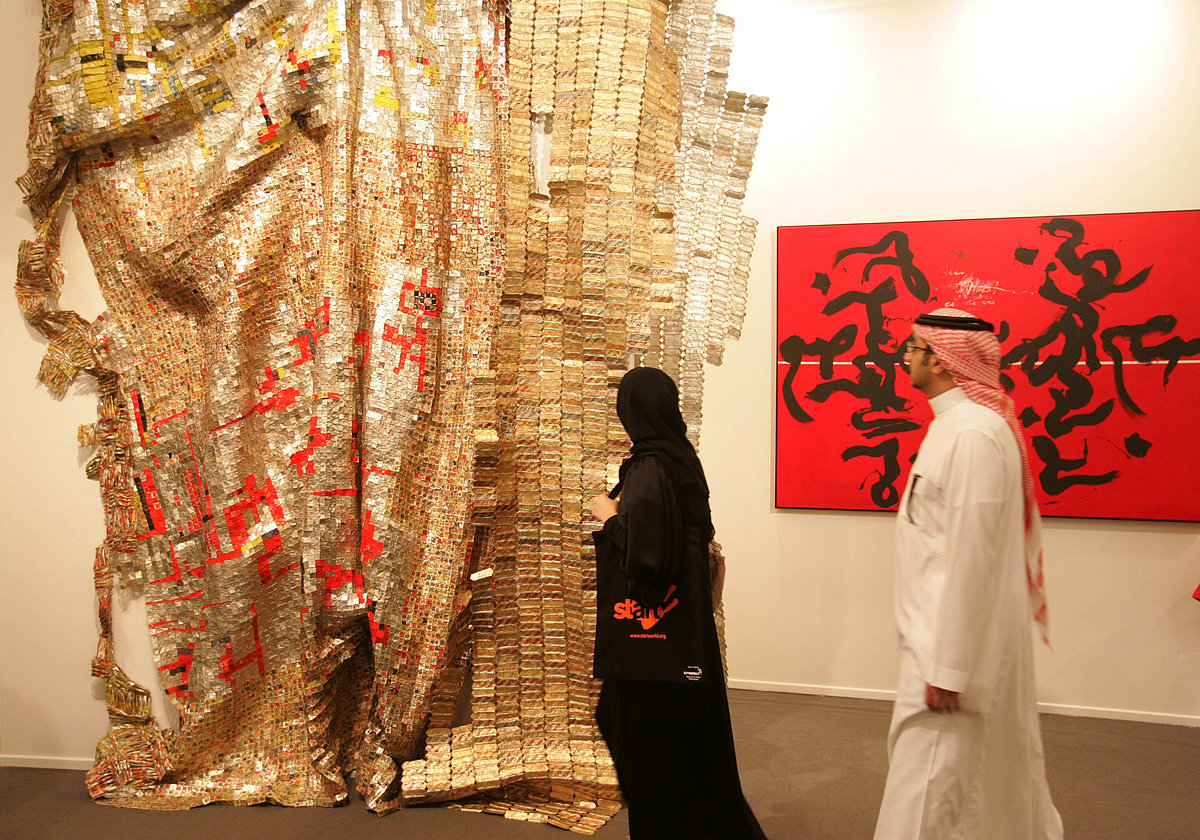
Visitors check out art displayed at Art Dubai in 2011, which has become a leading contemporary art fair for collectors artist and professionals from the Middle East,
Gulf News archives
Dubai: When Art Dubai launched in 2007, there were around 10 commercial galleries in Dubai. Today, there are more than 40. That number alone tells part of the story, but only part of it.
This year, as the fair returns for its 20th edition from May 15 to 17, the conversation has shifted. It is no longer about what Art Dubai is, but about what it has built, and what two decades of deliberate, sustained investment in culture leaves behind.
From annual event to year-round institution
"The most defining shift is that Art Dubai grew from being an annual fair into part of the city's year-round cultural infrastructure," says Benedetta Ghione, Executive Director of Art Dubai Group.
Benedetta Ghione, Executive Director of Art Dubai Group.
"That has been a series of conscious decisions made over time, to invest in commissioning, education, research and public programming alongside the commercial fair, and to keep extending that work outward into the city."
Some of the most significant careers in contemporary art today have a chapter that begins at Art Dubai.
Wael Shawky won the Abraaj Group Art Prize at the fair in 2012. Ruangrupa, the Indonesian collective that would later curate Documenta 15, was introduced through the Marker section in 2011. Yto Barrada showed at Art Dubai Commissions in 2012 and is representing France at this year's Venice Biennale. The GCC artist collective, whose members include Fatima Al Qadiri, Monira Al Qadiri and Amal Khalaf, came together in the fair's VIP room in 2013.
Art Dubai in 2019, Muted Lion Dance by Samson Young
"Two decades of moving the needle is a sustained build of careers, programmes and patronage that have solidified Dubai's place in the global art world," Ghione says.
A community gathering, not just a fair
The 20th edition arrives at a complex moment for the region, but Dunja Gottweis, Director of Art Dubai Fair, is clear that the response has been to lean into community rather than retreat from it.
"This special edition is, above all, a testament to what 20 years of building can do," she says. "The heartbeat of this edition is the continued belief that coming together still matters, especially now."
Dunja Gottweis, Director of Art Dubai Fair
Around 60 per cent of the gallery programme comes from the region, a figure that surprises some first-time visitors but captures precisely what the fair has always stood for.
Long-standing exhibitors sit alongside first-time participants, and the result is a programme that feels grounded without being fixed.
Among the most powerful threads running through this year's edition is the presence of Palestinian artists, including Nabil Anani, Mohammed Al Hawajri and Dima Srouji, whose work addresses land, identity and memory with urgency and depth.
The Third Line by Farah Al Qasimi, Swimming Pool (Michigan), 2024
The digital presentations have also evolved. Where earlier editions were dominated by screen-based work, this year artists are using technology to create physical, sensory experiences.
Daniel Iregui presents interactive works driven by real-time tracking and directional sound, while Siddhartha Kunti translates the scent of oud into a digital-physical artwork through molecular science and 3D modelling.
Lilia Ben Salah_Amal Abdenour, 1931-2020, Maman ne pleure pas ! je suis bien ! 1974-79, electrographie, 41 x 93 cm.
What to see and who to watch
For first-time visitors, Gottweis points to a programme that rewards curiosity and time. Emirati artist Hashel Al Lamki, presented by Tabari Artspace, brings an installation created in collaboration with artisans across Mallorca, Kerala and Cairo.
Hashel Al Lamki, Maat, presented by Tabari Artspace
Roudhah Al Mazrouei, presented by Taymour Grahne Projects, brings new works spanning painting, film, sculpture and printmaking. "That is where Art Dubai is most itself," Gottweis says, "in the meeting point between the established and the emerging, the local and the international, the artwork and the conversation around it."
Taymour Grahne Projects presents Roudhah Al Mazrouei, The Rest I_2025, Oil on Canvas
Reshaping the experience of the fair
That sense of the fair as a gathering rather than just a marketplace runs through the work of Alexie Glass-Kantor, Executive Director Curatorial at Art Dubai Group, whose programming this year has actively reshaped how visitors move through and experience the fair.
Alexie Glass-Kantor, Executive Director Curatorial at Art Dubai Group
The collaboration with Alserkal Avenue produced Moving, a co-curated moving image programme bringing together 13 artists working across experimental film, animation, documentary and poetics, presented both at Alserkal Avenue and within the fair's Cinema Majlis.
"What interested us was the possibility that audiences could encounter the works differently in each setting," Glass-Kantor explains, "perhaps pausing briefly while moving through the city, or sitting for an extended period within the fair itself."
Factory Drain art work by Thomas Zipp at Art Dubai 2017.
The installations across the fair grounds extend this further. Ahmed and Rashid bin Shabib's Manameh pavilion draws on Gulf architectural traditions to create a contemporary meeting space at the fair's centre, while Khalid Al Banna's large-scale geometric sculptures transform how visitors navigate the site entirely.
Hashel Al Lamki's Maat, suspended above the gallery halls and transforming reclaimed textiles and natural pigments into an environment shaped by light and material memory, is among the most visually arresting works in the programme.
Art Dubai 2023, Gallery Halls
Get updated faster and for FREE: Download the Gulf News app now - simply click here.
Building what comes next
The curatorial framework for this edition, "things we do together", emerged, Glass-Kantor says, not from the anniversary itself but from what the anniversary clarified.
"I don't think the anniversary has made us nostalgic. If anything, it has sharpened the sense of responsibility around what Art Dubai can continue to become."
Art Dubai 2024, Debashish Paul by Art Dubai Commission 2024
Ghione echoes that forward momentum. "Success looks like a maturing gallery ecosystem, a rapidly expanding collector base, and a year-round cultural environment the fair anchors," she says.
"Art Dubai will continue to build the conditions that allow culture to thrive, because that is what cities that endure are made of."
Twenty years in, that project is very much still underway.
Art Dubai 2024, Installation
Network Links
GN StoreAbout Gulf NewsTerms & ConditionsReach by GNSitemapContact usPrivacy PolicyGN FocusHave your sayWork with usAdvertise with usGulf News epaperPrinting Services
Download our app
© Al Nisr Publishing LLC 2026. All rights reserved.