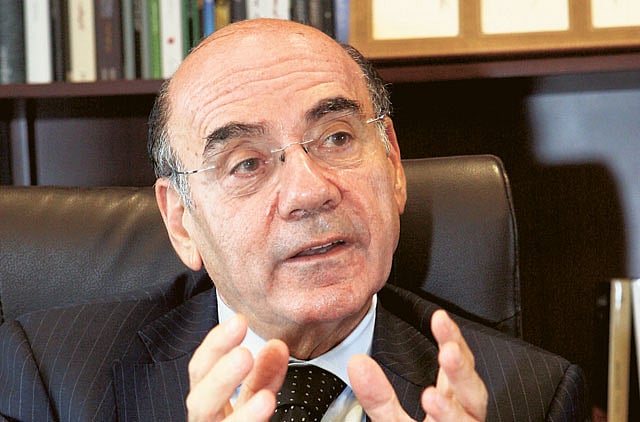
Abu Dhabi: The beginning was a miraculous creation, a miraculous birth that brought into being the United Arab Emirates, says a man who has lived through the country's history.
Having lived in the UAE well before the Federation and having worked for more than 30 years as an interpreter for the founder of the country, the late Shaikh Zayed Bin Sultan Al Nahyan, Zaki Nussaibah, Vice-Chairman of Abu Dhabi Authority for Culture and Heritage and Adviser at Ministry of Presidential Affairs, shares his memories with Gulf News.
Nussaibah said his life in Abu Dhabi started after Jerusalem, his home town, was occupied by Israeli forces in 1967 and war broke out.
The young Nussaibah then had just finished education in England but could not go back home because of the occupation.
Small village
In the 1960s, Abu Dhabi was a small village with simple houses, no roads, and no power. Nussaibah lived in a prefabricated room in one of the camps owned by a family member, who had a company. They had a power generator for electricity. "When it rained the camps got flooded," he said.
"I remember the small fishing village that I came to, you drove over tracks of sand everywhere, there was very little urban development. Driving to Dubai from Al Ain was an adventure. If you strayed from the rest, you were stuck in sand. Remembering the community that was around then. It was a unique experience. It gave off a kindness.
Every 10 years, it was as if you were passing through a new phase and you have the feeling that you're moving from one level to another, so that in 10 years you see yourself in a totally new environment.
"Looking around you and seeing Abu Dhabi as it is today, the fact that all of this happened is in itself miraculous. But at the same time, to be able to go down to Al Ain and still see the traditions and characteristics of the soul of the Emirates preserved in its oases [is also miraculous].
Characteristics
"If you go to a Majlis of the Shaikhs, you see that the characteristics of what it is to be Emirati are still there. The hope is that as we go further into the twenty-first century, this harmony remains. Rapid modernisation is required as we live in a global village, in a world of technology. So you cannot live isolated in this community and hope to survive for long. But at the same time we need to retain the purity, the nobility that helps make up the Emirati character."
The father of three, who spent many years accompanying the late Shaikh Zayed on foreign trips, says it's very important as we celebrate the 40th anniversary of the establishment of the federation to look back to remember where it all started.
"I always like to think of the first 40 years of the federation's life as the foundation years. Throughout the early part of the twentieth century the Emirates passed through rough economic and social conditions since it emerged on the world scene in 1971.
"The need was to create a political structure that was viable within two or three years. And that was, in the eyes of all observers, a miraculous creation that brought into being this new state, the United Arab Emirates. The partnership Shaikh Zayed was able to establish with his brothers, the rulers of the Emirates like the late Shaikh Rashid Bin Saeed Al Maktoum [was remarkable]. Shaikh Zayed, the visionary, the leader with the wider humanist vision of the region and the word, and Shaikh Rashid, the pragmatist, the person who wanted to see concrete results, came together to make this success possible.
On what were the major tasks that the federation faced, Nussaibah said there were two different processes that had to be started together. "The first was the physical building of the state. We are talking about seven emirates that did not have roads, airports, harbours, schools, hospitals, government structures, police, and the army.
Gigantic task
"That was one major task, and it was a gigantic task. This went through different stages, and passed through different crises when the Emirates started working with each other, remembering that each Emirate was used to being a kind of sovereign running of its own affairs.
"Shaikh Zayed's genius in leadership was to say that each Emirate should retain what it had as sovereign will in its internal development; and at the same time to come together in areas that had to be federated to make sense on the union, that is foreign affairs, security, police force, army, education and health."
Sign up for the Daily Briefing
Get the latest news and updates straight to your inbox
Network Links
GN StoreDownload our app
© Al Nisr Publishing LLC 2026. All rights reserved.