Hockey India's hundred marks turning point
Legends of the game reflect on an unmatched legacy
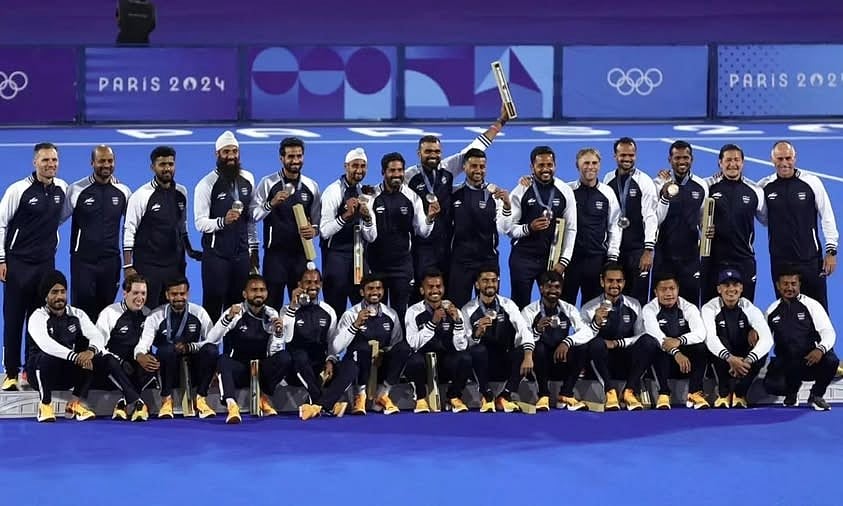
A quiz question on India’s most popular sport would be a no-brainer – it’s cricket. But what about the sport that has brought the country its greatest glory on the Olympic and world stage? That honour belongs to field hockey, which is currently celebrating 100 years of Hockey India, its governing body, and is now ready to turn a new leaf.
A staggering 13 Olympic medals, including eight gold — six of them on the trot from 1928 to 1956 — one World Cup, four men’s Asian Games golds and 12 other podium finishes at the continental showpiece, along with a women’s gold, not to speak of the Champions Trophy, underlined India’s status as one of the sport’s powerhouses not so long ago.
If there was a slump in fortunes, especially on the Olympic stage where the team went without a medal for four decades, the current men’s side has restored self-belief with back-to-back bronze medals at Tokyo 2020 and Paris 2024.
Raising the bar after bronze
“No doubt, there has been a turnaround in the national team’s performance over the last six to eight years. However, we now need to change the colour of the medals from bronze sooner than later,” says Dilip Tirkey, one of the finest defenders and currently the president of Hockey India. Ever since assuming the hot seat unopposed in 2022, in keeping with Indian Prime Minister Narendra Modi’s vision of having former sportspersons in key administrative roles, he has also been the face of the organising committee of the FIH Men’s Hockey World Cup, which was staged in Bhubaneswar the very next year.
Expectations were sky high that Harmanpreet Singh’s men could make a dash for their second World Cup at home, after their only triumph in 1975 in Malaysia; but they finished a disappointing ninth. With the next edition due later this year in The Netherlands and Belgium, Tirkey sounds cautiously optimistic, “The challenge will be a tough one for Asian teams on European turf with the likes of both co-hosts, Germany, Australia, England and Argentina in the fray. We have to raise our game at another level and consistently at that,” Tirkey tells GN Focus.
“It will provide us a wonderful sense of occasion if the men’s team can do something as it will coincide with our centenary celebrations. The junior team stood out in Chennai when they bounced back to claim the bronze in the Junior World Cup,” says the three-time Olympian with a record 412 international caps to his credit.
World Cup and Olympics
The Men’s World Cup is but one of the main goals on their radar, along with the Asian Games, also scheduled later in the year in Aichi-Nagoya in Japan, and the Los Angeles Olympics in two years’ time. The competitive edge of the Asian Games has lost some sheen, with traditional powerhouses no longer as dominant, while India ran roughshod over Japan 5-1 in the last final at Hangzhou.
For PR Sreejesh, the rock behind the country’s back-to-back bronze finishes at the last two Olympics, it is time to raise the bar higher than the Asian showpieces.
“We need to aim big and not worry about the Asiad or Asian Champions Trophy as we have been dominating them. Our aim is to make a big impact in the World Cup and then Los Angeles 2028,” says Sreejesh, who was the head coach of India’s bronze medallist team at the Junior World Cup last month.
Lessons from the lean years
In contrast to India’s almost uninterrupted golden run in the Olympics until the Fifties, there was a prolonged period of despondency when, after the gold in Moscow 1980, they had to wait until Tokyo 2020 to walk towards the podium again. This was despite the country boasting a galaxy of stars in the Eighties, ranging from Mohammed Shahid, Zafar Iqbal to M.M. Somaya.
Somaya, captain of the 1988 Seoul Olympics team and now a member of the selection committee, says that it took Indian hockey far too long to come to terms with the Astroturf game as well as the rule changes.
Looking back at the recent past, Sreejesh says, “The desperation actually started when we as a nation, with eight gold medals to show, failed to even qualify for Rio 2016. However, you can’t win medals overnight and it took the group a lot of passion, dedication and hard work to end the jinx with a bronze in 2021.”
Women’s hockey
However, there is an area of concern in women’s hockey, where performances dipped after Rani Rampal and her Chak De girls finished a hugely creditable fourth in Tokyo 2021. They did finish runners-up in the Asia Cup in China earlier this year, but the Hockey India supremo feels their performance has been a matter of concern.
Celebrating 100 years
A star-studded gathering, boasting some of the legendary names such as Ajit Pal Singh, captain of India’s 1975 World Cup-winning side, Ashok Kumar and Aslam Sher Khan, along with current stars, kicked off the centenary celebrations in style at the Major Dhyan Chand Stadium in Delhi on November 7 last year. The year-long affair, being co-hosted by Hockey India and the Union Ministry of Sports & Youth Affairs, is scheduled to feature over 1,400 matches across 550 districts in the country. Such an initiative looks fine at the grassroots level, but there is little doubt that Indian hockey needs to make more noise to become a more saleable product, given the quality it has at its disposal.
The Hockey India League (HIL), revived after a gap of seven years after being shut down for not being financially viable, is yet to find its feet, with the second edition having got under way with the women’s event in Ranchi. Asked about a possible recipe to remedy this, Somaya highlights that it is imperative to make hockey a more TV-friendly sport.
“Hockey is not a good TV sport and one needs to think seriously about it, even if it means the FIH considers tweaking the rules. Apart from this, sponsorship had been a problem with HIL, though corporate giants like Hero and Samsung have done their bit,” he says.
Network Links
GN StoreDownload our app
© Al Nisr Publishing LLC 2026. All rights reserved.