POWER LUNCH in a small box
POWER LUNCH in a small box
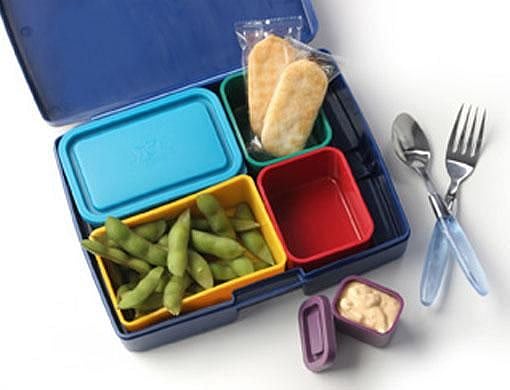
When her daughter was 15 months old, Kim Becker began packing the girl's lunch to take to her nanny-share.
One day, Becker baked Alexa and her playmate a treat of muffins secretly fortified with flaxseed and brewer's yeast, figuring Alexa wouldn't notice.
The toddlers excitedly tore into the dense cake and choked down the first bite. Then they put the muffins on the ground and ran away.
Packing a child's lunch is truly a labour of love. It also involves guilt and anxiety — is the container made of vinyl?
Does vinyl have lead? Will the food stay hot?
10x7 inches of angst
Add to these the usual trials of lunch-packing — a child's mercurial tastes, other parents who cut their kids' sandwiches like topiaries — and you've got a microcosm of parental angst in a 10x7-inch box.
The packed lunch began modestly enough: a sandwich in a dome-lidded steel box carried by factory workers.
It wasn't until the early 1950s that Thermos came out with a Hopalong Cassidy box.
The lunchbox became a childhood totem. “It is one of the earliest points when children get to choose something for themselves.
"It's an early test of consumerism,'' said David Shayt, a curator with the Smithsonian Institution's National Museum of American History.
Today's lunchboxes are too sterile for Shayt: “They look like something you stick a Nutri-Grain bar in, not a bologna sandwich.''
But lunchbox makers know what they're doing. They're tapping into our avian-flu-freaked, mad-cow-manic, global-warming-worried zeitgeist.
Fear gradually crept into lunchbox design. Thermos boxes came with insulated containers.
By the 1980s, rust-prone metal was replaced with easier-to-clean plastic. The plastic boxes, however, weren't good at keeping food at the temperature required to reduce the risk of bacterial growth. So in the 1990s, plastic gave way to fabric or vinyl stuffed with insulating foam.
Environmentalists have raised concerns about the health effects of chemicals used to make vinyl and plastics. There are now water bottles with descriptions straight out of a laboratory-supply catalogue.
Safer alternatives
Many lunchboxes are PVC-free, meaning they are not made with polyvinyl chloride, which may contain lead.
An alternative to vinyl is neoprene. Another is FDA-approved food-grade PEVA, a non-chlorinated vinyl.
The biggest challenge, however, has little to do with such externalities. Consciously or not, many parents compare themselves with some unattainable ideal.
Several mothers interviewed for this article referred to themselves as “the mum who gave up'' or “a lazy mum'' because they haven't figured out how to pack a scrumptious meal made of green vegetables and whole grains, laid out in a toxin- and commercial-free container made from recycled material.
Whatever you pack, being judged is inevitable. The crumbs in the Tupperware container say it all. You know instantly whether meatloaf dumplings were a success.
The latest hot solution is the bento box. The art of the bento as perfected in Japan is a takeout or a home-made meal comprising rice, fish and vegetables, packed tightly into a washable container.
Japanese parents have been known to spend hours arranging their children's bento-box meals — the containers themselves can be quite elaborate.
Americans have embraced ersatz bentos, most notably in the form of Lunchables, those packaged meals of crackers, cheese and other processed foods sold by Kraft Foods.
Inspired by bento boxes, Lunchables have been huge sellers for 20 years, owning nearly 80 per cent of the $750 million (Dh2,755 million) packaged-kids'-meal market, according to a market research firm.
But for Deborah Hamilton of San Francisco, sending her son to school with Lunchables is the ultimate defeat. Hamilton has tried to reclaim bento as a healthful solution to the lunch-packing conundrum.
The beauty of bento, as she says, is its ability to accommodate all sorts of foods and palates and present it in a way that entices kids.
“We're really competing with Lunchables, with fast food,'' Hamilton said. “But one thing the fast-food and packaged-food industry has done really well is make food fun.''
Meal mantra
Though her meals look elaborate, her mantra is speed and key preparation.
Hamilton believes in “leftover makeovers'', such as using curried vegetables from dinner as the stuffing for dumplings or turning last night's spaghetti into sesame noodles for lunch the next day.
Bento boxes must be packed to the gills to keep food from shifting.
Hamilton has tricks — colourful silicon baking cups to hold a small drumstick and keep it separate from the other food, filling gaps with cherry tomatoes or other fruits and vegetables. The result is a riot of colours, textures and tastes.
Sign up for the Daily Briefing
Get the latest news and updates straight to your inbox
Network Links
GN StoreDownload our app
© Al Nisr Publishing LLC 2026. All rights reserved.