Iran warns Britain, France against Hormuz mine-clearing mission as Europe moves to help free world's most critical oil chokepoint
Hormuz mine-clearance drive pits European security plans against Iranian leverage
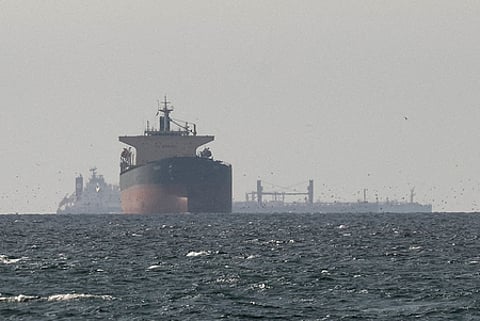
Mine-clearing operations are among the most dangerous tasks at sea.
Now, despite the 60-day ceasefire under the US-Iran memorandum, a British- and French-led naval mission to clear sea mines from the Strait of Hormuz has drawn an immediate warning from Iran.
This exposing the fragility of a ceasefire that has allowed oil exports to resume but left one of the world's most strategically important waterways operating well below normal capacity.
Iran's deputy foreign minister, Kazem Gharibabadi, recently warned against any "foreign military deployment" in the strait after London and Paris confirmed plans to lead an international maritime security effort aimed at restoring safe commercial navigation.


Get updated faster and for FREE: Download the Gulf News app now - simply click here
"Iran, as the responsible power and guarantor of the Strait's security, warns with sensitivity to any military movement in this waterway," Gharibabadi said, in what officials viewed as a direct response to the proposed Anglo-French operation.
The warning underscores growing tension over what comes after the June 18 US-Iran memorandum of understanding (MoU), which established a 60-day period of free navigation through the Strait of Hormuz following months of conflict that disrupted global energy markets.
Unresolved questions
While the agreement halted direct hostilities, it did not resolve questions over long-term security arrangements or who would guarantee freedom of navigation once the temporary accord expires.
Western officials said Britain and France are preparing to lead a multinational maritime task force whose immediate priority would be clearing an estimated 80 naval mines believed to have been laid across parts of the 34-kilometer (21-mile) waterway during the conflict.
The operation would also escort commercial shipping, reassure insurers and restore confidence among shipowners still reluctant to send vessels through the strait.
"We expect the announcement within days to get the strait fully open and get the ships moving," one Western official said.
"The primary task is to assure mariners and shipping companies that the Strait of Hormuz is clear of mines and that we are assisting in reopening it."
Officials said the mission would rely heavily on specialist mine-countermeasure vessels, destroyers, frigates and unmanned underwater systems.
Britain is expected to deploy Royal Fleet Auxiliary Lyme Bay as a "minehunting mother ship," carrying autonomous underwater drones capable of locating and neutralizing mines.
The vessel would operate alongside HMS Dragon, while France is expected to contribute frigates, destroyers and minehunters despite withdrawing its carrier strike group from the region.
The operation would coordinate closely with Oman, whose territory borders the southern side of the strait and which has played a central diplomatic role throughout the crisis.
Nato members answer Trump's pressure
Although Nato itself is not expected to launch a formal alliance operation, officials say the mission will include substantial participation from alliance members under a so-called "coalition of the willing."
Up to 19 NATO countries are expected to contribute ships, aircraft, personnel or funding, including Germany, Belgium, the Netherlands, Norway, Italy, Denmark and Canada.
The effort comes ahead of the Nato leaders' summit in Ankara, where European governments are expected to face renewed pressure from President Donald Trump, who has repeatedly criticised allies for leaving the burden of securing Hormuz largely to the United States during the conflict.
Oil is flowing, commercial shipping isn't
The proposed naval mission reflects an unusual postwar reality.
Oil exports have rebounded far faster than commercial shipping.
Saudi Arabia has exported an estimated 34 million barrels of crude through Hormuz since the ceasefire, while the UAE has expanded production and accelerated shipments into Asian markets.
Commercial shipping, however, remains depressed.
According to the International Monetary Fund's PortWatch, only about 27 vessels a day are transiting the strait with active Automatic Identification System (AIS) signals — roughly one-third of the prewar average of about 84 daily crossings.
Industry officials estimate more than 100 oil tankers remain queued for escorted transit, alongside hundreds of cargo vessels delayed by lingering security concerns, sea mines and sharply higher war-risk insurance premiums.
Many of the ships currently carrying Gulf crude belong to state-backed fleets operating under sovereign insurance arrangements or are limiting AIS transmissions during transit.
Iran still holds leverage
Maritime analysts caution that mine clearance alone cannot eliminate the risks.
Former Royal Navy commander Tom Sharpe, who regularly commanded warships through Hormuz, said safe navigation ultimately depends on Tehran's willingness to avoid confrontation.
"It is still largely in Iran's gift," Sharpe said.
Despite the ceasefire, Iran retains significant capabilities in the area, including fast attack craft operated by the IRGC, armed drones and anti-ship cruise missiles capable of threatening commercial traffic.
Oman's balancing act: 'Voluntary contributions'
The diplomatic focus has increasingly shifted to Oman, whose long-standing neutrality has made it the principal intermediary between Tehran and Western capitals.
During visits to Paris and London last week, Sultan Haitham bin Tariq reaffirmed Oman's commitment to the international law of the sea, including the principle of unimpeded transit through international straits.
Diplomats familiar with the discussions say Muscat has proposed a compromise framework modeled partly on the Strait of Malacca, where Indonesia, Malaysia and Singapore jointly oversee maritime safety while allowing voluntary contributions to support navigation services.
Such a system could provide a face-saving mechanism that avoids Iranian demands for unilateral transit fees while allowing regional states to play a larger role in maintaining security.
IMO traffic separation scheme
For now, however, no changes have been proposed to the International Maritime Organisation's (IMO) Traffic Separation Scheme, which governs vessel movements through Hormuz.
Whether the British-French mission proceeds with Iranian acquiescence — or in defiance of Tehran's warning — may determine whether the ceasefire evolves into a durable maritime security arrangement or merely marks a pause before renewed confrontation in one of the world's most vital energy corridors.


