Rashmika Mandanna with Vijay Deverakonda in this season's Koffee With Karan
Rashmika Mandanna, Vijay Deverakonda and 100 proposals: When did love become an endurance test?
Rashmika and Vijay spark questions on romance and gender roles
Last updated:
4 MIN READ
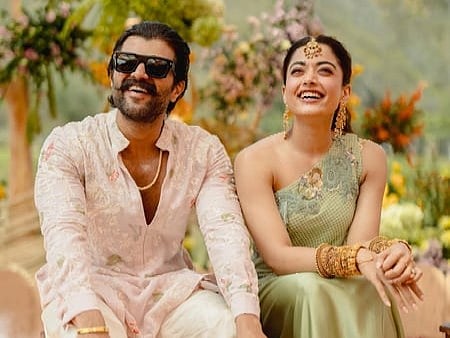
Vijay Deverakonda & Rashmika Mandanna
Dubai: I had made a solemn promise to myself that I wouldn't add my two cents to the Rashmika Mandanna-Vijay Deverakonda controversy and exercise restraint. The internet was already doing a spectacular job of turning a celebrity marriage proposal into a national referendum on romance, red flags and relationship goals.
For those blissfully unaware, here's a recap. On Koffee With Karan, a glossy chat show hosted by a very catty producer mogul Karan Johar, Rashmika revealed that Vijay had asked her to propose marriage to him 100 times before they finally took the plunge.
Predictably, India's movie-mad fans went into meltdown, branding Vijay a walking red flag and questioning why a woman should have to audition for marriage a hundred times.
I stayed out of it because KKK is a show you rage-watch, not a manifesto for life goals. Celebrities spill the beans, make questionable revelations and give the internet ammunition for weeks.
But then Rashmika decided to explain herself. In nine Instagram pages, no less. As my colleague pointed out, it was giving major Friends energy. Remember Ross Geller's exasperated cry over Rachel's infamous 18-page letter? "FRONT AND BACK!"
At least Ross had the good sense to fall asleep halfway through.
By the time I finished Rashmika's marathon defence, I wasn't sure whether I'd read a clarification, a love letter or a doctoral thesis on why we'd misunderstood romance.
That's an awful lot of emotional paperwork for a supposedly simple love story.
Now, I have absolutely no problem with a woman proposing to a man. More power to her. If Rashmika wanted to propose once, twice or a hundred times, that's her prerogative. But there's a world of difference between a woman choosing to propose and a man asking her to propose 100 times before agreeing to marry her.
That's where the romance loses its sparkle. Rashmika insists their conversation wasn't about grand proposals or diamond rings, but understanding each other, weathering life's highs and lows and eventually choosing each other.
Fair enough. But why introduce the number 100? Why was the woman apparently expected to keep asking while the man took his time deciding?
Rashmika describes herself as impulsive and all heart, while Vijay is supposedly pragmatic. It's a familiar romantic script, isn't it? The woman is emotional. The man is rational. She follows her heart. He exercises judgment. She makes grand gestures. He decides when the timing is right.
We've seen this movie before. Several hundred times before! Rashmika says she'd propose a thousand times if necessary. A hundred is nothing, apparently. But Rashmika, that's precisely the point.
A woman's willingness to do something a thousand times for love doesn't automatically make the expectation romantic. You do you, doesn't just cut it.
Women have spent generations being told love means patience, sacrifice and proving their devotion. We've romanticised the woman who waits, forgives and fights for her man.
And now we're supposed to applaud the woman willing to propose a thousand times?
Where does devotion end and unequal emotional labour begin?
Rashmika has every right to define happiness on her terms. She says she's in the happiest phase of her life, and I have no reason to doubt her.
Rashmika reacts to trolls questioning her relationship with Vijay Deverakonda: We chose each other
But personal happiness and public criticism aren't mutually exclusive. You can be deliriously happy in your marriage and still share an anecdote that raises legitimate questions about gender expectations.
Then came the part of her statement that reminded me of her character in Animal.
Rashmika defended Vijay by saying he's there when she's in physical pain or suffering through her period, unlike strangers criticising him online.
Of course he is. He's her husband. But since when did showing up for your partner during illness become extraordinary proof of romantic virtue?
Isn't that the bare minimum? A husband being present when his wife is in pain is lovely. It's also what partnership should look like. It doesn't automatically answer questions about other aspects of that relationship.
And this conversation is bigger than Rashmika and Vijay. Indian movies has spent decades selling us the idea that women must prove love through persistence and sacrifice, while men enjoy the luxury of hesitation and eventual enlightenment.
When celebrities repeat these narratives, impressionable fans risk mistaking unequal expectations for aspirational romance.
Does that make Vijay a terrible husband? Absolutely not. I don't know him, and neither do those diagnosing his personality through television clips.
Online pile-ons can be vicious. Rashmika is entitled to challenge abuse and misinformation. But there's a difference between trolling a couple and questioning the gender politics of a story they voluntarily shared.
Perhaps those 100 proposals were playful expressions of affection rather than a serious condition. If so, that's an important distinction.
But nine pages later, I still wish Rashmika had confronted the criticism rather than treating it as hostility towards her happiness.
Nobody needs her to apologise for loving her husband. And nobody should mistake feminist criticism for an attempt to destroy a happy marriage.
As for the piggyback video closing her statement, undeniably sweet. But a cute couple moment isn't a rebuttal to patriarchy. I wish Rashmika and Vijay every happiness. I just wish we'd stop confusing a woman's willingness to do absolutely anything for a man with female empowerment.
Because the most romantic thing about marriage shouldn't be how many times a woman asks for it. It should be that two people want it equally.
And that shouldn't take a hundred proposals or nine Instagram pages to explain.
Network Links
GN StoreAbout Gulf NewsTerms & ConditionsReach by GNSitemapContact usPrivacy PolicyGN FocusHave your sayWork with usAdvertise with usGulf News epaperPrinting Services
Download our app
© Al Nisr Publishing LLC 2026. All rights reserved.