Gerwig’s Narnia goes rock opera, but the BBC’s White Witch haunted childhoods on a shoestring budget
Gerwig’s Narnia reimagines magic with rock opera flair and cosmic spectacle.
There was a time when Narnia arrived on videotape.
Between 1988 and 1990, the BBC adapted four of C.S. Lewis’s seven Chronicles for Sunday-evening television. It was the time of the VCR and the cassette, of special effects stitched together on a public-broadcaster budget and sets that wobbled if you looked too closely. To be honest, none of it mattered at that time because that’s all most of us kids knew.
Nearly four decades on, the BBC series is still worth watching before the Disney–Walden films, and certainly before Greta Gerwig’s glittering new vision, which begins in the dead city of Charn and ends in a world still wet from creation. Anyone who read the books as a child will recognise how faithful the BBC version was. Alan Seymour’s scripts stayed so close to Lewis’s prose that they read almost like the book spoken aloud: Scene for scene, line for line.
Into the Wardrobe
It began where Lewis began, with The Lion, the Witch and the Wardrobe. Four children, Peter, Susan, Edmund and Lucy Pevensie (Richard Dempsey, Sophie Cook, Jonathan R. Scott and Sophie Wilcox), are evacuated from wartime London and walk straight into another war.
They are billeted in the rambling country house of an old professor, played with quiet warmth by Michael Aldridge, and inside a wardrobe they find a world.
It is fantasy, it is magic, and yet, strangely, it never feels like a magical world. The magic intrudes, cold and real, into ordinary lives. Marilyn Fox’s direction carries a deathly hush, the hush of an occupied country where, as Mr Beaver warns, even the trees may be listening for the Witch.
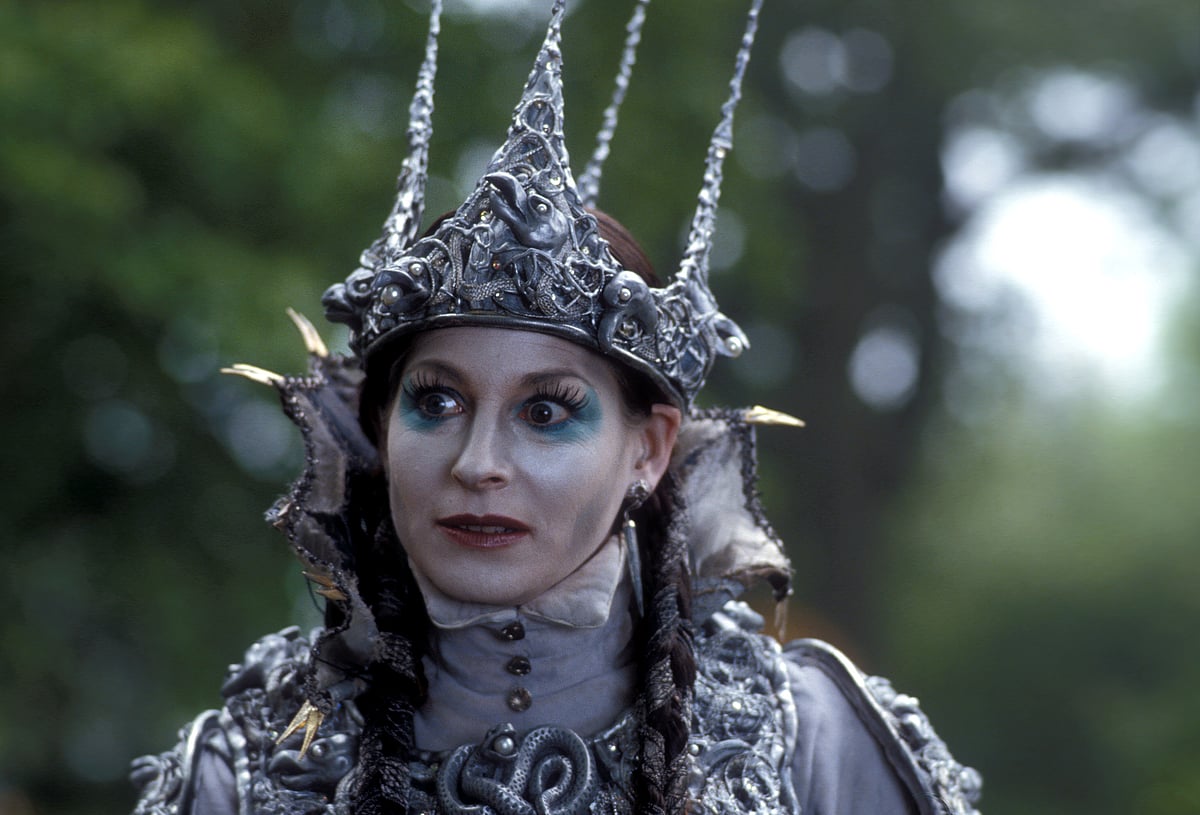
That Witch was Barbara Kellerman, and she was chilling to the bone. Her Jadis is a restless, commanding spectre who rules through fear and knows exactly how her reign will end: when four humans take the thrones of Cair Paravel, she falls. Kellerman haunted the series so effectively that the BBC brought her back twice, as the Hag in Prince Caspian and the serpentine Lady of the Green Kirtle in The Silver Chair.
Against her stood Aslan: a life-size animatronic lion, worked from inside by puppeteers Ailsa Berk and William Todd-Jones and voiced with grave tenderness by Ronald Pickup. By modern standards he lumbered.
But, when he spoke, he was Aslan.
The winter you could feel
The snow was a character.
The children trudge through drifts in heavy boots and borrowed fur coats, breath clouding in the air, and even if you knew the ending by heart you feared for them. The series is mostly quiet, and the quiet gives it gravity. When Father Christmas finally breaks through the hundred-year winter, he brings no toys, only instruments of war: a sword and shield for Peter, a bow and a horn for Susan, a dagger and a vial of healing cordial for Lucy.
Then the war came, rendered as only a late-1980s BBC production could. Cel-animated ghouls and goblins crawl from the cracks of the earth as the Witch musters her army, cartoon creatures spilling into live action in a way that is oddly unnerving. The battle lasts a few minutes, and then it is over. Somehow that brevity makes it feel more like a children’s memory of a war than a spectacle.
The Hollywood years
In 2005, Disney and Walden Media gave the same story the scale the BBC could only imagine. Their Lion, the Witch and the Wardrobe was lush, sweeping and occasionally theatrical, and genuinely moving. It took liberties with scenes rather than the story, usually to tighten the screws.
A few lines in the book become a heart-stopping sequence in which Maugrim’s wolves hunt the children and the Beavers across a frozen river that cracks beneath them as the long winter starts to thaw.
Prince Caspian (2008) went further, adding a flicker of romance between Caspian and Susan. But that door was always going to close. The film ends with the Pevensies stepping back into England while Regina Spektor’s “The Call” plays, one of the best uses of a song in any fantasy film: a promise of return, sung as a farewell.
That goodbye felt long, and it felt final.
The book before the beginning
Now Greta Gerwig has rekindled the hope by doing what no screen adaptation has done before. She has gone back to the start, to The Magician’s Nephew.
For now, all we have is a trailer, released this October, and it announces itself loudly. Set to Led Zeppelin’s Stairway to Heaven, a song famously difficult to license, which Gerwig secured by meeting Robert Plant and Jimmy Page in person, it promises what she has called a fantasy rock opera: Glam, colour, cosmic spectacle. Meryl Streep voices Aslan. Emma Mackey is Jadis. Daniel Craig plays the meddling Uncle Andrew, and newcomers David McKenna and Beatrice Campbell are Digory and Polly. The film opens in IMAX and cinemas worldwide on 12 February 2027, before arriving on Netflix in April.
It is a far, far cry from the snow-muffled Narnia many of us grew up with. Online reaction has split accordingly, between those thrilled by the ambition and those who fear the soul of the thing has been lost in the glitter.
And yet The Magician’s Nephew may be wilder than we remember. It is one of Lewis’s strangest and most wicked books. It opens not in Narnia but in Edwardian London, with a vain, cowardly amateur magician who experiments on guinea pigs and then on children, tricking his nephew Digory and young Polly into testing his rings. From there it drifts into the Wood between the Worlds, a drowsy forest of pools where each pool is a doorway, and then into Charn, a dead red-sunned city whose queen killed every living thing in her world with a single Deplorable Word. She lies frozen among the statues of her ancestors, waiting for a foolish boy to strike a bell.
He does, of course. And the rest of the book is the reckoning.
How the Witch was made
At the heart of it all is Jadis. The Magician’s Nephew is, in the end, the story of how a queen became the White Witch. She is in Narnia on the very morning of its creation, as Aslan sings the stars and the animals out of the dark, so the world is not one day old before evil has walked into it. She scales a walled garden in the far west and eats a silver apple of endless life. That gives her the long, terrible strength that, centuries later in Narnian time, will become the hundred years of winter.
Then she turns to Digory and tempts him: steal an apple, save your dying mother. It is the oldest temptation, and Lewis writes it with real anguish. Digory refuses, and is rewarded with an apple freely given. He carries it home, its core is planted in a London garden, and it grows into a tree. Years later, a storm brings the tree down, and its wood is made into a wardrobe.
The boy who rang the bell is the old professor. In the BBC series, the gentle, white-haired man in whose house the Pevensies find that wardrobe was the magician’s nephew all along.
So it seems fitting that Gerwig’s trailer opens on a wardrobe carved with an apple tree. Her Narnia may be louder and brighter than ours, and it may sing in a register Lewis never imagined. But it is building the same door we walked through as children. The question now is whether, behind all that rock-and-roll thunder, we will still hear the lion.
Network Links
GN StoreDownload our app
© Al Nisr Publishing LLC 2026. All rights reserved.