‘Chinese whispers’: AR Rahman says Bollywood changed, stars push back
Music maestro speaks on Chhaava, Bollywood power shifts and ‘Chinese whispers’
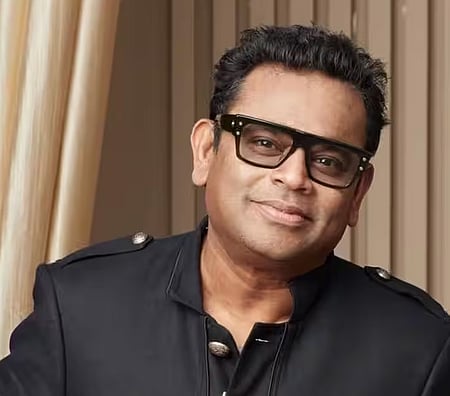
Oscar-winning composer AR Rahman has sparked widespread debate after suggesting that the Hindi film industry may have developed a bias in its workings.
Speaking to BBC Asian Network, Rahman said he has received fewer opportunities in Bollywood over the past eight years, hinting that the slowdown could be linked to shifts in the industry’s power dynamics. He added that such instances often reached him through “Chinese whispers” rather than being communicated directly.
Rahman also weighed in on Chhaava, calling the film divisive but clarifying that its underlying theme of bravery prompted him to take on the project. He said he felt honoured to compose music for a film based on Chhatrapati Sambhaji Maharaj.
Views on bias and industry shifts
Addressing claims of bias in Bollywood—particularly against Tamils or those from outside Maharashtra—Rahman said he had not personally experienced overt discrimination but acknowledged subtle changes within the system.
“Maybe I never got to know of this, maybe it was concealed, but I didn’t feel any of this. Maybe in the past eight years, a power shift has happened, and people who are not creative have the power now. It might be a communal thing also… but it is not in my face,” he said.
Rahman added that he often hears, second-hand, about projects he was considered for but eventually lost out on. “It comes to me as Chinese whispers that they booked you, but the music company went ahead and hired their five composers. I say good—I have more time to chill with my family,” he remarked.
‘I’m not in search of work’
Rahman stressed that the slowdown in opportunities has not affected his creative peace or sense of self-worth. Rather than chasing projects, he prefers to let work come to him organically.
“I’m not in search of work. I want work to come to me; my sincerity to earn work—whatever I deserve, I get,” he said.
His remarks come at a time when Bollywood music has increasingly leaned towards formula-driven soundtracks and multi-composer albums, often prioritising speed and commercial viability over a singular musical vision.
Celebrity reactions
Rahman’s comments have drawn mixed reactions from across the film and music fraternity, ranging from sharp criticism to more nuanced assessments of the industry.
Actor-director Kangana Ranaut intensified the debate by claiming that Rahman refused to work on her directorial Emergency, allegedly calling it a “propaganda” film despite what she described as its balanced portrayal. She accused the composer of being prejudiced and hateful in a social media post.
Playback singer Shaan dismissed any communal interpretation, urging artists to focus on their craft. “Whatever work you get, do it well. I don’t think there is any communal minority angle. In music, it doesn’t happen,” he said.
Author and columnist Shobhaa De termed Rahman’s remarks “very dangerous,” arguing that Bollywood has largely remained free of communal bias. “If you have talent, you get a chance. Rahman is such a successful, mature man; he should not have said this,” she said.
Veteran singer Anup Jalota also rejected the claims, pointing to Rahman’s prolific output. “He has done the work of 25 years in just five years. There’s no truth to this communal angle,” he said.
Offering a more measured view, legendary singer Hariharan described the current Bollywood music ecosystem as “neither black nor white.” Calling it a “grey area,” he said creative decision-making must take precedence over commercial considerations. “Creativity has to come first and money later. If you only think of money when it comes to art, then who knows what the future will be,” he cautioned.
Journey to Hindi cinema
Despite his stature today, Rahman has said it took him nearly seven years to feel at home in Hindi cinema. He made his Bollywood debut with Mani Ratnam’s 1991 romantic thriller Roja and went on to score the acclaimed trilogy of Roja, Bombay (1995) and Dil Se.. (1998). He also made a strong impression with Ram Gopal Varma’s Rangeela (1995), which marked a stylistic shift from his earlier work.
However, it was Subhash Ghai’s 1999 romantic drama Taal that helped him shed the feeling of being an outsider. “I was still an outsider with these three films, but Taal became a household album. It entered the kitchens of everybody,” Rahman said.
He attributed his early struggles to language barriers, revealing that he began learning Hindi—and later Urdu, Arabic and Punjabi—to better connect with Hindi cinema. This journey led to iconic collaborations with singer Sukhwinder Singh on tracks such as Chaiyya Chaiyya, Ramta Jogi and the Oscar-winning Jai Ho. Songs from Taal, including Taal Se Taal, Ishq Bina and Kahin Aag Lage Lag Jaye, went on to cement Rahman’s place as a household name.
With inputs from ANI, IANS
Network Links
GN StoreDownload our app
© Al Nisr Publishing LLC 2026. All rights reserved.