Enriched by tradition
Pouran Jinchi draws inspiration from calligraphy to explore the power of religion
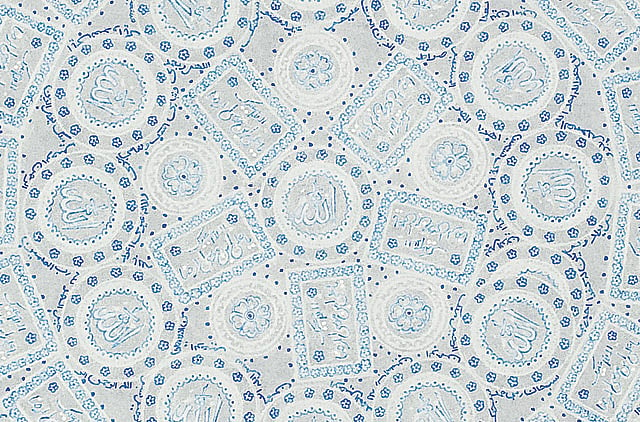
It is drawn from my observations on the time," says Iranian artist Pouran Jinchi about Ritual Imprint, an ambitious body of work that questions the state of religious rituals in a secular age. "The culture of money and consumerism became the rituals of our lives during the past decade. But as the world went through a major financial shift, societies started speculating their existence through difficult times. They looked into their faith and religion to fill that void. Look at the power of religion and the role it can play!"
Ritual Imprint consists of a selection of drawings of inscribed textures and geometric shapes found in Islamic art, specifically on mohr (prayer stones). Calligraphic letters and phrases from religious rituals become visual motifs as they are layered in intricate arrangements or singled out as symbolic forms. Together they form maps of faith, imagining an act of prayer. In addition they reflect the artist's process and formulation.
"What would a prayer look like if you were asked to draw it?" asks the 51-year-old artist. "I visualise the spiritual fulfilment of prayers and then translate that into aesthetic creations to see whether they relay what prayer could mean. It is a two-way portal of sorts. And one could be ‘translated' into the other without taking anything away from the meaning."
Born in Mashad, one of the holiest cities in Iran, Jinchi's afflatus is deduced from the ancient traditions of Iranian heritage, or from more esoteric sects such as Sufism to underline the complexity of diasporic art and highlight the enduring power of belonging. "My parents persuaded me to study engineering," she says. After acquiring a degree in engineering from the George Washington University in 1982, she took up painting at the University of California, Los Angeles, followed by studio painting at the Art Students League in New York.
Jinchi imbues historical and cultural strands with personal skill and character. Amid a mystical and intense state of ecstasy, she harnesses her internal excitement, yet retains the kind of peace and serenity that Persian calligraphy requires. On vibrantly-hued backgrounds, texts are morphed beyond recognition into flowing, anthropomorphic shapes.
Sufficient to create the effect they portray, the strokes meld into delineations and structures to mark a meeting of aesthetics of forms and letters. In Ritual Imprint, too, she employs an unusual matrix while retaining the tradition of Persian calligraphy of writing repeated letters to produce abstract compositions. The practice was especially strong in Qajar Iran, a time when calligraphers writing in the Shikasteh script would fill entire pages with repetitions of certain letters without literal meaning.
Here the artist places thin black and white paper over mohr — a prayer tablet made of baked clay from shrines that may be decorated with the word "Allah", or with prayers for peace directed to a revered leader in the Shiite line of spiritual succession. She scratches and rubs charcoal against the paper to reproduce an imprint of lacelike arabesque patterns. In and around the imprint, Jinchi adds words from daily prayers written over and over in a minute calligraphic hand.
The canvas becomes a palimpsest; the replicating motifs and diacritical marks add separate layers to existing shapes, resulting in a work of meditative calmness. In this way, Jinchi offers her viewers a prayer that has been turned into a physical object through her stylistic process.
Jinchi lives in New York and admits that having been there for the past 30 years, her work is sometimes charged with socio-political implications to address negativity and misunderstanding surrounding her identity and her religion.
Even though Persian calligraphy is not widely comprehended in the West, it does not worry her. "Familiarity can bring comfort and remove fear," she says. "Once you draw some parallels, it is easier for people to understand." Jinchi's previous set of works, Fabricated, was structured around such objectives.
She combined delicately crafted paintings of branded fabrics of the West with traditional calligraphy and Islamic designs of the East, creating customary, Post-Modern headgear. According to her, she addressed the issues of vanity and identity. Though both are dissimilar, they have acquired a vernacular place among humans.
"We got lost a bit in an era where there was too much emphasis on consumption and commercialism and not enough on serious issues. Given our mass-media culture, after the September 11 attacks and the wars that followed, certain headgears became universally known and easily identified," she says. By focusing on the cultural weight of the garment and the brands, Jinchi reconfigured these high-end lifestyle items in an effort to articulate a personalised identity that deconstructs notions of other identities and renegotiates how they are formed in a globalised society.
Jinchi has explored many realms through works such as Antworks, which documented the patterns of ants' movements, and Derakht (meaning "tree" in Persian) inspired by trees and foliage. Following this was the Recitation, which comprised calligraphic symbols citing text from the Quran but with only the vowels present, creating an indecipherable language.
Isn't it dangerous as an artist to measure success in activist terms? "The tension between powers and arts is constant," Jinchi says. "There is a resurgence of religion because people are disillusioned by failed secularism that has offered no vision for humanity. All our struggles resurface strongly in times of uncertainty and history has proved that good things can happen if we have the vision. The point is, to be effective you have to look at issues in a broad sense and not necessarily from your own personal experiences."
Layla Haroon is a freelance writer based in Abu Dhabi.
Ritual Imprint is on at The Third Line, Dubai, until February 25.
Sign up for the Daily Briefing
Get the latest news and updates straight to your inbox
Network Links
GN StoreDownload our app
© Al Nisr Publishing LLC 2026. All rights reserved.