The good, the bad and the ugly of Photoshop in today's media
Software known for manipulating photos celebrates 20 years
Dubai: It was a 17th century English politician who was perhaps first aware of what we now refer to as "photo-shopping".
At the time, painted portraits were popular among aristocrats, but often portrayed them in a more attractive light. Oliver Cromwell, however, told the painter to paint him with "warts and everything".
After painted portraits came film-loaded cameras, along with the saying "the camera never lies".
This may have been partially true decades ago, before digital cameras became prevalent and photographers still developed their own pictures using rolls of film, but now digital technology rules.
For the media, pictures taken with traditional cameras were seen to be reliable — the camera certainly couldn't lie (if it was an original picture).
Modifications
However, with the advent of digital photography came Photoshop, giving photographers (and indeed anybody) the ability to modify and even change the situation portrayed in an image completely, more easily and believably.
The Adobe's Photoshop image manipulation software has in fact become so widely used and available that the brand name has attained verb status. "Photoshopped", "photoshopping" and "photoshop it" are words and a phrase that have come into everyday use.
Hence a question of ethics arises. Where the public once trusted an original photograph printed in the media, for example, now there is increasing room for speculation and question.
The method of doctoring photographs, however, wasn't impossible before programmes such as Photoshop.
In one famous case, a photograph discovered during the investigation into the role of Lee Harvey Oswald in the assassination of President John F. Kennedy turned out to have been doctored.
The photograph showed Oswald in an aggressive stance, brandishing a rifle, which was said to have proved that he had firearms experience. It was later discovered that the shadows in the picture proved that it was in fact a combination of two or three pictures.
Doctoring photographs before the digital age wasn't impossible, but to make it look original was very difficult. One would have to physically cut and paste one photograph onto another and then take another photograph of the copy-pasted image.
This was a common practice for newspapers before digital technology, to cover up parts of the body, for example, that were deemed too revealing.
However, it was both time-consuming and difficult, and, in several instances quite obvious to the naked eye.
However, digital image manipulation software has made this process much easier, faster and more effective.
Journalism ethics
Reporting during times of war is no easy task. Facts have to be written and displayed accurately in difficult, dangerous situations.
However, in one case, a photographer documenting an Israeli air strike in Beirut decided to manipulate the pictures, adding and darkening smoke and even duplicating a house.
It was actually bloggers who noticed the inconsistency on an image taken by Reuters photographer Adnan Hajj, who denied that any manipulation had taken place.
Reuters acted when it was brought to their attention in August 2006, removing Hajj's complete 920-strong photographic catalogue from their database.
Global picture editor Tom Szlukovenyi told the BBC at the time: "There is no graver breach of Reuters standards for our photographers than the deliberate manipulation of an image."
Manipulating any image in this way can be viewed as a direct contravention of journalism ethics.
Digital strokes
- 1930 Stalin routinely air-brushed his enemies out of photographs. In one photograph, a commissar was removed from the original photograph after falling out of favour with Stalin.
- 1937 Adolf Hitler had Joseph Goebbels removed from an original photograph. It remains unclear why exactly Goebbels fell out of favour with Hitler.
- 1942 In order to create a more heroic portrait of himself, Benito Mussolini had a horse handler removed from an original photograph.
- February 1982 On a National Geographic magazine cover story on Egypt by Gorden Gahen, the Great Pyramid of Giza was digitally moved to fit the magazine's vertical format. Tom Kennedy, who became the director of photography at National Geographic after the cover was manipulated, stated that: "We no longer use that technology to manipulate elements in a photo simply to achieve a more compelling graphic effect. We regarded that afterwards as a mistake, and we wouldn't repeat that mistake today".
- June 1994 A digitally altered photograph of O.J. Simpson appeared on the cover of Time magazine shortly after Simpson's arrest for murder. This photograph was manipulated from the original mug-shot that appeared, unaltered, on the cover of Newsweek. Time magazine was subsequently accused of manipulating the photograph to make Simpson appear "darker" and "menacing".
- January 2003 A cover of GQ magazine featured a digitally slimmed actress Kate Winslet. Winslet said that the retouching was "excessive." "I don't look like that and more importantly I don't desire to look like that. I can tell you that they've reduced the size of my legs by about a third," said Winslet.
- April 2003 A digital composite of a British soldier in Basra, gesturing to Iraqi civilians urging them to seek cover, appeared on the front page of the Los Angeles Times shortly after the US led invasion of Iraq. Brian Walski, a staff photographer for the Los Angeles Times and a 30-year veteran of the news business, was fired after his editors discovered that he had combined two of his photographs to "improve" the composition.
- August 2006 A photograph by Adnan Hajj, a Lebanese photographer, showed thick black smoke rising above buildings in the Lebanese capital after an Israeli air raid. The Reuters news agency initially published this photograph on their website and then withdrew it when it became evident that the original image had been manipulated to show more and darker smoke. "Hajj has denied deliberately attempting to manipulate the image, saying that he was trying to remove dust marks and that he made mistakes due to the bad lighting conditions he was working under," said Moira Whittle, the head of public relations for Reuters. "This represents a serious breach of Reuters' standards and we shall not be accepting or using pictures taken by him." A second photograph by Hajj was also determined to have been doctored.
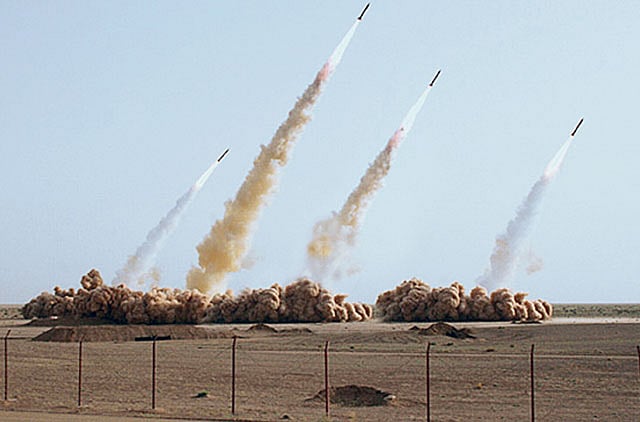
- July 2008 An image of an Iranian missile test appeared on the front pages of many major newspapers. The image is from the website of Sepah News, the media arm of Iran's Revolutionary Guards. After the publication of this photo, it was revealed that the second missile on the right was digitally added to the image in order to conceal a missile on the ground that did not fire.
Source: Dartmouth College Computer Science Department
Political games
- In July 2008, Iran released photographs apparently showing nine missiles being tested, while US satellite tracking recorded just six. So where did the other three missiles go and were they even there in the first place?
- In his report Skyful of Lies, BBC World anchor Nik Gowing explained: "The launch pictures and video were examined closely. Even amateurs quickly deduced the pictures released by the Revolutionary Guards through their media agency Sepah had been doctored."
Source: Dartmouth College Computer Science Department
Sign up for the Daily Briefing
Get the latest news and updates straight to your inbox
Network Links
GN StoreDownload our app
© Al Nisr Publishing LLC 2026. All rights reserved.