Sharjah eyes bigger share of Asia-Gulf trade with integrated ports and free zones
Khorfakkan Port expansion to boost capacity to 10 million TEUs in the longer term
Sharjah is positioning itself to capture a larger share of trade flows between Asia, the Gulf and Africa, leveraging its strategic ports, integrated customs services and free zones to attract international investors and strengthen supply chain connectivity.
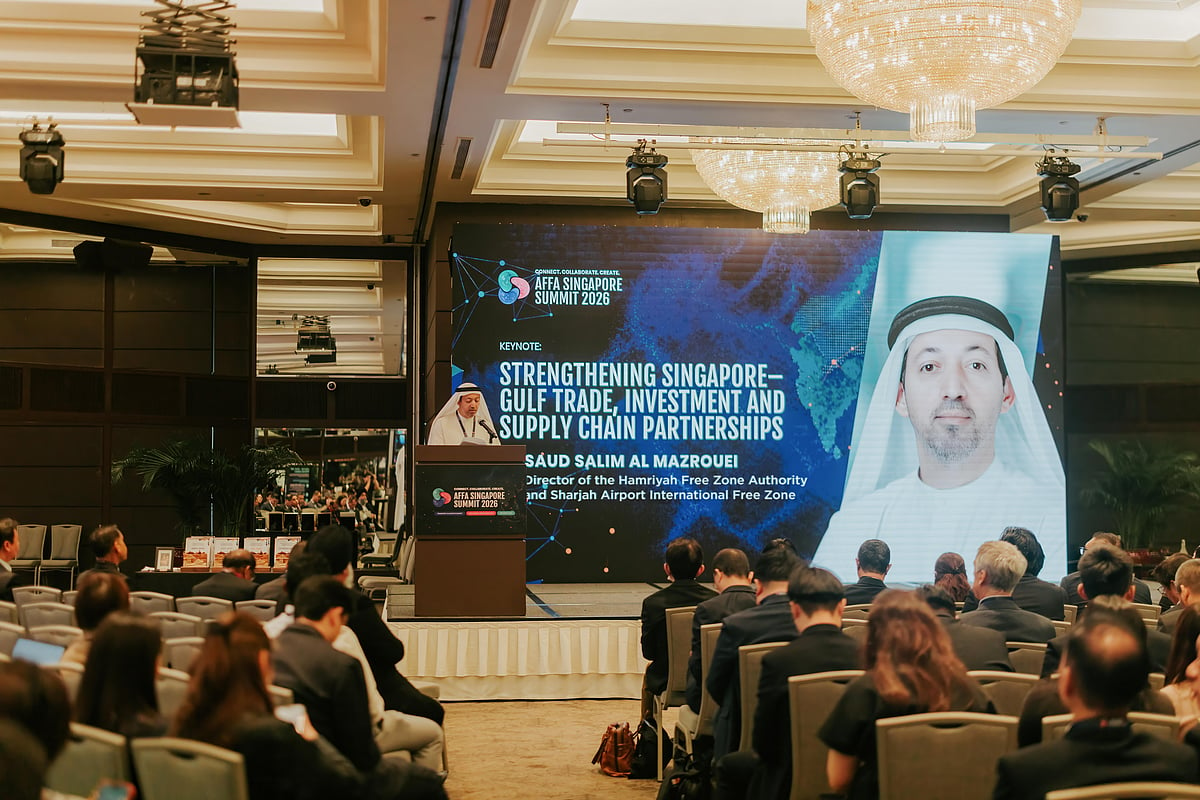
The Sharjah Ports, Customs and Free Zones Authority (SPCFZA) highlighted the emirate’s competitive advantages at the ASEAN Federation of Forwarders Associations (AFFA) Singapore Summit 2026, showcasing its growing role as a regional logistics and trading hub.
Get updated faster and for FREE: Download the Gulf News app now - simply click here.
Organised by the Singapore Logistics Association, the summit brought together government officials, industry associations and logistics companies to explore cross-border connectivity, digital transformation and supply chain efficiency.
Addressing the summit, Saud Salim Al Mazrouei, Director of Hamriyah Free Zone Authority (HFZA) and Sharjah Airport International Free Zone Authority (SAIF Zone), said the competitiveness of logistics hubs increasingly depends on their ability to provide flexible shipping routes and seamlessly integrate transport, customs, warehousing and distribution.
He said Sharjah's geographical position, supported by ports on its eastern and western coasts, enables businesses to diversify trade routes and improve supply chain resilience.
Khorfakkan expansion
Al Mazrouei highlighted Port Khorfakkan's strategic location on the Gulf of Oman, outside the Strait of Hormuz, providing direct access to the Indian Ocean and an alternative gateway for international shipping.
Development plans aim to increase the port's annual handling capacity to five million twenty-foot equivalent units (TEUs), with a longer-term target of 10 million TEUs.
He stressed that efficient customs clearance, digital solutions and the swift movement of goods between ports, land crossings and free zones are essential to maintaining competitiveness.
15,000 companies
Al Mazrouei said Hamriyah Free Zone and SAIF Zone collectively host more than 15,000 companies from approximately 160 countries, supporting manufacturing, trading, warehousing, distribution and re-export activities.
Hamriyah's direct connection to Hamriyah Port supports industrial and maritime operations, while SAIF Zone's proximity to Sharjah International Airport facilitates air freight and logistics.
Expanding Asian partnerships
Al Mazrouei said the UAE and Singapore's intention to negotiate a Comprehensive Economic Partnership Agreement (CEPA), alongside existing agreements with Southeast Asian countries, creates opportunities for stronger trade and investment ties.
He identified logistics, warehousing, manufacturing, re-exports and maritime technologies as five priority areas for cooperation.
Describing Singapore as a gateway to Southeast Asia, he said Sharjah offers Asian businesses access to markets across the GCC, Middle East, Africa and South Asia.
He invited companies and industry associations to explore investment opportunities through trade missions, business meetings and sector-specific initiatives aimed at building long-term economic partnerships.
Network Links
GN StoreDownload our app
© Al Nisr Publishing LLC 2026. All rights reserved.