In less than a month, without paid marketing, the app crossed 1,000 users across more than 30 countries.
My Business: How a 21-year-old Emirati built a mobile learning app from his bedroom
Hamad Almheiri built a global learning app alone, powered by curiosity and discipline
Last updated:
4 MIN READ
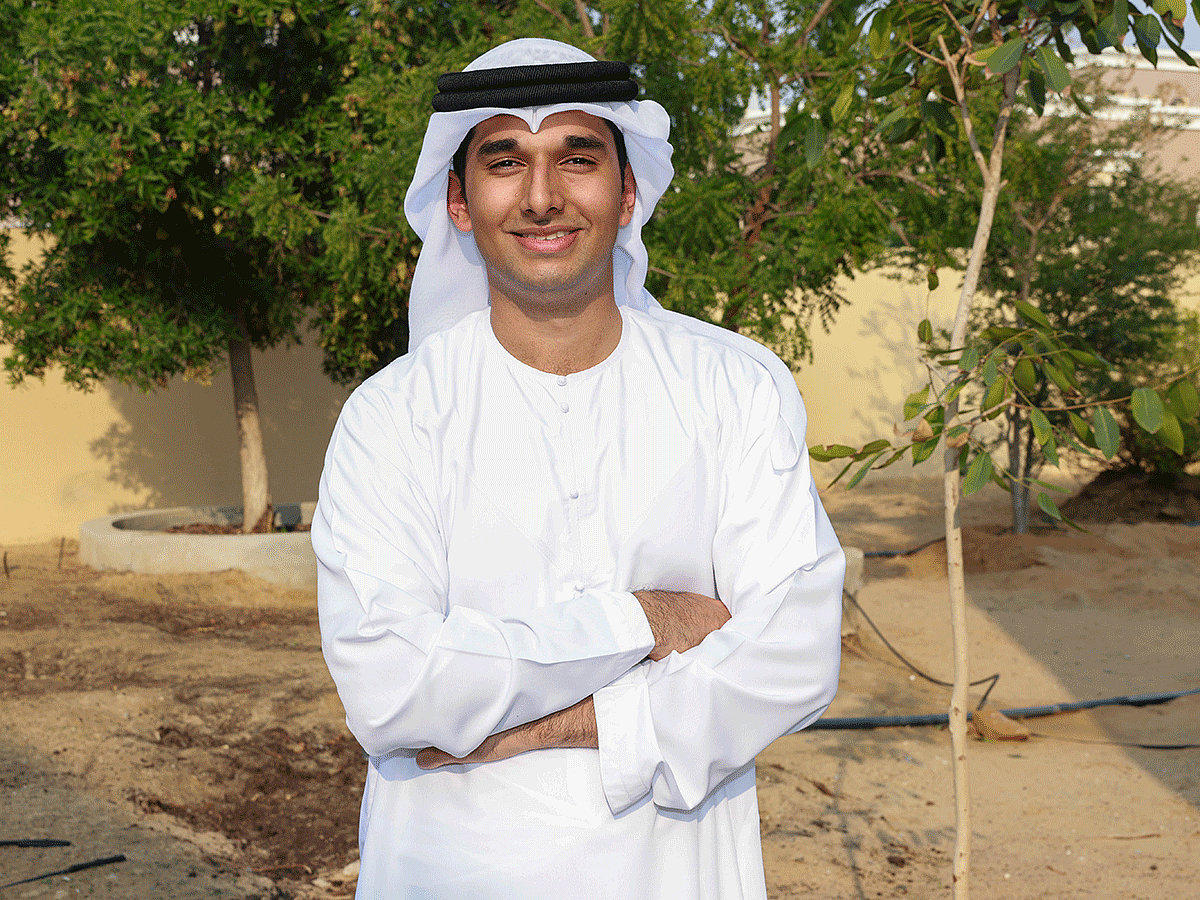
Hamad Almheiri is an Emirati founder based in Sharjah.
Ahmad Alotbi/Gulf News
Dubai: Hamad Almheiri does not describe himself as a typical tech founder. There was no pitch deck, no early investor interest and no launch buzz when he started building BrainScroller. What he had instead was time, curiosity to work without reassurance that anyone would ever use what he was building.
Growing up in the UAE shaped that mindset. Almheiri says watching the country evolve left a strong impression on him. “I grew up seeing how strong execution and long-term thinking can transform a nation,” he said. That belief stayed with him as he learned to code on his own, late at night, mostly through YouTube videos and trial and error.
From scrolling to learning
The idea for BrainScroller came from observing habits rather than chasing trends. Almheiri belongs to a generation that spends hours on phones, often scrolling without intention. Instead of seeing that behaviour as a problem, he saw an opportunity.
“That made me think about technology and attention, not as something negative, but as something powerful,” he said. “If people naturally engage with their phones, why not use that behaviour to make learning more accessible?”
BrainScroller delivers short pieces of knowledge in a format that feels familiar. The goal was never to replace books or long-form learning, but to fit into how people already consume information. Almheiri says the product reflects his own love of learning and curiosity across subjects.
“I believe technology should make curiosity easier to follow,” he said.
Six months without feedback
Building the app tested more than technical skill. Almheiri spent around six months working completely alone, without users, feedback or validation. During that time, he was writing code, fixing bugs and making design decisions without knowing whether the product would ever find an audience.
“The biggest challenge was building for a long time without feedback,” he said. “That period tested discipline more than skill.”
Progress was slow and often invisible. There were no milestones to celebrate, only small improvements made day after day. What kept him going was consistency. “Progress is rarely visible day to day, but it accumulates quietly over time,” he said.
Once users did arrive, his approach shifted. Listening closely, iterating quickly and staying close to the product became central to how he worked. That early discipline shaped how BrainScroller evolved.
Also Read
My Business: How a long search for a home in Dubai sparked the idea behind MiftaMy Business: How a father-son team turned a hospital-bound dream into Dubai’s leading VR academyMy Business: How a childhood obsession with cars shaped a UAE entrepreneur’s success storyMy Business: How one renovation crisis sparked a tech platform now reshaping a $40 billion marketMy Business: How a mother turned her son’s medical journey into a UAE VR emotional-recovery toolBuilding with personal savings
BrainScroller was funded entirely by Almheiri himself. He used personal savings to build the first version and handled everything from development to design. There was no team and no external funding.
To test the app, he used his own old phones and his parents’ devices, running builds, fixing crashes and refining features. “There was no one else involved,” he said. “Just persistence and a belief that the dots would connect.”
That belief was tested more than once. There were moments when the pressure of managing everything alone felt overwhelming. Server costs, technical issues and an endless list of feature ideas created long stretches of uncertainty.
“Yes, many times I thought about giving it up,” he said. “What kept me going was knowing I wouldn’t regret putting it out into the world, even if it didn’t work.”
Support at home, ambition abroad
Although he built independently, Almheiri says the UAE ecosystem has been encouraging, especially for young founders. He found people willing to listen, offer advice and take early ideas seriously.
“I’m grateful to be building in an environment where ambition is taken seriously,” he said. Launching in the UAE felt natural. Almheiri is Emirati, based in Sharjah, and says the emirate’s focus on education and long-term thinking influenced how he approached building the product.
He sees BrainScroller as part of a long-term journey in the UAE, not a stepping stone elsewhere.
Looking five years ahead
In five years, Almheiri wants BrainScroller to reach several million active users. Growth matters, but sustainability matters more. Engagement and retention are priorities, not vanity metrics.
Localisation is central to the plan. Arabic is the first focus, followed by other major languages. The goal is for BrainScroller to feel native in more than 100 countries.
“If we execute well, it can become part of people’s daily learning habits,” he said.
For others thinking about starting their own business, his advice is: “Focus on building,” he said. “Ideas are easy to have. Execution is what creates clarity.”
Looking back, Almheiri says the hardest part was not the technical work, but staying committed when no one was watching. Publishing the app, even imperfect, changed everything. “What I would have regretted deeply was never putting it out at all,” he said.
Nivetha Dayanand is Assistant Business Editor at Gulf News, covering aviation, financial markets and commodities. A business and financial journalist with a strong interest in multimedia storytelling, she regularly takes complex financial and economic subjects beyond the written word, producing explainer videos that make them easier for a wider audience to understand. Nivetha has interviewed senior policymakers, business leaders and global financial figures both on and off camera. Her past guests include UAE Minister of Economy and Tourism Abdulla bin Touq Al Marri, Khaled bin Alwaleed Al Saud, a member of the House of Saud and the founder and CEO of KBW Ventures, Jihad Azour, Director of the Middle East and Central Asia Department at the International Monetary Fund and Indian ministers Hardeep Singh Puri and N. Chandrababu Naidu. She has also hosted and moderated panels, conferences and awards shows, bringing her newsroom experience to live conversations on business, finance and the economy. An Erasmus Mundus journalism alum, Nivetha is drawn to stories that affect people directly and to reporting that gives a platform to voices that might otherwise go unheard. She was among the first journalists to speak to Petrofac employees in the UAE about unpaid salaries, broke the news of the planned demolition of Dubai’s well-known “Toyota Building”, and helped set the record straight on widely circulated claims that a giant replica of the Moon was coming to Dubai. More recently, her exclusive interview with EDGE Group CEO Hamad Al Marar revealed how the UAE-based defence group deployed its systems along the country’s shore border and established a geofence around the UAE within 48 hours of the February 28 escalation. Prior to joining Gulf News, Nivetha worked at ITP Media, where she helped launch Finance Middle East, a new publication covering the region’s financial sector. Her role spanned reporting and editing, video production, interviews and events. Across print, digital, and video, she focuses on finding the people behind business stories and explaining why those stories matter to the audience reading or watching them.
Sign up for the Daily Briefing
Get the latest news and updates straight to your inbox
Network Links
GN StoreAbout Gulf NewsTerms & ConditionsReach by GNSitemapContact usPrivacy PolicyGN FocusHave your sayWork with usAdvertise with usGulf News epaperPrinting Services
Download our app
© Al Nisr Publishing LLC 2026. All rights reserved.