Dubai: The dividends announced by UAE companies until now, amid declining profits, have largely been welcomed with some caution by local analysts.
When compared to last year's cash payouts, it's a mixed picture. While companies such as Emirates NBD and etisalat have maintained the same cash dividend per share, 20 per cent and 60 per cent respectively, others such as First Gulf Bank and Bank of Sharjah have increased from 35 per cent to 50 per cent and from 15 per cent to 20 per cent respectively. Ras Al Khaimah White Cement, which had not distributed a cash dividend last year, turned out quite generous this year with a 12 per cent payout.
National Bank of Abu Dhabi and Dubai Islamic Bank were among those to cut their dividends from 30 per cent to 10 per cent and 25 per cent to 20 per cent respectively.
With the continuing uncertain economic environment and issue of liquidity still a matter of concern, analysts say that going forward, companies, especially banks and real estate, which still potentially face earnings risks, have to be guarded about their expenditures and cash flow.
Some companies have limited their cash dividend distribution to 50 per cent of the net profit of the year. Others have not, some of which have even exceeded their annual profits.
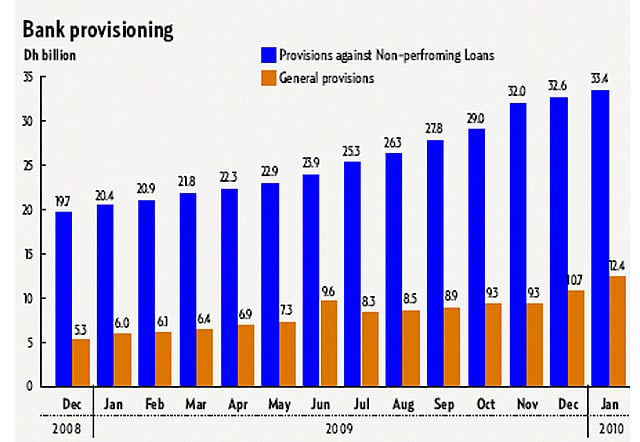
The UAE Central Bank had called on banks to cap their cash dividends to the 50 per cent limit. Most of the banks are under pressure from increasing non-performing loans (NPLs) and loan-to-deposit ratio, though improving, continues to be higher than Central Bank's prescribed limit.
Sharing fortune
Dividends, after all, are paid from a company's cash flow and analysts feel that though it is always good to share the fortune with investors, it has to be judged in the light of the current balance sheet and future potential earnings.
"I believe that limiting the cash dividend distribution in 2009 to up to 50 per cent of the net profit of the year is a wise move at the current time by public companies, as this way the companies can build up their reserves and keep some cash in retained earning while at the same time rewarding the investor for holding the stock for the longer period," says Mohammad Ali Yasin, CEO of Shuaa Securities.
The cash-rich telecom giant etisalat with a net profit of Dh8.83 billion proposed a 60 per cent cash dividend and one bonus share for every 10 shares held, totalling Dh5.03 billion. The total pay out will be 56.93 per cent of the annual profits. Emirates NBD, with a net profit of Dh3.34 billion declared a 20 per cent cash dividend, totalling Dh1.11 billion — that's about 33.23 per cent.
But then there is Air Arabia, with a net profit of Dh452.2 million, doling out a dividend of Dh466.67 million. A strong balance sheet, and the large aircraft capital expenditure not starting until the end of the year justifies such a payout, says Hatem Alaah, senior analyst, HC Brokerage.
Dividend payouts of Bank of Sharjah, National Bank of Umm Al Quwain (NBQ), Dubai Islamic Bank and United Arab Bank are 80.49 per cent, 85.14 per cent, 57.42 per cent and 53.25 per cent respectively of their net profits.
"As for the first two banks, they have fared better in terms of provisioning charges even in 2009, especially Bank of Sharjah. Hence, if these banks are targeting a niche market and free of provisioning woes, then we cannot come to a blanket conclusion that it is bad in their case," Janany Vamadeva, financial analyst, HC Brokerage said.
As for DIB, "it is worrying as the bank has huge provisions to cover, so it would have rather retained its earning to enhance its capital base instead of paying out dividends," she added.
National Bank of Abu Dhabi, First Gulf Bank and Rak Bank have been conservative with dividends ranging from per cent to 7.22 per cent to 20.77 per cent.
Banks are already under pressure due to their exposure to the Dubai World restructuring. And the issue of increasing NPLs hangs over the heads of almost all banks. In these hard times, was it a better idea to for them to conserve cash rather than pay out cash dividends?
The banks' dividend payouts in varying degrees have some rationale to them, though perhaps not the wisest policy under the circumstances, says an analyst.
"We believe there are mainly two reasons that banks have continued with their dividend payments," says Vamadeva. "First, cutting dividend or not paying would send a negative signal in a market where investors are already adopting a wait and watch policy; and second, banks are not in an expansionary mode or aggressive lending in the current environment.
"As such banks would have considered it better to return whatever they consider to be excessive capital to investors which will make investors happy while improve return on equity as well. Nonetheless, we do not view this as a wise act, given the uncertainty of unexpected loan losses which may wipe off capital."
Without downplaying the problems facing banks and real estate companies, Yasin still feels dividend distribution is important in attracting the long-term investors into investing in equity markets.
"In my belief, people invest in public companies to get return on their investments through dividend distribution, not just trading gains in the stock markets. Otherwise, with low dividend distribution, everyone will become a speculator, and our markets will become volatile and less attractive to long term institutional investors," he explains.
"However, I believe that 2009 is an exceptional year, and if in 2010 or 2011 companies achieve better performances, then shareholders need to be rewarded for their patience and understanding of the tough conditions of 2009, and better dividend distribution to be given the following year if the environment is better," Yasin adds.
Borrowing channels
With respect to banks and real estate companies, borrowing channels still remain limited whether within the UAE and or form foreign banks. And so, with cash being distributed to share profits with investors, what does that mean for some of the sectors going forward that are still not yet out of the woods?
"They need to tighten their expenditure on the short term until the financial system loosens up and liquidity becomes better available for them," says Yasin. "That is, they need to rely more on their current liquidity in trying to achieve their goals and deliverables."
Sign up for the Daily Briefing
Get the latest news and updates straight to your inbox
Network Links
GN StoreDownload our app
© Al Nisr Publishing LLC 2026. All rights reserved.