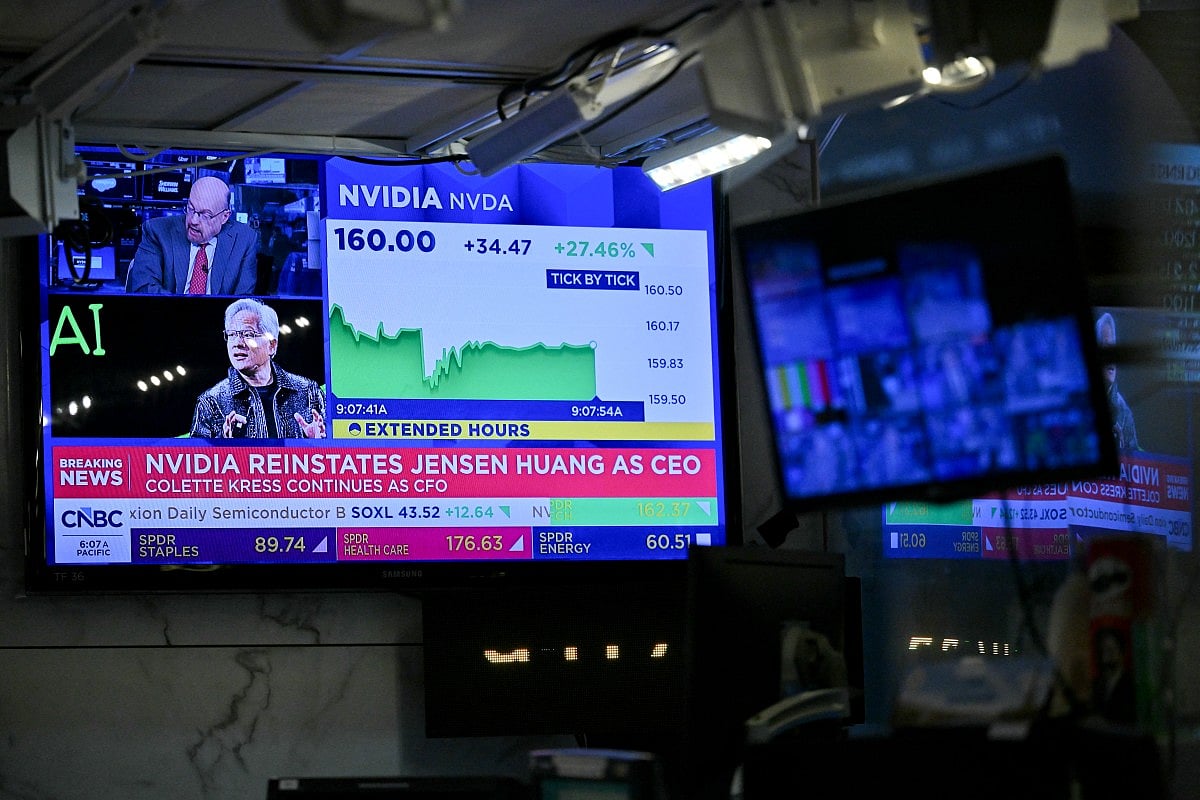
Asian stock markets surged on Tuesday, following a dramatic rally on Wall Street after Nvidia reinstated co-founder Jensen Huang as chief executive.
Technology stocks led the gains across Asia, with Taiwan's benchmark Taiex jumping 9.1%, Japan's Nikkei 225 climbing 5% and South Korea's Kospi advancing more than 7% in early trading.
The rally followed a powerful rebound in US stocks on Monday, led by Nvidia. Its shares surged 31.5% after the company announced Huang's return, adding nearly $1 trillion to its market value.
The Nasdaq Composite jumped 6.5%, while the S&P 500 gained 4.7% and the Dow Jones Industrial Average advanced nearly 3%, or 1,447.98 points.
Get updated faster and for FREE: Download the Gulf News app now - simply click here.
The gains helped Wall Street recover just over half of the losses recorded during last week's technology-led sell-off.
Asian stocks rally: Taiwan jumps 9%, Nikkei gains 5%
Semiconductor manufacturers and technology companies led the recovery across Asian markets, reflecting renewed investor interest in the global AI trade.
Here is how major Asian markets performed in early trading on Tuesday:
Taiwan: The Taiex jumped 9.1% to 40,151.84, with Taiwan Semiconductor Manufacturing Company (TSMC) and MediaTek both gaining around 10%.
South Korea: The Kospi advanced more than 7.2%, supported by gains of over 7% in Samsung Electronics and SK Hynix.
Japan: The Nikkei 225 climbed around 5%. Tokyo Electron rose 8.7%, while chip-testing equipment maker Advantest gained 11%.
TSMC, Nvidia's primary contract semiconductor manufacturer, was among the biggest contributors to Taiwan's rally. The company produces the advanced processors used by the US technology giant.
The gains followed a difficult period for Asian technology shares, which had come under pressure during last week's broader sell-off.
Wall Street rebounds as Nvidia adds nearly $1 trillion
The optimism first emerged on Wall Street on Monday, when Nvidia led a broad recovery across US technology stocks.
Nvidia shares surged 31.5%, adding approximately $1 trillion to the company's market value. The rally followed a plunge of nearly 23% last week.
How US stock markets closed on Monday:
Nasdaq Composite: Jumped 6.5% to 24,089.56.
S&P 500: Gained 4.7% to 7,237.17.
Dow Jones Industrial Average: Advanced 1,447.98 points, or around 3%, to 49,595.31.
The S&P 500 recorded its strongest daily performance since April 2025, while the Nasdaq led the gains as investors returned to beaten-down AI and semiconductor stocks.
Nvidia shares close at $165.05
Nvidia shares ended regular trading at $165.05 on Monday, compared with Friday's closing price of $125.53.
However, the closing price remained slightly below Friday morning's opening level of around $167, indicating that the sharp rebound had not fully recovered the stock's earlier losses.
Other companies linked to the AI boom also recorded substantial gains:
Micron: Rose more than 19%.
Intel: Advanced more than 16%.
CoreWeave: Climbed 22.3%.
Oracle: Gained 12.3%.
GE Vernova: Advanced 8.2%.
The rally demonstrated how heavily Wall Street has become influenced by major technology and semiconductor companies. Nvidia has grown into one of the market's most influential stocks, with even relatively small price movements capable of significantly affecting the S&P 500.
Why Huang's return matters to global markets
Nvidia is a central player in the global artificial intelligence industry, supplying graphics processing units (GPUs) used to train and operate advanced AI models.
Its processors are widely used by technology companies building data centres and expanding their AI capabilities.
Huang's departure had raised concerns beyond Nvidia itself. Investors were watching whether leadership uncertainty could affect:
Nvidia's business relationships and strategic decisions.
The supply of advanced chips to global technology companies.
Investments in AI infrastructure and data centres.
Investor confidence in semiconductor and technology stocks.
His reinstatement appears to have eased some of those immediate concerns, prompting investors to return to AI-related stocks.
What Huang said about returning as Nvidia CEO
Huang's return followed a public statement in which he said he would be willing to resume the leadership role if Nvidia's board considered it to be in the company's best interests.
Five days after stepping down, he acknowledged his personal mistakes and apologised for the problems they had caused the company.
"I did not live up to the standards expected of everyone at NVIDIA, and I have made serious mistakes in my personal life," he wrote in a post on X.
He also expressed regret over creating difficulties for the board and pledged to cooperate with its independent investigation.
"If the Board of Directors decides that my return is in the best interest of our shareholders, our employees, the company, and America, I would be honoured to answer these calls and return as CEO," he said.
Nvidia's board subsequently voted unanimously to reinstate him as CEO and president.
Videos of his return to the company's headquarters showed employees welcoming him enthusiastically.
"Thank you all for the second chances," Huang told colleagues.
"I'm going to be a better CEO the second time around," he said, apologising for putting employees through the controversy.
Trump takes credit for Huang's return
US President Donald Trump also claimed a role in Huang's reinstatement, saying he had spoken to Nvidia's board and helped persuade directors to bring the co-founder back.
Trump said he had communicated with the board both directly and indirectly.
"I believe my intervention was very important," he told CNBC.
The US President also said he had "made the deal" to bring Huang back, describing him as a "great patriot".
Trump said his administration had assured Nvidia that it had no reason to believe Huang's return posed a national security risk.
The controversy had attracted scrutiny from US officials following allegations involving a woman described as a Chinese spy and her alleged relationship with Huang. He had also faced separate allegations involving an Nvidia executive.
Nvidia still faces political scrutiny
Despite the market's positive reaction, Huang's return does not mean the controversy is over.
Several developments could keep the company under scrutiny:
Senate testimony: The US Senate Banking Committee has announced that Huang will testify on December 3.
House committees: He has also been called to appear before three House committees.
Potential investigations: Democrats have indicated that they want to investigate Nvidia and the Trump administration's handling of the company.
Megaspeed restrictions: The US Department of Commerce has announced plans to add Singapore-based AI company Megaspeed Ltd to its restricted entities list, following allegations involving a former executive and concerns about the possible diversion of Nvidia's advanced AI chips to China.
These developments could keep Nvidia under political and regulatory pressure even as investors welcome the leadership change.
Can the stock market rally last?
The strong recovery across Wall Street and Asia has offered relief, but several concerns remain for investors.
What could influence markets next?
AI valuations: Investors remain concerned that some AI stocks may be overvalued.
Infrastructure spending: Technology companies are investing heavily in data centres, but questions remain about the returns these investments will generate.
Interest rates: Higher borrowing costs could make it more expensive to finance large-scale AI infrastructure projects.
Regulation: Potential tighter US regulation of the AI industry remains another risk.
Corporate earnings: Strong company profits continue to support market sentiment.
Companies in the S&P 500 are on track to report nearly 33% growth in earnings per share for the summer quarter compared with a year earlier, according to FactSet. This would mark the third consecutive quarter of growth exceeding 25%.
Barclays analysts said risks facing the AI sector could slow investment and make expansion more selective, but were not necessarily enough to derail the wider growth cycle.
For now, Huang's return has provided a significant boost to global investor sentiment. The rally across Asian markets and Wall Street highlights how closely the fortunes of the global technology sector are tied to Nvidia.
Whether the recovery develops into a sustained market rally will depend on corporate earnings, the pace of AI investment, borrowing costs and Nvidia's ability to maintain its position in the global semiconductor industry.
Network Links
GN StoreDownload our app
© Al Nisr Publishing LLC 2026. All rights reserved.