Nvidia stock surges 33% as Jensen Huang returns as CEO after shock board reversal
Chipmaker gains nearly $1T in market value as investors welcome founder's reinstatement
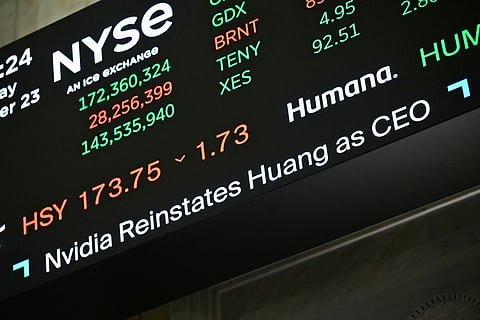
Nvidia shares surged more than 33% on Monday, November 23, after the company's board unanimously reinstated co-founder Jensen Huang as president and chief executive officer, reversing its decision to remove him just days earlier.
The announcement triggered a powerful rebound in technology stocks, with Nvidia adding an estimated $900 billion to $1 trillion to its market capitalisation as investors welcomed the return of the executive who transformed the company into the world's leading supplier of artificial intelligence chips.
Nvidia shares were trading around $167.49, up $41.96 or 33.43%, in a November 23 market snapshot reported by Investing.com. The price is a live-session reference, not a confirmed closing price.
Nvidia published an official announcement dated November 23 confirming that Huang had immediately resumed his positions as president, CEO and board director.
The board said it had "unanimously approved" his return.
Get it: Fast, verified news for FREE ... download the Gulf News app — simply click here
What happened to Jensen Huang?
Huang's return reverses an extraordinary leadership crisis at Nvidia.
The billionaire co-founder resigned on November 12 following revelations about alleged extramarital relationships, including one involving a woman alleged to have been connected to Chinese intelligence.
The controversy raised questions about corporate governance, national security and Nvidia's exposure to US-China technology tensions.
The board initially ruled out bringing him back, appointing chief financial officer Colette Kress as interim CEO.
However, pressure mounted from investors, business leaders and political figures who argued that losing Huang could damage Nvidia's leadership position in the global AI industry.
A public petition supporting his return reportedly attracted more than 180,000 signatures.
US President Donald Trump also backed his reinstatement, describing Huang as a national asset and supporting the board's decision.
Nvidia Q3 FY2027: The numbers behind the rally
The leadership drama comes against the backdrop of extraordinary financial performance.
Nvidia announced its third-quarter fiscal 2027 results on November 17, covering the three months ended October 25, 2026.
The data centre business remains Nvidia's main growth engine, accounting for approximately 93% of quarterly revenue.
This reflects continuing demand for AI accelerators, high-performance computing infrastructure and the servers needed to train and operate increasingly sophisticated AI models.
Developments investors are watching
Vera Rubin production: Nvidia has started shipping its next-generation Vera Rubin NVL72 computing platform, which the company describes as its fastest product ramp to date.
Major AI customers: Cloud providers and technology companies, including Microsoft, Google, Oracle, Meta and CoreWeave, are expanding their Nvidia infrastructure deployments.
AI ecosystem expansion: Nvidia continues to strengthen its position across AI data centres, networking, robotics, autonomous vehicles and scientific computing.
What drove Monday's stock rally?
Three developments converged.
Leadership stability: Huang's reinstatement reduced immediate uncertainty about the company's executive direction and product roadmap.
Strong earnings: The latest results demonstrated that AI infrastructure spending continues to translate into substantial revenue and profits.
Market-wide recovery: Nvidia's rebound helped lift other AI-related companies and broader US equity indexes.
AP reported that Nvidia shares initially surged 27.8% after falling nearly 23% the previous week. The Nasdaq was up approximately 6% and the S&P 500 4.1% in the morning trading snapshot.
CoreWeave also jumped 26.7%, demonstrating how closely other AI infrastructure businesses are linked to Nvidia's fortunes.
The reaction among investors and analysts is broadly positive about Huang's return, but there are important differences in how they assess the longer-term implications.
Morningstar: Governance remains a concern
Lindsey Stewart, director of institutional insights at Morningstar, said investors could welcome Huang's return because of his history of creating shareholder value.
However, he warned that questions remain about corporate governance and who will provide effective oversight of risks at a company with Nvidia's global importance.
Summit Insights: Downgrade to Hold
Summit Insights Group downgraded Nvidia from Buy to Hold before the reinstatement.
Its concern was that the leadership change created uncertainty about Nvidia's product roadmap beyond Vera Rubin. It also highlighted potential consequences of tighter US restrictions on chip sales to cloud providers in Southeast Asia.
Bill Ackman: Shareholder interests prevail
Pershing Square founder Bill Ackman welcomed the board's reversal, initially saying better governance prevailed before describing the decision as a victory for common sense.
Brad Gerstner: Unanimous support
Altimeter Capital CEO Brad Gerstner, who helped organise the campaign for Huang's return, welcomed the unanimous board decision.
Barclays: AI investment cycle remains intact
Barclays analysts Ajay Rajadhyaksha and Amrut Nashikkar argued that the risks facing the AI industry could slow and narrow infrastructure expansion rather than derail it.
They pointed to continuing earnings growth and global economic resilience as reasons not to assume that the AI investment cycle has ended.
The immediate rally reflects relief over Huang's return, but it does not automatically resolve concerns about valuation, competition, governance or regulation.
What's next for Nvidia?
The next major test will be whether Nvidia can sustain its growth while navigating leadership scrutiny, export restrictions and increasing competition.


